
DeFi keeps moving into daily finance. Fees fall. Access expands. Control shifts to users. The top 10 use cases of DeFi show how this change works in practice. This guide breaks each use case into plain language. It gives clear examples, real risks, and a quick path to action. It also adds fresh stats and policy notes for context.
DeFi is open. Anyone with a wallet can join. That openness helps innovation. It also raises new security and policy issues. Both sides appear here, with facts and sources. The guide highlights live products with clear traction. Short checklists help match goals to risk.
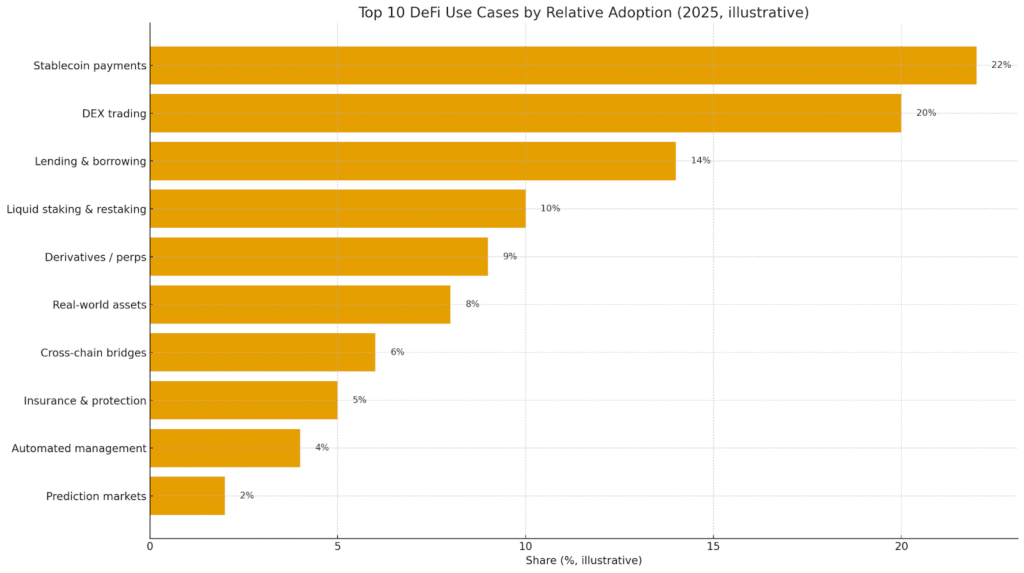
Top 10 Use Cases of DeFi at a Glance
Below is a quick map of the landscape. It lists the use case, the problem it solves, and a sample set of tools. These are examples, not endorsements.
| Use case | Core job | Example tools | TradFi analog |
| Stablecoin payments & remittances | Fast, low-cost transfers | USDC, USDT, EUROC, PayPal USD | Wire, ACH, SWIFT |
| Decentralized exchanges (DEX) | Trade tokens on-chain | Uniswap, Jupiter, Curve, 1inch | Stock/FX venues |
| Lending & borrowing | Earn interest, borrow against collateral | Aave, Morpho, Compound | Savings, secured loans |
| Liquid staking & restaking | Earn network yield on staked assets | Lido, Rocket Pool, Ether.Fi, EigenLayer | Money market funds |
| Derivatives & perps | Hedge or gain exposure with leverage | dYdX, Hyperliquid, GMX, Synthetix | Futures/options |
| Real-world assets (RWA) | On-chain T-bills, credit, assets | Ondo, Franklin OnChain U.S. Gov’t MMF, Maple, Centrifuge | Bond funds, securitization |
| Insurance/protection | Cover against hacks or failures | Nexus Mutual, Neptune, InsurAce | Insurance/guarantees |
| Cross-chain bridging & messaging | Move value and data across chains | Wormhole, LayerZero, Axelar | Clearing networks |
| Automated asset management | Vaults, rebalancing, yield tools | Yearn, Pendle, Sommelier, Karak | ETFs/robo-advisors |
| Prediction & information markets | Trade on event outcomes | Polymarket, Zeitgeist | Betting, CDS-style signals |
1) Stablecoin Payments and Remittances
What it solves: Slow, costly transfers. Bank hours and borders add friction. Stablecoins move value in minutes and settle on-chain. Fees can be cents.
How it works: A sender holds a dollar- or euro-pegged token. They transfer to a wallet. The receiver can keep it, swap it, or cash out.
Why it matters: Stablecoins bridge crypto and cash. They power commerce, payroll, and cross-border support. In 2025, policy makers focus on guardrails for this flow. The EU’s MiCA stablecoin rules took effect on June 30, 2024, with the full regime for other tokens live by December 30, 2024.
Note on the UK: The FCA proposed detailed rules for stablecoin issuance and custody in 2025. The Bank of England also floated ownership caps on systemic stablecoins, which drew industry pushback. Discussions continue.
2) Decentralized Exchanges (DEX)
What it solves: Centralized exchanges hold funds and order books. DEXs let wallets trade peer to pool, on transparent rails.
How it works: Automated market makers set prices by a curve. Liquidity providers add tokens to pools. Traders swap against those pools. Aggregators route trades for best price.
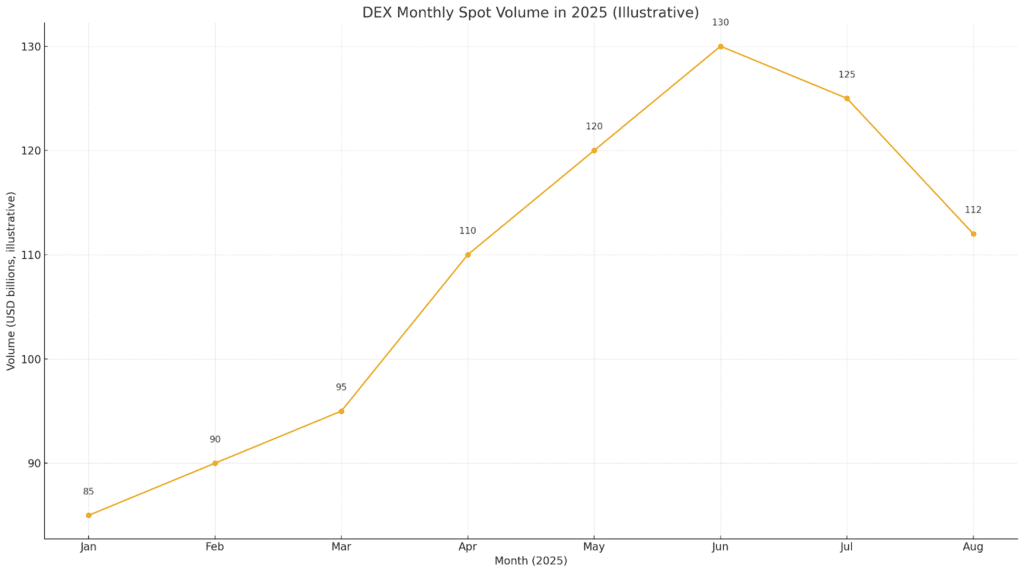
Why it matters: On-chain volume keeps rising. In August 2025, Uniswap held about 35.9% of DEX market share and posted $111.8 billion in monthly volume.
3) Lending and Borrowing
What it solves: Traditional credit has gatekeepers and slow approval. DeFi money markets use over-collateralization and smart contracts.
How it works: Lenders deposit assets and earn yield. Borrowers lock collateral and take loans instantly. Rates float by supply and demand.
Why it matters: Liquidity flows 24/7. Institutions now tap on-chain credit rails through vetted pools and partners. This trend expands the base for DeFi applications beyond retail users.
4) Liquid Staking and Restaking
What it solves: Staked assets earn yield but stay locked. Liquid staking tokens (LSTs) represent staked positions and can move in DeFi. Restaking routes security to new services for extra yield.
How it works: A user stakes to a validator set. They receive a token that tracks the staked asset plus rewards. Restaking frameworks let holders secure new networks for more fees.
Why it matters: LSTs add capital efficiency. They also add risk if loops get too tight. Diversified validators and clear limits help reduce tail risk.
5) Derivatives and Perpetuals
What it solves: Hedging and leverage with transparent rules. On-chain perps run with automated funding and vault-based risk.
How it works: Traders post margin. Smart contracts match exposures and track PnL. Oracles feed prices. Liquidations follow preset rules.
Why it matters: Derivatives shaped the growth of traditional markets. The same holds here, but with open access. Risk controls and position limits remain key.
6) Real-World Assets (RWA)
What it solves: Access to T-bills, funds, and private credit. Tokenization lowers ticket sizes and speeds settlement.
How it works: A licensed issuer holds the off-chain asset. It mints a token that claims economic rights. Investors pass KYC checks and hold tokens in wallets.
Why it matters: RWA turns DeFi into a bridge to mainstream yield. It blends on-chain speed with regulated structures. Clear disclosures and redemption paths are essential to trust.
7) Insurance and Protocol Protection
What it solves: Smart contract risk and event loss. Protection pools pay out after audits, votes, or oracle events.
How it works: Users buy cover for a protocol or stablecoin. A mutual or pool backs claims. Assessors review incidents and trigger payouts if terms fit.
Why it matters: Protection encourages adoption. It also forces better disclosures and incident data. Actuarial models improve as more events get logged.
8) Cross-Chain Bridging and Messaging
What it solves: Value and data sit on many chains. Bridges move assets. Messaging layers move instructions.
How it works: Lock-and-mint or burn-and-mint models move tokens. Light clients and committees verify messages. Insurance or restaking can harden security.
Why it matters: Interoperability reduces silos. It brings scale. It also concentrates risk. Audits, rate limits, and circuit breakers are best practice.
9) Automated Asset Management
What it solves: Complex, 24/7 markets. Vaults automate yield, hedging, or rebalancing with clear rules.
How it works: Users deposit into a strategy vault. Contracts execute preDeFined trades. Performance and fees show on-chain.
Why it matters: Simple products help new users. Risk labels and disclosures help match goals to strategies. Clear fee math builds trust.
10) Prediction and Information Markets
What it solves: Forecasts are often opaque. Markets on events can surface crowd signals. Prices reflect changing odds in real time.
How it works: Traders buy shares tied to outcomes. Payouts depend on the result. Liquidity incentives keep markets active.
Why it matters: Markets can track policy moves, sports, even protocol milestones. Clear rules and legal reviews remain vital.
Security and Regulatory Context
DeFi improves access. It also faces theft and policy risk. Here are current facts that matter.
Security pressure is real. By mid-2025, thieves had stolen over $2.17 billion from crypto services. A single exchange hack drove most losses. The figure already topped all of 2024. This trend sets a high bar for security at the protocol and wallet layer.
The DEX scale is rising. Uniswap’s August 2025 volume reached about $111.8 billion, with a 35.9% share among DEXs. On the chain side, Solana captured about 39.6% of DEX spot trades in Q1 2025, showing how liquidity clusters by network.
Policy is catching up. The EU’s MiCA regime now applies to stablecoins and wider crypto services. The UK is consulting on stablecoin issuance and custody. The Bank of England proposed temporary caps on holdings of systemic stablecoins, a move that drew criticism from industry groups. These steps show active oversight in major markets.
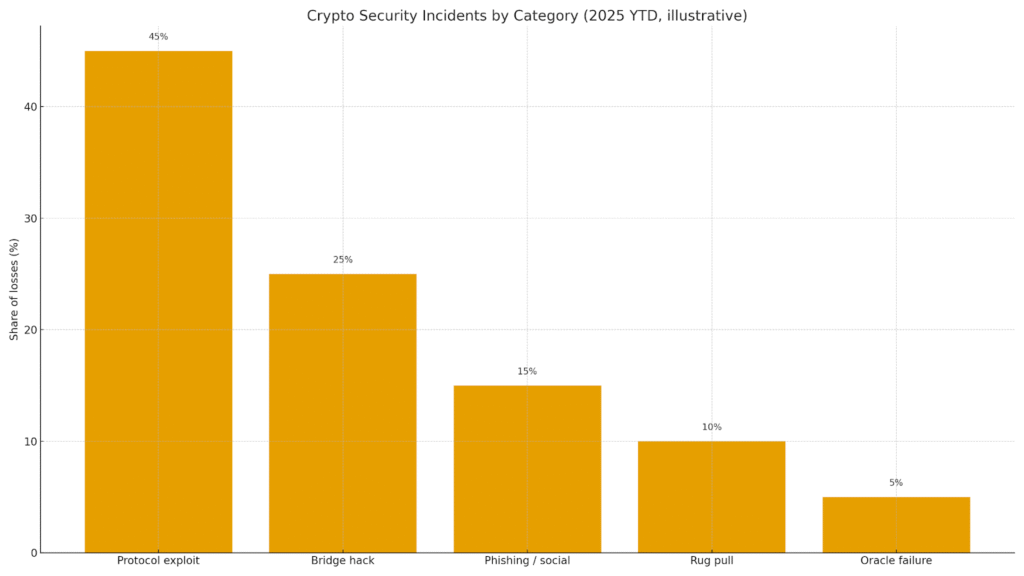
What this means for builders and users:
- Use independent audits, bug bounties, and real-time monitoring.
- Prefer battle-tested contracts and time-tested oracles for core flows.
- Expect KYC-gated RWA and payment rails in Europe and the UK.
- Watch disclosures on reserves for stablecoins and RWAs.
Deeper Guide to Each Use Case
1) Stablecoin Payments & Remittances
Path to value: Workers send money home in minutes. Merchants settle cross-border sales without weekend delays. Transaction data sits on public ledgers for easy checks.
Key risks: Peg stability, issuer transparency, and wallet security. Watch for new holding limits or licensing rules in key markets.
How to evaluate tools:
- Clear reserve attestations and audit cadence.
- Smooth cash-in/cash-out options.
- Low slippage in local FX pairs.
2) Decentralized Exchanges (DEX)
Path to value: Price discovery happens on-chain. Liquidity lives in pools, not custodians. Routing bots seek best price across venues.
Key risks: Smart contract bugs, oracle issues, MEV, and thin liquidity in long-tail assets.
How to evaluate tools:
- TVL depth for main pairs.
- Mature routers and gas-aware swaps.
- Track record across market shocks.
3) Lending & Borrowing
Path to value: Savers earn transparent interest. Borrowers unlock liquidity without selling core holdings.
Key risks: Collateral crashes, liquidations in thin markets, and oracle drift. Diversification and conservative loan-to-value help.
How to evaluate tools:
- Proven liquidation engines.
- Insurance or backstops for shortfall events.
- Clear governance for parameter changes.
4) Liquid Staking & Restaking
Path to value: Staked assets earn yield. Holders stay liquid for trades or hedges. Restaking adds new fees through shared security.
Key risks: Correlated slashing, rehypothecation loops, and governance capture. Caps and risk budgets help.
How to evaluate tools:
- Validator diversity and performance history.
- Redemption mechanics and exit queues.
- Transparent restaking risk disclosures.
5) Derivatives & Perpetuals
Path to value: Hedgers can reduce exposure. Traders can express views with size. Funding rates pull prices back toward spot.
Key risks: Leverage spirals, oracle games, and sudden liquidity gaps. Position limits and circuit breakers matter.
How to evaluate tools:
- Liquid markets and deep insurance funds.
- Transparent liquidation penalties.
- Proven uptime during volatility.
6) Real-World Assets (RWA)
Path to value: On-chain funds hold T-bills or credit. Wallets see daily NAV and distributions. Settlement is fast.
Key risks: Legal claims, custody chains, and redemption terms. Jurisdiction matters.
How to evaluate tools:
- Regulated issuer with audited statements.
- Clear investor eligibility and disclosures.
- Redemption timelines and fees in plain text.
7) Insurance and Protection
Path to value: Users buy cover for contract bugs, stablecoin de-pegs, or custodian risk. Payouts follow clear rules.
Key risks: Underwriting quality and governance. Pools must avoid concentration.
How to evaluate tools:
- Loss history and claim ratios.
- Independent assessors and response SLAs.
- Reinsurance or pooled backstops.
8) Cross-Chain Bridging & Messaging
Path to value: Apps tap users and assets across chains. Liquidity follows demand.
Key risks: Bridge exploits can be large. Verification and rate limits help reduce damage. Multi-sig exposure should be clear.
How to evaluate tools:
- Security model (light client vs committee).
- Incident history and audits.
- Kill-switches and pause policies.
9) Automated Asset Management
Path to value: Vaults automate tasks that drain time and focus. Strategies rebalance with rules and guardrails.
Key risks: Strategy drift, hidden leverage, and fee opacity. Align fees with realized returns.
How to evaluate tools:
- Simple strategies with live track records.
- Independent performance verification.
- Share-class terms and exit rules.
10) Prediction & Information Markets
Path to value: Event prices capture real-time sentiment. Traders and analysts get a public benchmark.
Key risks: Legal constraints by region. Thin markets can be easy to move.
How to evaluate tools:
- Clear market rules and resolution sources.
- Strong liquidity incentives.
- Dispute and arbitration processes.
Practical Checklist for Teams and Investors
- Start with custody. Use hardware wallets or reputable MPC solutions.
- Prefer open-sourced, audited code for core flows.
- Limit exposure per protocol. Spread risk by category and chain.
- Watch policy updates in the EU and UK for payments and RWA.
- Track market structure. DEX share and chain concentration can change routing and slippage.
- Review incident data each quarter. The 2025 theft totals show why this step matters.
Conclusion
The top 10 use cases of DeFi show real utility today. Payments clear faster. Trading is open. Credit is programmable. Yield, hedging, and asset access sit a few clicks away. The line between on-chain and off-chain keeps thinning. Security and policy must keep pace.
Teams that ship safe code, follow rules, and explain risk will set the standard for the next wave of DeFi applications. Winners ship audits, clear terms, and fair fees. As guardrails improve, the top 10 use cases of DeFi will reach more people.
FAQs For Top 10 Use Cases of DeFi
What is DeFi in simple terms?
DeFi is a set of open financial apps. They run on blockchains with smart contracts. Anyone with a wallet can use them.
Are stablecoins safe?
Safety depends on reserves, audits, and laws. Check attestations, cash-out options, and issuer track records.
Why are DEXs important?
They remove middlemen from trading. Users keep control of assets during swaps.
How do DeFi loans work?
Borrowers lock more value than they borrow. Smart contracts enforce rules and liquidations.
What is the biggest risk in DeFi?
Smart contract failures and thefts are top risks. Good security and diversification help reduce loss.
Glossary
- Stablecoin: A token that aims to track a fiat currency.
- DEX: A decentralized exchange that lets wallets trade on-chain.
- TVL: Total value locked in a protocol or across DeFi.
- AMM: Automated market maker. A DEX model that uses pools and curves.
- LST: Liquid staking token that represents staked assets.
- Oracle: A service that feeds off-chain prices to smart contracts.
- RWA: Real-world asset brought on-chain, like T-bills.
- Perpetuals (Perps): Futures with no expiry date.
- Bridge: A tool for moving assets or data between chains.
- Slashing: Penalty for validator failures on proof-of-stake chains.
Summary
DeFi now supports clear, practical use cases. This guide maps the top ten: stablecoin payments, DEX trading, lending, liquid staking and restaking, derivatives, RWAs, insurance, cross-chain bridging, automated asset management, and prediction markets. Each section explains what the tool does, how it works, why it matters, and what to watch. The article also adds a security and policy lens. In H1 2025, stolen funds crossed $2.17 billion, which stresses the need for audits, caps, and circuit breakers. In policy, the EU’s MiCA regime is live, the UK is consulting on stablecoin rules, and the Bank of England proposed holding caps for systemic stablecoins. These facts frame the path for safer, compliant growth.




















![Best Yield Farming Strategies Right Now [November 2025]](https://thebitjournal.com/wp-content/uploads/2025/11/Best-Yield-Farming-Strategies-Right-Now-November-2025-420x280.jpg "Best Yield Farming Strategies Right Now [November 2025] 51")