





In the volatile, fragmented world of digital assets, crypto arbitrage stands out as one of the few strategies promising relatively lower risk. At its core, crypto arbitrage means spotting a price gap for the same coin on two or more platforms, buying low on one, and selling high on another, often within seconds. Traders call it “arbitraging the inefficiency” of decentralized markets.
Because cryptocurrency markets lack a unified, global pricing mechanism, price discrepancies arise. These gaps can last a few seconds or longer, and they create opportunities for fast, astute traders.
But the story is more nuanced than “buy low, sell high.” Behind crypto arbitrage lie competing forces: execution speed, transaction costs, settlement delays, regulatory friction, and, sometimes, outright scams.
Crypto Arbitrage Explained: Profit from Price Differences
To understand crypto arbitrage, think of it like shopping for apples in two markets. One stall quotes apples at $1 each. Another stall, few blocks away, sells the same apples at $1.10. If you could instantly buy and resell the apples (ignoring costs), you pocket $0.10 on every apple. That is arbitrage in its pure form.
In crypto:
One exchange might list Bitcoin at $27,500.
Another lists it at $27,530.
A trader buys one BTC at $27,500 and sells at $27,530, netting $30 (minus fees and time slippage).
That price difference might be small, but repeated at scale, it becomes meaningful.
Why do such gaps exist? Several reasons:
Liquidity differences across exchanges.
Delayed price feeds or updates.
Geographic or regulatory constraints.
Withdrawal and deposit delays on blockchains.
Traders exploit these momentary mismatches through crypto arbitrage.
Why Crypto Arbitrage Exists in the First Place
This question lies at the intersection of market design and human behavior.
Market Fragmentation
Unlike equities, cryptocurrencies trade on dozens, if not hundreds, of exchanges, each with its own liquidity pool, user base, and trading dynamics. The price of a coin like Ethereum can lean slightly upward on one platform and downward on another at the same time. Latency and Settlement Delays
Blockchain transactions are not instantaneous. Moving funds from one exchange to another can take seconds, minutes, or even longer. During that lag, prices can shift, erasing your margin. Indeed, some academic work has shown that settlement latency constrains arbitrage opportunities, especially during network congestion.
Supply and Demand Imbalances
A large buy order on one exchange can push a price upward locally before other platforms have time to catch up. Arbitrageurs act on these imbalances.
Exchange Policies, Fees, and Regulatory Barriers
Some exchanges impose high withdrawal costs, delay withdrawals, or restrict access for certain users. These frictions widen the “gap” traders must overcome to profit. On top of it, regulatory or KYC rules in different jurisdictions can slow operations.
Types of Crypto Arbitrage
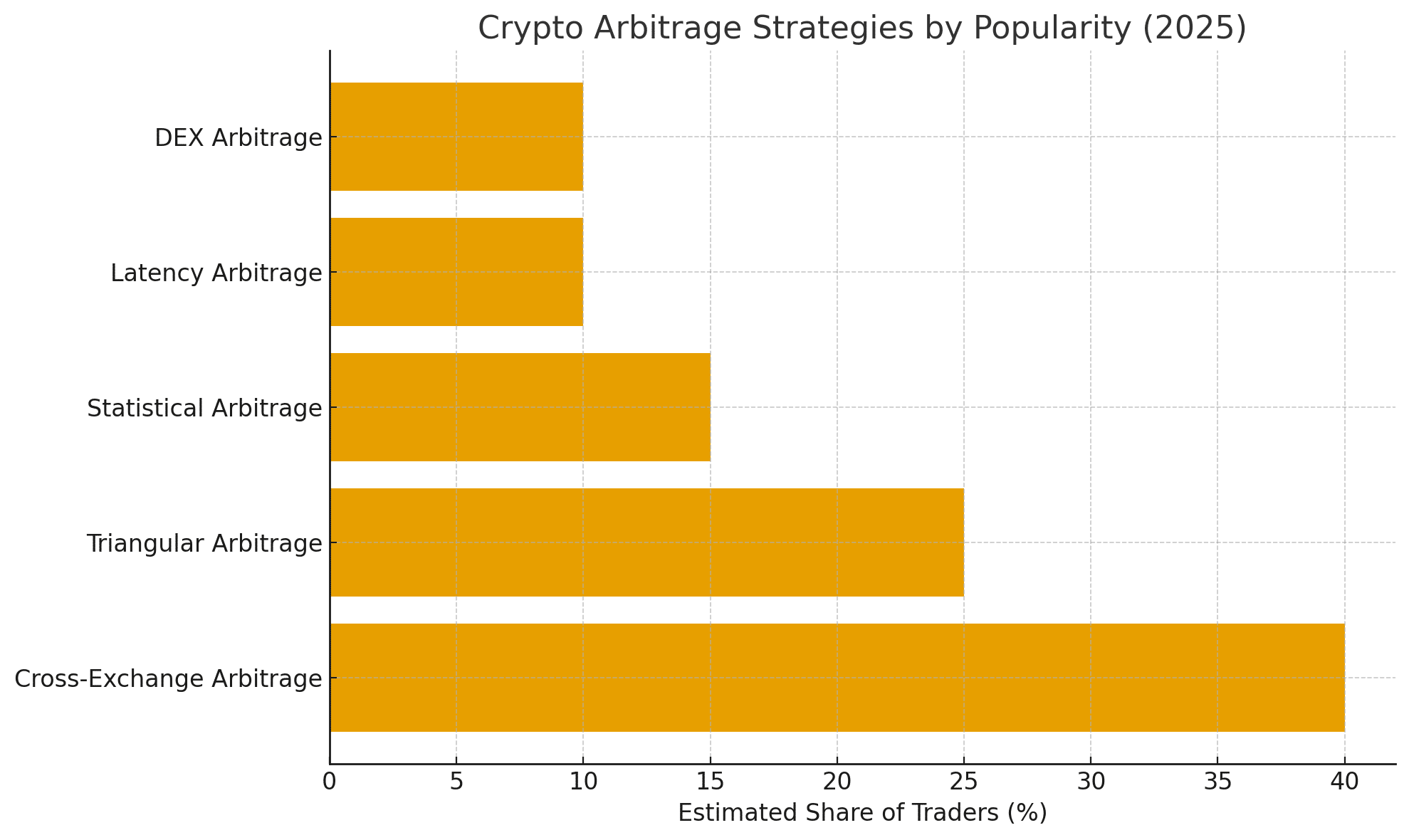
There is not one single “crypto arbitrage” form. Traders use several strategies depending on tools, capital, and access. Below are the main types.
Cross-Exchange (Spatial) Arbitrage
The most basic form: buy a coin on Exchange A, move it, and sell it on Exchange B. Success depends on swift execution and low transfer costs.
Triangular (Intra-Exchange) Arbitrage
This happens within a single exchange by exploiting inefficiencies between three trading pairs. For example, convert USD → BTC, BTC → ETH, ETH back to USD, if the ratios misalign. No fund transfers are required.
Statistical (Quantitative) Arbitrage
More advanced. Here traders use models to predict when price relationships (say between BTC and ETH) will diverge from their average, then place offsetting bets hoping they converge again.
Latency/High-Frequency Arbitrage
Here, the aim is to act on microseconds of price discrepancies, often using ultra-fast servers, co-location, and algorithmic strategies. Even tiny mismatches can generate profit at scale.
Decentralized/DEX Arbitrage
With growth in decentralized exchanges (DEXs), arbitrageurs roam between DEXes and centralized exchanges to exploit differences. But DEX trades can also carry gas fees, front-running risks, and slippage.
Key Indicators and Metrics Traders Watch
To spot arbitrage opportunities, expert traders monitor a handful of key signals:
Price spread
The absolute difference between bid and ask across exchanges or pairs. The wider the spread (after fees), the more room for profit.
Volume and liquidity
High volume means you can enter and exit large positions without dragging the price. Low liquidity kills margins.
Transfer cost/withdrawal fees
Gas costs, exchange withdrawal fees, and deposit fees subtract from the arbitrage profit.
Settlement time/latency
If it takes 30 seconds to move BTC, that gap may evaporate in that time.
Slippage
The price you expect versus the actual price when executing. If execution shifts the price, your edge weakens.
Risk of failed settlement/counterparty risk
If your trade leg fails (say transfer not processed), you’re exposed. Exchange insolvency or network congestion are threats.
Exchange reliability and regulations
Some exchanges freeze withdrawals or limit transfers during volatile periods, which can trap funds.
How Traders Actually Use Crypto Arbitrage
Wall Street quant desks don’t own this game anymore. In crypto, nimble players and bots dominate. Here is a fictional but realistic scenario:
Julia, a crypto trader, spots that BTC trades at $35,200 on Exchange A and at $35,240 on Exchange B. She instructs her arbitrage bot to buy 1 BTC on A and simultaneously sell on B. The software accounts for transfer time, fees, and slippage. If net profit remains positive (say $30), it executes both legs at once.
This happens in split seconds. Her system monitors multiple pairs, hunts spreads, and executes relentlessly. If one leg fails, it aborts or hedges the other leg to reduce loss.
Large firms, too, engage in cross-exchange arbitrage. Historically, Alameda Research made millions by spotting price gaps, especially between markets like Japan and the U.S.
Risks, Pitfalls, and Cautions
Crypto arbitrage is not a free lunch. It carries several dangers:
Execution risk/leg risk
If one side of the trade fails, say your sell order does not fill, your exposure can turn negative.
Transfer delays
Blockchain congestion or exchange backlogs may delay one leg, eating your margin.
Fee creep
High withdrawal, deposit, or gas fees can erase gains.
Slippage and price movement
While your trade is being processed, market moves can eliminate profits.
Regulatory and compliance constraints
Some regions ban or restrict cross-border transfers.
Scams and fraud
Be wary of “arbitrage bots” sold online. A recent paper analyzed thousands of “arbitrage bot” scams on social media, revealing over $15 million in thefts.
Exchange insolvency risk
Funds parked on an exchange that collapses may vanish.
Because of all this, arbitrage opportunities need a strong margin buffer and excellent risk management to work reliably.
Voices from the Crypto Community,
Another voice, from a blockchain quant group, warned:
“Don’t trust black-box arbitrage bots sold on Telegram. Most are pump-and-dump or exit scams.” Such caution echoes the academic findings on arbitrage bot scams.
Why Crypto Arbitrage Remains a Viable Strategy
In many traditional markets, arbitrage margins have shrunk due to high competition and regulatory oversight. In crypto, market inefficiencies are still plentiful. Even after factoring in costs, many arbitrage windows persist because:
New exchanges continuously emerge.
Markets remain globally disjointed.
Retail traders create sudden imbalances.
Institutional players have varied access across regions.
But the bar keeps rising. To stay ahead, arbitrageurs need faster systems, deeper capital, and robust risk controls.
Conclusion
Crypto arbitrage means exploiting price differences across exchanges or trading pairs in order to generate profit. It is not a magic bullet, but a disciplined method requiring speed, precision, and strong risk management. We live in a world where markets remain fragmented, so opportunities persist, but margins are thin and dangers lurk.
Traders who succeed tend to automate extensively, understand costs and latency, and approach every trade with a plan B. The days of getting lucky are fading. Pure skill, solid tooling, and execution grit now decide who wins in the arbitrage game.
Frequently Asked Questions
What is crypto arbitrage?
Crypto arbitrage is the process of buying a cryptocurrency on one exchange where it is cheaper and selling it on another where it trades higher, profiting from the price gap.
Is crypto arbitrage risk-free?
No. While arbitrage is often framed as low risk, real market dynamics, latency, fees, slippage, and exchange failure can introduce risk.
How much capital do you need to start crypto arbitrage?
It depends. You can begin with small amounts, but to make consistent gains after fees, many traders operate with substantial capital tied across exchanges.
Do I need coding skills to do crypto arbitrage?
It helps. Most profitable arbitrage is algorithmic, so you’ll benefit from coding, API knowledge, and automation.
Are there legal issues with crypto arbitrage?
It depends on your jurisdiction. Some regions restrict cross-border transfers or have strict tax rules on trading profits.
Glossary of Key Terms
Spread
The difference in price (often between bid and ask or across exchanges) that can be exploited in arbitrage.
Slippage
When executing a trade, the actual price diverges from the quoted price due to market movement or order size.
Latency
The delay between initiating a trade or transfer and its execution or confirmation.
Leg risk
The danger that one side (leg) of a multi-leg trade fails or executes improperly.
Liquidity
How easily an asset can be bought or sold without significantly moving its price.
Statistical arbitrage
A method using statistical models to predict mispricings and profit from reversion.
DEX (Decentralized Exchange)
A blockchain-based exchange where trades occur peer-to-peer without a central intermediary.
Bot (Trading Bot)
Software programmed to monitor markets and execute trades automatically when certain conditions are met.