
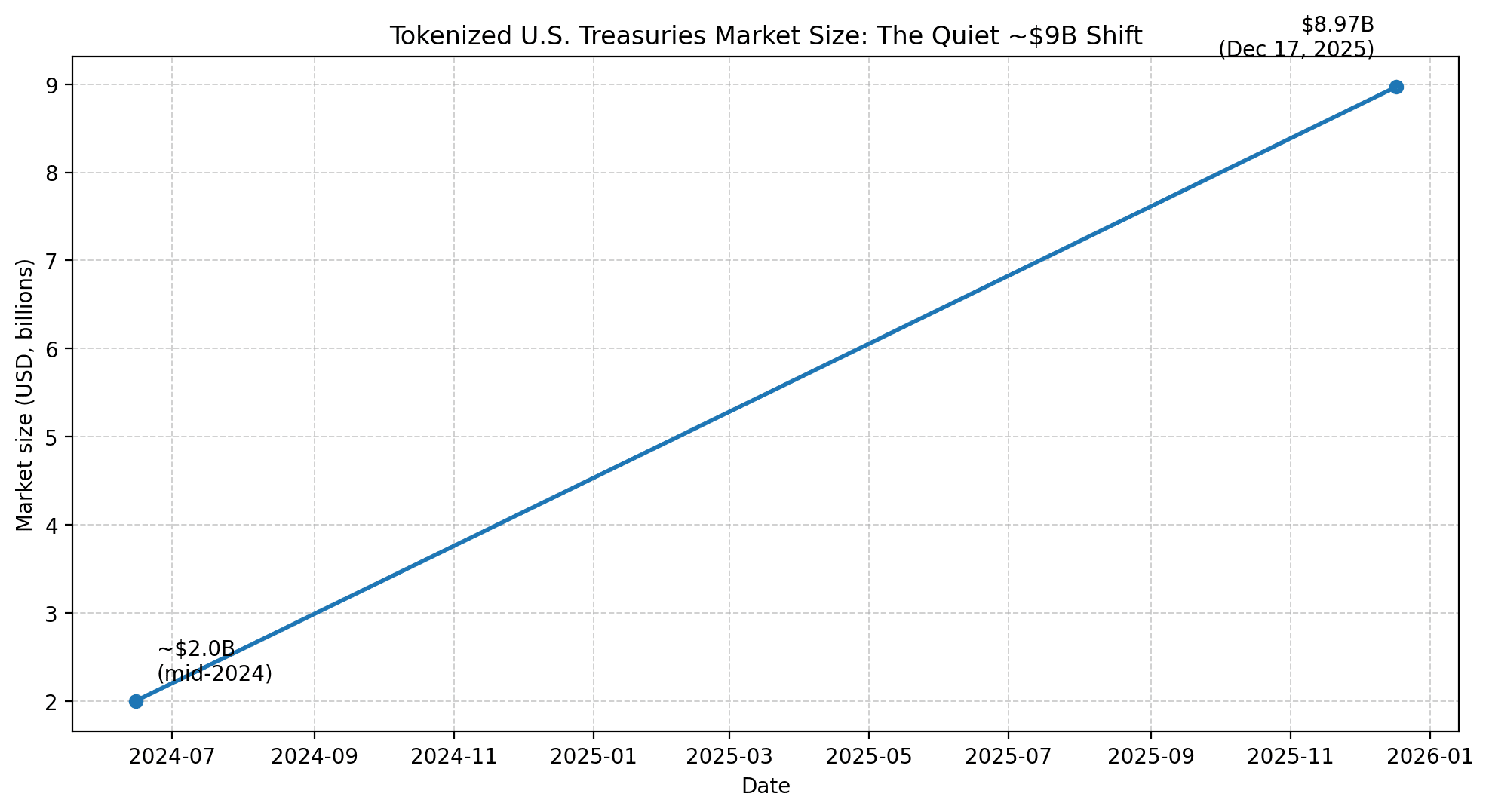
Crypto’s first DeFi boom was built on volatile coins, wrapped versions of them, and stablecoins that behaved like cash. In late 2025, the more durable story sits behind the scenes, where collateral choices shape leverage, borrowing costs, and behavior during drawdowns. Tokenized U.S. Treasuries, issued as on-chain representations of short-duration government exposures, have expanded into a multi-billion-dollar market and are increasingly treated as acceptable margin, not just a curiosity for RWA enthusiasts.
As of 12/17/2025, a leading market dashboard tracked $8.97B in tokenized Treasury value across 60 products and 58,804 holders, alongside a published 7-day annualized yield metric of 3.38%. At that size, integration and risk approval start to matter more than marketing, because the asset class starts acting like infrastructure.
Why does this collateral feel different from a stablecoin
Stablecoins still run payments and settlement, but they typically leave yield on the table. Tokenized U.S. Treasuries offer a cash-like parking spot that can also pay income from the underlying portfolio, which appeals to treasuries and market makers who measure performance in basis points. It is less a replacement story than a balance-sheet story, where cash is expected to work while it waits.
Off-exchange collateral is the catalyst that institutions care about
Tokenized U.S. Treasuries are now being wired into off-exchange collateral stacks, and the strongest signal is not composability; it is custody design. In November 2025, a major exchange integrated a tokenized short-term fund tied to U.S. government bills into its institutional collateral programs and emphasized structures where clients can trade while assets remain segregated with third-party banking partners or institutional custody.
In July 2025, a major issuer framed a similar point from the other side of the trade, announcing yield-bearing off-exchange derivatives collateral and stressing near-instant conversion into a widely used USD stablecoin.
What it means for DeFi in the long term
DeFi will still prize open access, but the market is drifting toward a layered model. Permissionless protocols will keep using public collateral, while institutional lanes will prefer assets that fit internal rules and eligibility checks. As tokenized U.S. Treasuries expand, wrappers and vaults are likely to grow around them, creating more liquidity but also introducing new middle layers where fees, control points, and operational risk concentrate.
Public market data already hints at this concentration risk by showing meaningful platform share inside tokenized U.S. Treasuries across platforms. During calm markets, that looks like efficiency. During stress, it can turn into a bottleneck if redemption, secondary liquidity, or a single integration point becomes constrained.

Key crypto indicators worth watching, beyond price
Durability will show up first in risk acceptance. Tokenized U.S. Treasuries appearing in more margin frameworks matters because risk approvals tend to stick unless something breaks.
Inside DeFi, total value locked is useful only when paired with utilization and borrow rates, since idle deposits can inflate TVL. Perpetual funding rates, open interest, and realized volatility help flag leverage stress before charts look obvious, while stablecoin supply trends show whether liquidity is expanding or rotating into yield-bearing cash equivalents.
The risks are in the wrapper, not the government paper
A Treasury is not risky in credit terms, but the wrapper can be. Tokenized U.S. Treasuries introduce smart contract risk, custody and segregation dependence, and redemption constraints, especially when eligibility rules apply. That is why the most important due diligence is structural: what the token represents, how redemption works, and what the fallback is during market stress.
Rate dynamics still matter. If short-term yields fall materially, the appeal can fade. If yields rise, even short-duration portfolios can show price sensitivity, and margin models can respond in ways that surprise traders who assumed cash-like meant price-static.
Conclusion
The tokenization narrative often sounds futuristic, but the collateral shift is already tangible. Tokenized U.S. Treasuries are becoming a bridge between crypto’s always-on trading culture and traditional finance’s collateral discipline, reinforced by off-exchange custody structures and yield-driven treasury behavior. If the trend holds, the next phase of DeFi will likely reward platforms that manage collateral cleanly, publish clear terms, and handle stress without improvisation.
Frequently Asked Questions
Why are institutions adopting this now?
Institutions are adopting tokenized U.S. Treasuries because they can remain in segregated custody while still supporting trading activity, and because the yield profile makes idle collateral harder to justify at scale.
Does this make stablecoins less relevant?
Stablecoins remain essential for settlement and payments, but treasury balances may increasingly park in yield-bearing cash equivalents when risk systems and access rules allow it.
Are these products permissionless?
Many offerings are permissioned, with eligibility checks and jurisdiction limits, which can reduce composability even when tokens reside on public blockchains.
Glossary of key terms
Collateral: An asset pledged to secure borrowing or margin that can be liquidated if obligations are not met.
Off-exchange collateral: A setup where collateral stays segregated with banking partners or institutional custodians while trading occurs elsewhere.
Funding rate: A periodic payment between long and short positions in perpetual futures that signals leverage demand.
Open interest: The total number of outstanding derivative positions, often used to gauge crowding.
Redemption: Converting a token back into the underlying instrument or a cash equivalent, subject to stated terms and eligibility.
References
- Why does this collateral feel different from a stablecoin
- Off-exchange collateral is the catalyst that institutions care about
- What it means for DeFi in the long term
- Key crypto indicators worth watching, beyond price
- The risks are in the wrapper, not the government paper
- Conclusion
- Frequently Asked Questions
The price predictions and financial analysis presented on this website are for informational purposes only and do not constitute financial, investment, or trading advice. While we strive to provide accurate and up-to-date information, the volatile nature of cryptocurrency markets means that prices can fluctuate significantly and unpredictably.
You should conduct your own research and consult with a qualified financial advisor before making any investment decisions. The Bit Journal does not guarantee the accuracy, completeness, or reliability of any information provided in the price predictions, and we will not be held liable for any losses incurred as a result of relying on this information.
Investing in cryptocurrencies carries risks, including the risk of significant losses. Always invest responsibly and within your means.
For advertising inquiries, please email . [email protected] or Telegram