





Digital assets were built to move value across borders, but that freedom now sits inside a tighter legal map. Governments use sanctions to block money tied to war, terrorism, cybercrime, ransomware, weapons financing, and national security threats. In crypto, the issue is not only who owns the wallet. It is also who touches the transaction, which platform processes it, and whether a token is being used to bypass traditional finance controls.
crypto sanctions explained: global digital asset impact
Crypto sanctions are legal restrictions that stop people, companies, platforms, or wallet addresses from doing business with blocked parties. They can target a named person, a country, an exchange, a mixing service, or wallet addresses linked to illicit activity. In simple terms, they tell the market: this money cannot be handled.
Banks have screened payments for decades. What changed is the payment rail. A bank account has a name and regulated institution behind it. A blockchain wallet may only show a long string of letters and numbers. Public ledgers can still show routes, wallet clusters, and address links.
Why governments enforce restrictions on digital assets
Authorities enforce crypto sanctions to reduce access to global liquidity. A blocked actor may still hold coins, but sanctions make those assets harder to convert, transfer, or use through regulated services. This matters because crypto can move quickly across borders, especially when stablecoins, decentralized exchanges, bridges, or peer-to-peer markets are involved.
Recent enforcement has focused on ransomware networks, darknet markets, cyber groups, sanctioned exchanges, and payment channels linked to conflict or evasion. U.S. guidance makes clear that sanctions duties apply even when a transaction uses digital currency instead of fiat money. Global standards also require virtual asset service providers to manage money laundering, terrorist financing, and proliferation financing risks.
How restrictions affect exchanges
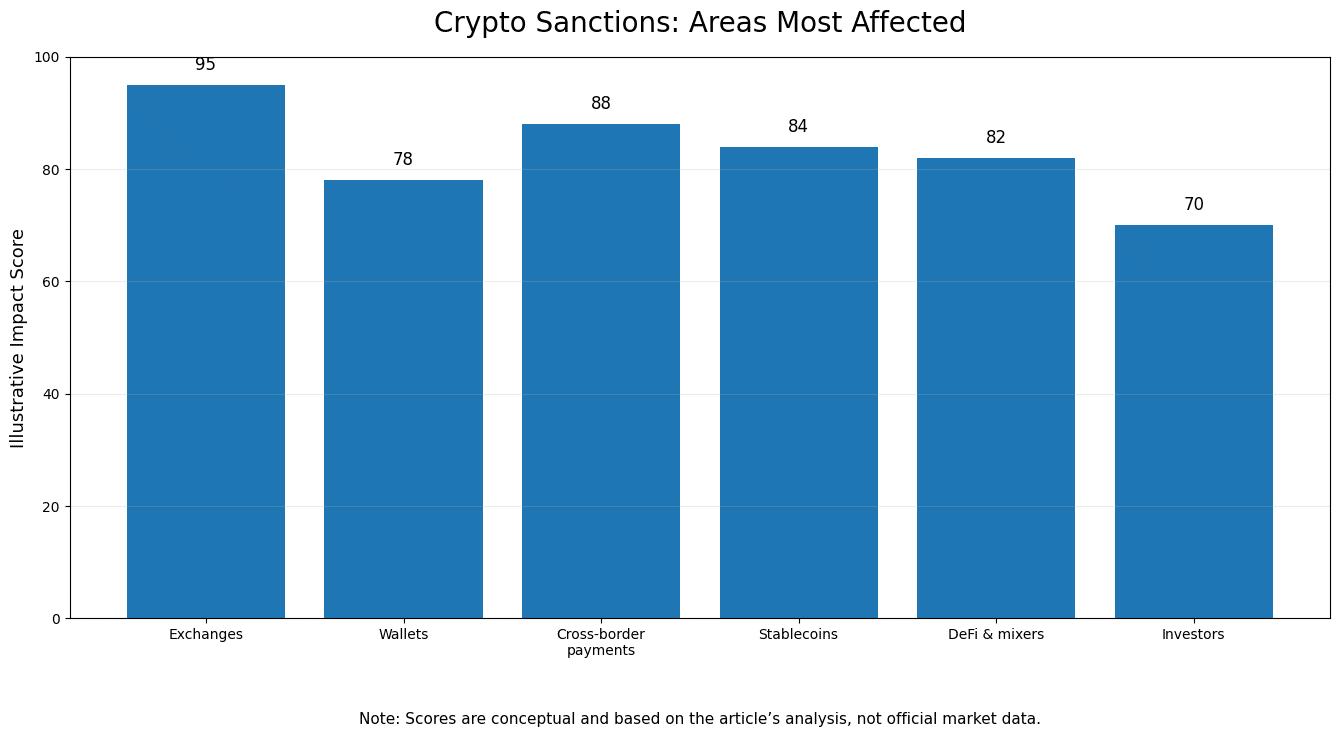
For centralized exchanges, crypto sanctions change daily operations. Platforms must screen customers, check wallet exposure, monitor deposits and withdrawals, and stop transactions that touch blocked parties. A simple account opening is no longer enough.
When a blocked address sends funds to an exchange, the platform may have to freeze the asset, block the transfer, report it, or reject the customer.

It also affects liquidity. If an exchange is sanctioned or cut off by stablecoin issuers, users can lose access to deposits, withdrawals, and trading pairs fast. In one recent case, a sanctioned Russian exchange suspended services after stablecoin wallets linked to the platform were blocked, showing how quickly compliance action can hit operations.
What it means for wallets and self-custody
Self-custody does not remove legal risk. A person can hold private keys, but regulated firms may refuse funds that came from a blocked wallet or high-risk service. That means tainted assets can become difficult to cash out, bridge, or use in mainstream applications.
Wallet providers also face scrutiny when they offer customer support, hosted features, swaps, fiat ramps, or other services. A pure software tool is different from a company that helps users move assets, hides location risk, or connects them with trading services. Wallet history follows funds.
Cross-border payments and stablecoins
Cross-border payments are one of crypto’s strongest use cases, but they are also a sensitive point for regulators. Stablecoins can settle 24/7, move across borders, and avoid some bank wire delays. That is useful for remittances and trade, but it can also attract actors trying to bypass blocked banking channels.
This is why crypto sanctions now focus on service providers, wallets, tokens, and payment networks, not only individuals. Recent European measures have moved toward broader restrictions on Russia-linked crypto providers and specific ruble-linked digital assets, including steps aimed at preventing circumvention through digital settlement channels.
Payment firms must know more about senders, receivers, wallet exposure, and geography. Stablecoin issuers may block wallets when required. Exchanges may reject deposits connected to sanctioned networks. Users may see delays or extra checks when funds cross several chains.
Key risk indicators investors should know
A token, wallet, or platform may carry higher risk if it is linked to sanctioned jurisdictions, sudden exchange delistings, frozen stablecoin balances, mixer usage, bridge exploits, ransomware flows, anonymous teams, weak compliance controls, or repeated warnings from regulators.
Another signal is liquidity that looks too easy. If a little-known platform offers simple access to blocked corridors or high-risk fiat routes, it may be filling a gap that regulated firms avoid for a reason. In crypto, cheap access can carry expensive legal risk. Transaction history also matters. Clean-looking assets can pass through dirty routes.
DeFi, mixers, and the gray zone
DeFi makes enforcement more complex because smart contracts can run without a traditional company in the middle. Still, front-end websites, developers, governance groups, liquidity providers, and users can face pressure when a protocol becomes a route for illicit finance.
Mixers sit in an even harder area. Privacy has real value, especially for journalists, businesses, and ordinary users who do not want every payment exposed. Yet mixers can also hide stolen funds and ransomware proceeds. Regulators look at actual use, control, intent, and scale.
Compliance is becoming a market advantage
For established firms, crypto sanctions are no longer just a legal headache. Good controls can build trust with banks, payment partners, institutions, and regulators. Poor controls can close doors fast.
The strongest firms usually follow a layered model. They verify customers, screen wallets, monitor transaction behavior, review alerts, train staff, keep records, and update controls when new risks appear. Algorithms help, but judgment still matters. Now it affects listings, banking access, investor confidence, and survival.
Global impact on digital asset adoption
The wider effect of crypto sanctions is mixed. Stronger rules can make crypto safer for institutions and users. Heavy restrictions, however, can push activity into opaque markets where oversight is weaker.
For emerging markets, the issue is delicate. People may use stablecoins because local banking is slow, expensive, or unstable. Broad restrictions can hurt innocent users if they are not designed carefully. That is why targeted enforcement, clear guidance, and fair appeal processes matter.
Conclusion
Crypto sanctions are now part of the digital asset market’s basic operating layer. They affect exchanges, wallets, stablecoins, DeFi platforms, payment firms, and users who move value across borders. The point is not that crypto is illegal or unsafe by default. The point is that open networks can be misused, and regulators are building tools to stop blocked actors from turning digital assets into escape routes.
For investors and businesses, the safest approach is simple: use regulated platforms, check wallet exposure, avoid suspicious payment paths, and treat compliance as financial hygiene.
Frequently Asked Questions
What are crypto sanctions?
Crypto sanctions are legal restrictions that block sanctioned people, companies, wallets, exchanges, or services from using digital asset markets.
Can a wallet address be sanctioned?
Yes. Authorities can identify and list wallet addresses linked to blocked parties or illegal activity. Regulated firms then use those lists and blockchain monitoring tools to detect exposure.
Do sanctions apply to DeFi?
They can. DeFi is harder to police, but users, interfaces, service providers, developers, and related businesses may still face legal duties depending on their role and location.
Can stablecoins be frozen?
Some stablecoins can be frozen by their issuers when required by law or internal compliance policies.
Glossary of Key Terms
Sanctioned address
A blockchain wallet address linked to a blocked person, entity, or illicit network.
Virtual asset service provider
A business that exchanges, transfers, safeguards, or administers digital assets for customers.
Wallet screening
The process of checking wallet addresses against sanctions lists and risk indicators.
Sanctions evasion
Any attempt to hide or reroute transactions so a blocked party can still access financial services.
Sources
Disclaimer
This article is for general education only and does not provide legal, financial, or investment advice. Crypto sanctions rules change often, and readers should consult qualified professionals before making compliance or investment decisions.