





Last updated on, 19th July, 2026
A DAO can feel like the purest form of internet-native organization: open voting, shared treasury control, smart contracts, and no traditional boardroom. Yet once a DAO holds funds, pays contributors, signs vendor deals, issues tokens, or influences a protocol used by real people, the law enters the room. A DAO Legal Framework gives decentralized communities a way to operate in the real world without pretending that code alone can solve taxes, liability, contracts, securities rules, and member accountability.
DAO Legal Framework: Why It Matters Now
A DAO Legal Framework is the legal structure that defines how a decentralized autonomous organization is recognized, managed, taxed, and held accountable. It helps answer simple but serious questions. Who can sign a contract? Who owns the treasury? Who is responsible if the DAO causes harm? Can token holders be sued? Are governance tokens securities? Can the DAO hire workers or pay service providers?
These questions are not theory anymore as regulators and courts have already treated DAOs as real legal actors in some cases, even when the groups behind them argued that decentralization made them different. In the United States, the 2017 DAO report made clear that token-based fundraising can fall under securities law when buyers expect profit from the work of others. The message was plain: using blockchain does not remove a project from investor-protection rules.
What Makes a DAO Different From a Company?
A traditional company usually has directors, officers, shareholders, legal registration, a bank account, tax records, and clear rules for decision-making. A DAO often starts with a smart contract, a governance token, a treasury wallet, and a group of voters spread across countries.
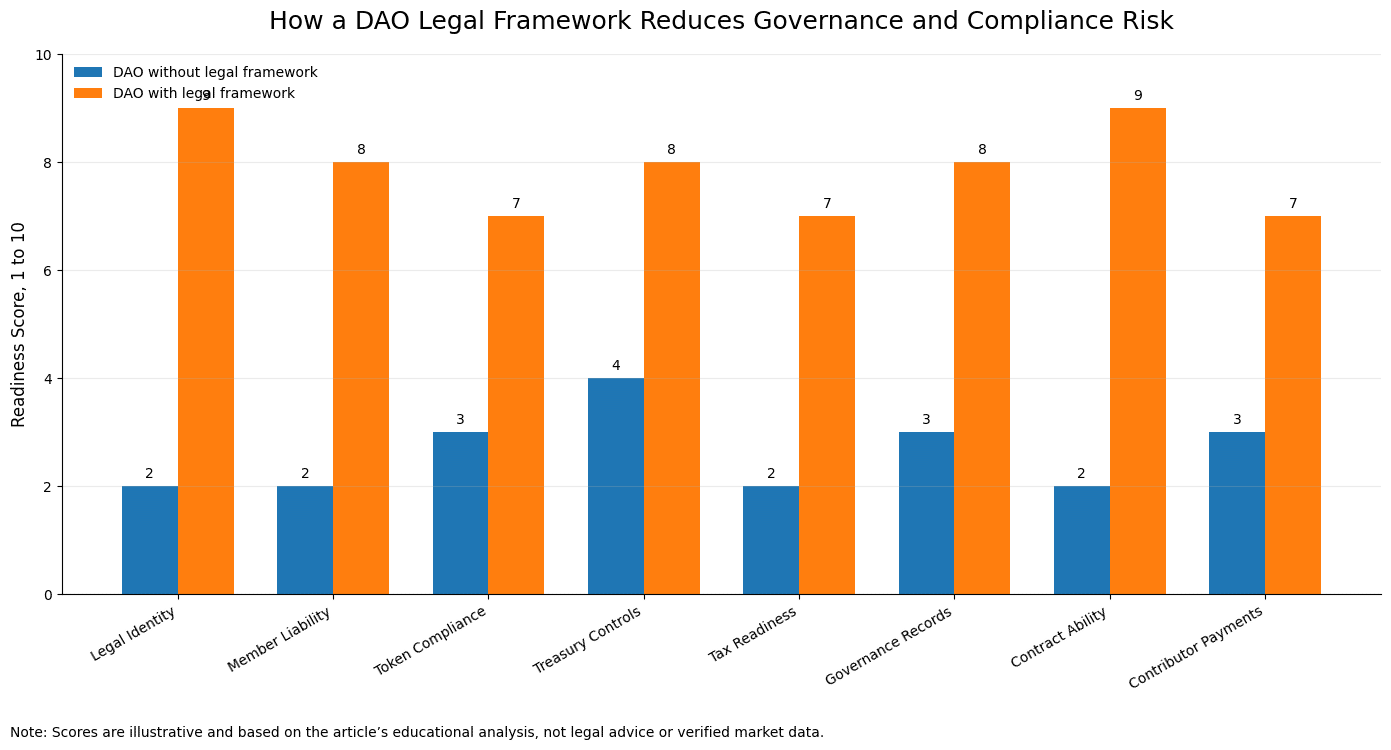
That setup can be efficient, but it creates a gap. The blockchain may show who voted, but it does not always show who is legally responsible. A vote may pass on-chain, yet a service provider still needs a legal counterparty before doing business. That is where a DAO Legal Framework becomes useful. It turns a loose digital community into a structure that courts, banks, tax authorities, vendors, and contributors can understand.
Legal Recognition Does Not Remove Regulatory Exposure
A legal wrapper can give a DAO separate legal identity, but it does not shield unlawful activity or automatically settle how its tokens will be classified. The SEC’s 2017 investigation into The DAO concluded that its tokens were securities because purchasers invested value with an expectation of profit linked to managerial efforts.
The Ooki DAO case later demonstrated a different risk: a U.S. federal court treated the DAO as an unincorporated association that could be sued and held liable under commodities law. Together, these cases show that regulators and courts examine what a DAO actually does, including how it raises money, promotes tokens, controls upgrades, serves users, and distributes authority. A project may therefore have limited-liability status under state or offshore law while still facing separate securities, derivatives, anti-money-laundering, tax, sanctions, consumer-protection, and data-privacy obligations.
How Common DAO Legal Structures Differ
| Legal structure | Main practical benefit | Governance connection | Important limitation |
|---|---|---|---|
| Wyoming DAO LLC | Provides a registered entity with limited-liability features and the ability to hold assets or enter contracts | Operating documents and smart contracts can help define voting, membership, and management rules | State registration does not exempt token sales or financial activity from federal law |
| Wyoming DUNA | Gives eligible nonprofit DAOs a separate legal identity without requiring a conventional shareholder structure | Designed to accommodate distributed governance, consensus mechanisms, and blockchain-based records | Generally better suited to nonprofit protocol governance than profit-distributing investment groups |
| Marshall Islands DAO LLC | Allows a DAO to register as a domestic LLC under legislation written specifically for decentralized organizations | Governance may be organized through smart contracts, member voting, or other agreed rules | Offshore formation does not prevent regulators in countries where members or users are located from asserting jurisdiction |
| Traditional foundation | Can hold intellectual property, fund development, employ staff, and represent a protocol in contracts | Usually works alongside token-holder voting rather than placing every legal decision directly on-chain | Foundation directors or council members may retain substantial legal authority, creating a gap between formal and advertised decentralization |
| Unincorporated DAO | Requires little formal setup and may preserve open participation | Decisions can remain entirely token-based or smart-contract-driven | Members may face uncertain personal liability, and the group may struggle to sign contracts, open accounts, or defend legal claims |
The best structure depends on whether the DAO distributes profits, controls a financial protocol, owns intellectual property, employs contributors, or exists mainly to support open-source development. No wrapper is universally suitable, and a DAO may use more than one entity to separate protocol governance, development work, treasury management, and commercial services.
The Legal Wrapper Concept
Many DAOs use what the industry calls a legal wrapper as this means the DAO forms or connects itself to a legal entity, such as an LLC, foundation, nonprofit association, or similar structure. The wrapper does not replace the DAO. Instead, it acts like a bridge between on-chain governance and off-chain law.
A strong DAO Legal Framework can help the DAO own intellectual property, enter contracts, pay contributors, open accounts, handle taxes, and limit personal liability for members. Without one, governance token holders or active contributors may face claims that the DAO is an unincorporated association, general partnership, or another informal group. That can create uncomfortable risk, especially when money, protocol control, or investor expectations are involved.
Wyoming, Marshall Islands, and the Rise of DAO Laws
Some jurisdictions have built specific legal paths for DAOs as Wyoming has been one of the most active. Its newer decentralized unincorporated nonprofit association model recognizes a DAO-style entity as separate from its members and allows distributed ledger technology, smart contracts, and consensus mechanisms to support governance. The law gives DAOs a clearer legal identity while preserving their decentralized character.
The Marshall Islands also created a route for DAOs to form as domestic limited liability companies under a dedicated DAO law. This model is aimed at projects that want an entity with familiar legal features while still allowing decentralized governance tools.
These models show how the DAO Legal Framework has moved from a niche legal debate into a practical operating issue for Web3 teams. Governments are not treating DAOs as invisible experiments anymore. They are asking how these groups should report, pay, disclose, protect users, and answer for decisions.
Why Governments Care About DAO Governance
Governments do not regulate DAOs only because they are new. They regulate them because DAOs can control large treasuries, direct protocol upgrades, influence markets, manage user funds, issue tokens, and coordinate contributors across borders. When a DAO looks like a financial project, investment scheme, marketplace, or service provider, existing laws may still apply.
A DAO Legal Framework helps reduce confusion, but it does not create a free pass. A DAO that issues tokens may still need to consider securities rules. A DAO that runs a lending or derivatives protocol may face financial regulation. A DAO that pays contributors may trigger employment and tax concerns. A DAO that stores user data may face privacy obligations. Put simply, decentralization may change how an organization works, but it does not erase the legal effects of what the organization does.
The Liability Problem Token Holders Cannot Ignore
One of the biggest DAO risks is personal liability, if a DAO has no recognized legal structure, claimants may argue that active participants are jointly responsible for the DAO’s actions. That concern has already appeared in enforcement and litigation involving decentralized groups. In one notable enforcement action, a decentralized organization was treated as an unincorporated association for legal purposes, showing that courts and regulators may still find a route to accountability.
This is why a DAO Legal Framework is not just paperwork. It can protect contributors who vote, build, moderate, audit, manage grants, or handle treasury operations. It can also make clear which decisions belong to token holders, which actions belong to delegates, and which matters require formal approval.
DAO Tokens and Securities Risk
A DAO token can be used for voting, access, rewards, staking, fee sharing, or protocol control. The legal risk depends on design, marketing, buyer expectations, decentralization, and the role of core developers. If token buyers expect profit mainly from the efforts of founders, managers, or a core team, regulators may view the token through securities-law lenses.
A careful DAO Legal Framework should address token purpose, disclosures, governance rights, treasury use, conflict rules, and communication standards. It should not promise profits loosely. It should not hide central control behind the language of decentralization. Investors and users deserve a clear view of what they are buying, what rights they hold, and what risks exist.
What a Good Framework Usually Covers
A good DAO structure starts with legal identity. The DAO needs to know whether it is an LLC, nonprofit association, foundation, cooperative, trust, or another entity. Then it needs governance rules. These rules should explain proposal creation, voting thresholds, delegate powers, treasury approvals, emergency actions, audits, contributor payments, conflicts of interest, and removal procedures.
A serious DAO Legal Framework also deals with tax classification, member rights, intellectual property ownership, smart contract upgrades, risk disclosures, dispute resolution, sanctions compliance, data handling, and record-keeping. It should connect on-chain votes with legal records, because a blockchain transaction is useful evidence, but legal systems still need context.
DAOs and Global Regulation
DAOs are borderless, but laws are not as a voter may live in Dubai, a developer may work from Berlin, a foundation may be formed offshore, and users may interact from the United States. This creates a patchwork of obligations.
Europe’s crypto-asset rules focus on transparency, authorization, supervision, and disclosure for many crypto activities, although truly decentralized models still raise difficult questions. In England and Wales, legal reform work has examined DAOs while taking a cautious view on creating a new DAO-specific entity, partly because there is no single agreed shape for all DAOs.
That mixed approach matters. A DAO Legal Framework may work well in one jurisdiction, but another country may judge the same DAO by its token sale, user base, marketing, management influence, or financial activity.
Key Indicators Crypto Projects Should Watch
For crypto analysts, several indicators show whether a DAO has a stronger legal footing. The first is entity clarity. A DAO with no registered structure may carry more liability risk than one with a recognized legal wrapper. The second is treasury transparency. If voters control large funds, the process for spending, auditing, and reporting matters.
The third is token design. Governance rights, fee links, staking rewards, and promotional language can change the legal profile. The fourth is decentralization in practice. A DAO may call itself decentralized, but if 5 insiders control proposals, code upgrades, liquidity, and communications, the claim may look weak. The fifth is compliance readiness. A mature DAO Legal Framework usually includes sanctions screening where needed, tax planning, contributor agreements, grant documentation, and security review procedures.
The Future of DAO Laws
DAO regulation is likely to become more practical, not less. Governments are learning that not every DAO is the same. Some are open-source software communities. Some are investment clubs in digital clothing. Some manage DeFi protocols with serious financial risk. Others look closer to online cooperatives, gaming guilds, grant networks, or social communities.
The next phase of the DAO Legal Framework will likely focus on separating genuine decentralized governance from projects that use DAO language as branding. Strong DAOs may welcome this shift because legal clarity can improve trust, attract better contributors, and make partnerships easier. Weak DAOs may struggle because vague governance is harder to defend when regulators, users, and courts ask direct questions.
Conclusion
A DAO may be born on-chain, but it still lives in a world of contracts, taxes, users, investors, courts, and regulators. That is the real lesson behind the DAO Legal Framework. It does not make a DAO less decentralized. When designed well, it gives the community a safer way to act, pay, build, vote, and defend itself.
The smartest DAO teams now treat legal design as part of protocol design. Code sets the rules of execution. Law sets the rules of responsibility. A DAO that respects both has a better chance of surviving beyond hype, market cycles, and governance drama.
Frequently Asked Questions
What is a DAO Legal Framework?
A DAO Legal Framework is the legal structure that defines how a DAO is recognized, governed, taxed, and held responsible under the law. It helps connect decentralized voting and smart contracts with real-world legal duties.
Does every DAO need a legal framework?
Not every small community needs a complex structure, but any DAO that controls funds, issues tokens, pays contributors, signs contracts, or manages a protocol should consider one. Without it, members may face unclear liability.
Can a DAO be sued?
Yes, a DAO can face legal claims depending on how courts view its structure, activities, and members. A legal wrapper may reduce uncertainty, but it does not remove all risk.
Are DAO tokens always securities?
No. The legal treatment depends on facts, including how the token is sold, what buyers expect, how governance works, and whether profit depends on a core team.
What is a DAO legal wrapper?
A legal wrapper is an entity around or beside the DAO, such as an LLC, foundation, or nonprofit association. It helps the DAO interact with banks, courts, vendors, tax authorities, and contributors.
Glossary of Key Terms
DAO
A decentralized autonomous organization is a blockchain-based group that uses smart contracts, token voting, or other digital governance tools to make decisions.
Smart Contract
A smart contract is blockchain code that executes actions when set conditions are met, such as releasing funds after a vote passes.
Governance Token
A governance token gives holders the right to vote on proposals, treasury spending, protocol upgrades, or other DAO decisions.
Legal Wrapper
A legal wrapper is a formal entity used to give a DAO legal identity, liability protection, and the ability to operate in the traditional legal system.
Treasury
A DAO treasury is the pool of crypto assets controlled by governance rules, usually used for grants, development, liquidity, operations, and community programs.
Liability
Liability means legal responsibility for debts, damages, misconduct, or obligations linked to the DAO’s actions.
Sources
Disclaimer: This article is for educational and informational purposes only. It is not legal, tax, financial, or investment advice. DAO founders, contributors, token holders, and investors should consult qualified legal and tax professionals before forming, joining, funding, or governing any DAO.