



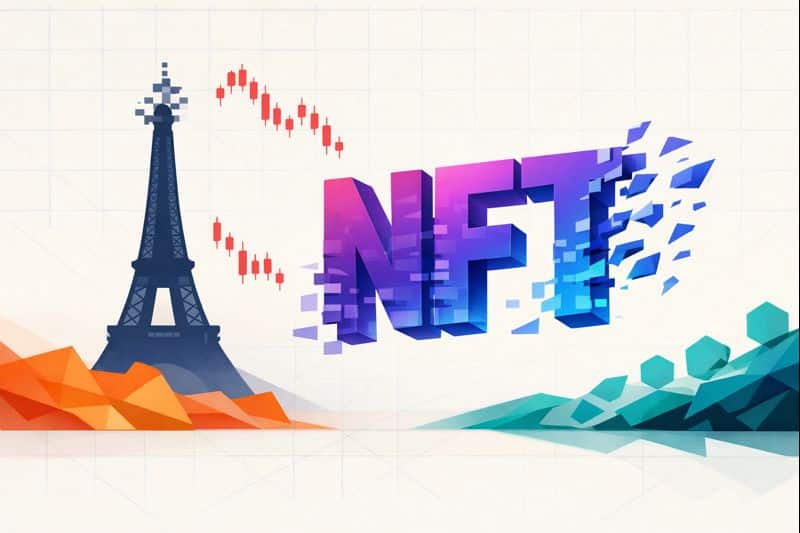

When NFT Paris, one of Europe’s most recognizable NFT market gatherings, canceled its 2026 edition close to the event date, it sent a clear signal to anyone still trading NFTs or investing in NFT infrastructure. Conferences are not just marketing. They are a real-world indicator of how much money is willing to show up, sponsor booths, fly teams out, and spend on community and dealmaking.
In its public announcement, NFT Paris said the “market collapse hit us hard,” and that even after major cost reductions, the team could not make the event work this year. The organizers also stated that ticket holders would be refunded within 15 days.
For traders, this is not proof that NFTs are “dead.” It is a spotlight on a harsher truth: there is still activity, but not necessarily enough profitable demand to sustain peak-cycle business models. That difference matters for how you size risk, where you hunt for liquidity, and which narratives you treat as tradeable versus terminal.
What happened and why the cancellation matters to markets
NFT Paris and the related “RWA Paris” event were canceled ahead of their planned February 2026 dates. The organizers framed it as a simple financial reality: the downturn made it impossible to execute at a viable scale, even after cutting costs.
Another element that traders shouldn’t overlook is the coverage for cancellations. According to reports, ticket refunds were offered as a result of the issue, but some sponsors reportedly received messages indicating that sponsorship fees might not be reimbursed because of expenses already committed.
That distinction is crucial. Tickets are mostly influenced by community mood and retail flow. Sponsorships are more in line with professional marketing expenditures, or at the very least, professional convictions. When sponsorship economics are broken down, it can be shown that platforms, service companies, and projects are saving money and reducing discretionary spending. That is typically a long sideways phase or late-stage bear-market behavior, where ROI scrutiny takes the place of growth-at-all-costs.
Sponsorship budgets are a liquidity signal, just not the on-chain kind
NFT traders tend to track floor prices, whale wallets, marketplace volume, and Twitter sentiment. But sponsorship demand is another useful chart, even if it is off-chain.
During bull cycles, events function like growth funnels. Protocols sponsor to capture users, marketplaces sponsor to win order flow, and creators sponsor to build distribution. When risk appetite fades, those same entities ask more uncomfortable questions: How many qualified leads did we get? What did it cost per conversion? Did any of this translate into revenue?
If the answers are weak, sponsorship is among the first budgets to be reduced. NFT Paris publicly stating that it could not make the economics work, even after cost reductions, suggests that sponsorship demand and overall revenue expectations fell below a workable threshold.
Investors can easily understand the implication. The NFT “supporting economy” is tightening. That means fewer aggressive marketing pushes, fewer large-scale launch campaigns, and likely less sustained speculative heat outside the most liquid collections and ecosystems.
The market did not disappear, but it changed into lower-value, faster-turnover activity
A common mistake is to treat NFT market weakness as total extinction. A better read is that the market has rotated.
In a peak cycle, NFTs often trade as high-priced, narrative-driven assets where attention and prestige can temporarily overwhelm fundamentals. In a down cycle, activity tends to shift toward lower average prices, quicker flips, and a higher share of volume that is more transactional than cultural. That can keep “activity” alive while making it harder for many businesses to earn healthy margins.
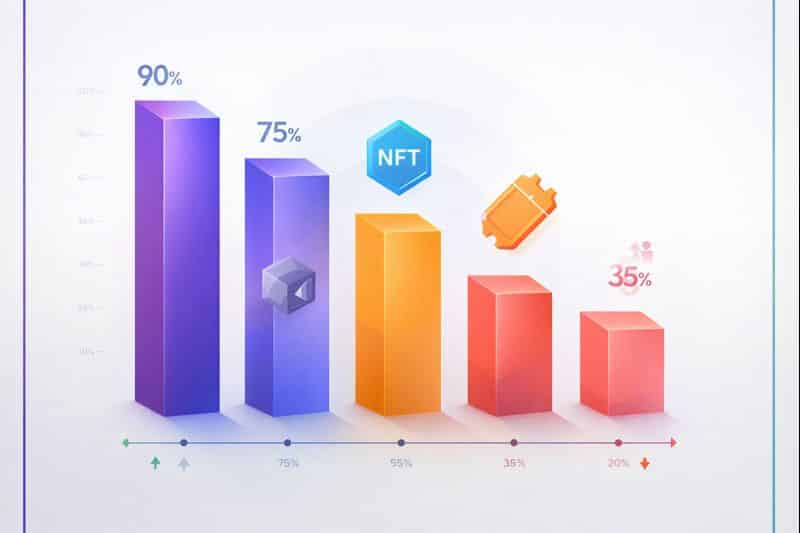
Recent reporting citing CryptoSlam data described 2025 NFT sales of around $5.63 billion, down from prior periods, alongside a decline in average sale values.
Even if you debate exact figures across data sources, the direction of travel is what matters for positioning. If average transaction value compresses and the long tail becomes illiquid, you can still trade NFTs, but the environment punishes slow exits and oversized positions. It also raises the premium on collections with deep bids, strong brand recognition, or consistent utility demand.
What traders and investors should watch next
Compared to overall sentiment, these signals are more useful to monitor.
1) Secondary liquidity depth: Do bids look real, or does the book vanish when volatility spikes? Thin liquidity turns small moves into cascades.
2) Brand and enterprise behavior: When brands come back with programs that run for months (instead of one-time promos), it’s a stronger sign than what influencers are saying. It shows brands have money set aside and feel more comfortable with legal rules.
3) Event format downshifts: When big conferences slow down, smaller meetups take over. Watch where the best teams meet and build. That is usually where the next big ideas and stories begin.
4) NFT utility that actually sticks: Sectors like gaming assets, loyalty, identity, and token-gated access can keep demand alive even when profile picture culture is weak. Traders should stop treating all NFTs as one chart and start treating them as multiple sub-markets.
Read More: How to Protect Your NFT Investments: NFT Scam Protection Strategies
Conclusion
The cancellation of NFT Paris is spectacular since it is public and noticeable. The message at its core is about sustainability and size. Despite cost reductions, the organizers said that the downturn prevented the event from taking place this year and guaranteed ticket refunds within a specified timeframe.
This implies that the NFT market is still active, but it is functioning at a level where only the most effective business models can succeed. Investors tend to choose items that don’t depend on peak-cycle excitement and infrastructure with diversified revenue. For traders, this suggests a market where discipline is more important than narratives, rotations are quicker, and liquidity is more concentrated.
If and when a new NFT upcycle arrives, it may not look like 2021. It may be smaller, more selective, and more integrated into broader crypto, gaming, and consumer products. That is not bad news. It simply means the edge goes to people who adapt their playbook, track real liquidity signals, and treat community hype as a trigger, not a thesis.
Glossary
Frequently Asked Questions