









The world is nowadays full of networked devices. The internet is connected to phones, smart watches, security cameras, and even refrigerators. It is known as the Internet of Things, or IoT. All the devices receive and transmit information to be operational. However, this expanding net of machines also has issues such as poor security, an expensive nature, and a lack of trust.
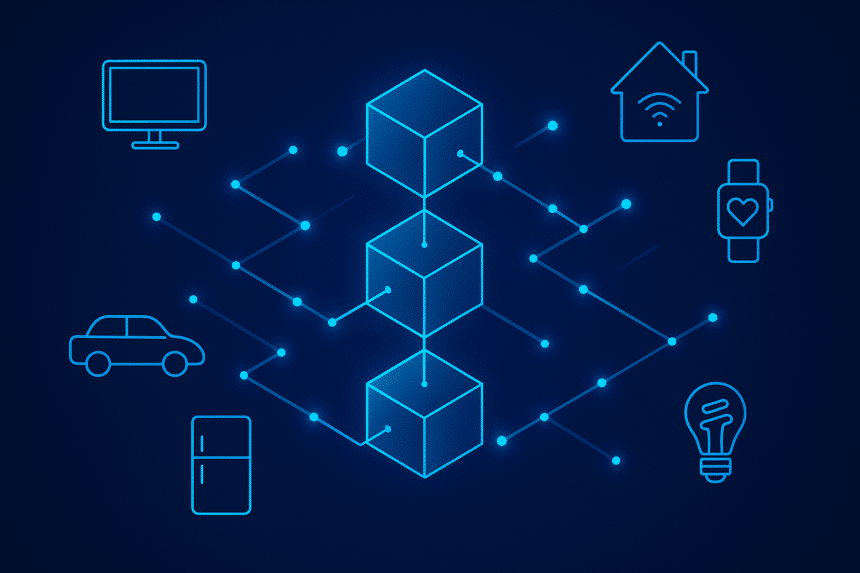
One of the solutions has been blockchain technology. It is also popular that blockchain ensures information security and transparency. It is able to provide IoT devices with improved mechanisms for sharing and storing information. Machines are able to communicate with each other without necessarily having to rely on a centralized system with the use of blockchain. This renders the relationship as safer and equitable.
As IoT continues to grow, blockchain is expected to play a bigger role in shaping how devices talk with each other. The mix of blockchain and IoT could bring safer smart homes, better supply chains, and even stronger city networks.
What is the Internet of Things (IoT)?
The Internet of Things, or IoT, implies ordinary things that are connected to the internet. Such devices gather and exchange information to simplify life. The easiest example is a smart thermostat that learns what a family prefers the temperature to be and turns the heat on/off by itself. The other example is an activity tracker which is able to track the number of steps and send them to a health app.
IoT has turned out to play a very significant role in numerous fields. Smart lights, voice assistants, and door locks are not uncommon in homes. Traffic and street lights are monitored by sensors in urban areas to ensure safe roads. Machines communicate with one another in industries to make the production process smooth and minimize wastes.
The number of IoT devices has grown very fast. Millions of devices already connect to the internet, and this number will only keep increasing. More devices mean more data moving every second. This data must be safe, clear, and handled with trust, which is not always easy.
What is Blockchain Technology?
Blockchain is a type of database, but not like the normal ones found in companies. In normalized databases, control and maintenance of the information is handled by a central authority. Blockchain is distinct as it is decentralized. The information is distributed in a network on numerous computers. All the data are clustered into blocks and these blocks are chained together. That is why it is referred to as blockchain.
Security, transparency and trust are the major aspects of blockchain. Data becomes very difficult to manipulate once it is inserted. The record is visible to everyone in the network and hence transparent. Meanwhile, robust cryptography ensures that it is not hacked.
Blockchain is usually associated with Bitcoin and other cryptocurrencies, yet the application is far broader. It has the ability to store contracts, track goods, handle identities and even assist IoT devices to connect. Blockchain is regarded as one of the most practical tools of the future of IoT connectivity, by eliminating the middle man and ensuring data security.
Why IoT Needs Blockchain
There are numerous strong points of the Internet of Things, but there are also weak points. In the current systems most IoTs rely on central servers. All the equipment forwards their information to a single location and the location determines what to do next. Such design facilitates the attackers. In case the central server is compromised, all the devices connected to it are vulnerable.
Another problem is trust. Internet of Things devices are products of various makers and they are applied in various locations. They do not necessarily trust the data of one another. An intelligent automobile may fail to acknowledge traffic information sent by a sensor with which it is not familiar. The network cannot be effective without trust.
These issues are addressed with the help of blockchain. It is also decentralized such that there is no single point of attack. Information is distributed throughout the network thus virtually impossible to alter by hackers. Blockchain also generates trust among the devices as it gives them a secure place to log and verify information. In so doing, IoT networks will be able to operate in a more fluid and confident manner.
Benefits of Blockchain for IoT Connectivity
| Feature | Traditional IoT Systems | IoT with Blockchain |
| Security | Central server is easy target for attacks | Data spread across many nodes, harder to hack |
| Trust | Devices depend on a middle company | Devices share trusted records directly |
| Cost | Higher due to servers and managers | Lower because of direct peer-to-peer sharing |
| Transparency | Data often hidden in private servers | Data visible on shared ledger |
| Scalability | Central servers can overload | Blockchain scales with network design |
Improved Security
Blockchain provides Internet of Things with tough security. Each operation is encrypted. After data is put in it cannot be removed or modified easily. This guard against forged data and cyber attack of IoT devices.
Decentralized Data Sharing
Blockchain does not require devices to send all information to the central server, but they can be directly communicating with each other. The information is distributed throughout the network, therefore, there is no one vulnerable point. This lessens the chances of failure and enhances reliability of sharing.
Faster Transactions
Internet of Things devices can perform autonomously with smart contracts on blockchain. As an illustration, a smart fridge might make an order at a store when it detects that there is less milk. Giving payment was also possible automatically with the blockchain. This will make the process quick and free of delays caused by middle agents.
Cost Savings
Centralized systems need servers, managers, and extra layers to keep the system running. Blockchain reduces the need for these middle steps. Devices can share directly and handle their own rules with smart contracts. This lowers costs and improves efficiency.
Real-World Use Cases of Blockchain in IoT
| Company | Use Case | Example Benefit |
| IBM | Smart city projects | Safer sharing of traffic and energy data |
| Bosch | Connected machines | Real-time monitoring and maintenance |
| Samsung | Smart appliances | Secure data between home devices |
| VeChain | Supply chain tracking | Proof of product authenticity |
| IOTA Foundation | Machine economy | Direct payments between devices |
Smart Homes and Appliances
The use of blockchain aids in the safety of communication between devices in smart homes. A smart lock is able to share access with family members without passing through a central company. Things can be done more privately and securely with smart appliances such as washers or ovens.
Supply Chain Tracking
Supply chains are one of the most powerful applications of blockchain in the Internet of Things. IoT sensors and blockchain records allow tracking products to the store in factories. The blockchain stores each step in such a way that it is immutable. This enhances confidence in businesses and clients.
Healthcare Devices
Sensitive data is collected by Internet of Things health devices such as smart watches or medical sensors. Using blockchain the data can remain confidential and yet be provided securely to the doctors or hospitals. The data of the patient remains safe and physicians receive real-time updates to provide more effective treatment.
Smart Cities and Energy Grids
Cities are applying Internet of Things on water, energy and traffic systems. This data can be stored securely and shared more easily with the help of blockchain across departments. Blockchain can also be used to monitor the real time amount of power generated and consumed by energy grids, resulting in more stable supply.
Blockchain Platforms Supporting IoT
Ethereum and Smart Contracts
Etherium comprises of one of the most popular blockchain platforms. It enables developers to create smart contracts which are small programs running on blockchain. In the case of Internet of Things, smart contracts may be used to have devices behave independently without a human being or middle server. As an illustration, a farm sensor in the IoT may monitor the status of soil and may place an order requesting water in case the soil is dry.
IOTA for Machine Economy
IOTA is designed specifically to Internet of Things. It also does not rely on the classic blockchain chain but rather relies on something known as Tangle. This medium is less heavy and suited to small gadgets with low power. Machines can also pay other machines directly through IOTA which is known as a machine economy. A self-driving vehicle could pay a parking spot or a charge station without the intermediary firm.
VeChain in Supply Chain
Another platform that is compatible with the Internet of Things is VeChain. It is centered on the monitoring of goods in supply chains. VeChain assists companies with demonstrating that their products exist and that they are safe by means of IoT sensors and blockchain records. It is already applied in such industries as food and medicine where trust is highly valued.
IBM Blockchain and Hyperledger
Big companies are also making blockchain platforms for Internet of Things. IBM and the Hyperledger project give tools for businesses to build safe IoT systems. They focus on private blockchains where only trusted members can join. This is useful for industries that deal with sensitive information, like health care and banking.
Challenges of Using Blockchain for IoT
Even with all the good points, blockchain and Internet of Things face many challenges.
One problem is scalability. Millions of devices can be a part of IoT networks. There are cases where blockchain has a problem with this enormous flow of transactions. When the system failure to manage the traffic, then it is slow and expensive.
Another issue is energy use. Other blockchains, in particular old ones such as Bitcoin, consume a lot of energy. IoT devices typically are small and are not able to consume that amount of energy. This implies that IoT requires leaner and slim blockchain mechanisms.
The devices too are limited. A lot of IoT machines have low storage and weak processing. They may be too heavy on running a full blockchain node. This leaves a loophole that needs to be filled with new designs.
And lastly there is the issue of standardization. Their own rules on Internet of Things and blockchain are being made by different firms and nations. The devices will have a difficult time communicating without shared standards. This is a slowdown to adoption and renders the system less useful.
Future of Blockchain in IoT Connectivity
The Internet of Things (IoT) is one of the areas where blockchain is starting to play an important role. The IoT will interconnect billions of devices such as smart home appliances, sensors used in healthcare, and city infrastructures. Such devices have issues that include security risks, distrust and high prices. This is made possible with the help of blockchain which provides fast transactions, high security, transparency and decentralization via smart contracts.
Already, practical applications in the supply chain tracking, smart cities, and healthcare have already yielded results. Ethereum, IOTA, and VeChain are the leaders in blockchain in the face of IoT. There are also tests of solutions by big companies such as IBM and Samsung. There are still challenges, such as scalability, energy consumption, and standards absence. The future of blockchain in the IoT is promising, however, with 5G internet and artificial intelligence coming into the picture.
Blockchain and IoT will transform the life every day. The future of IoT connectivity through smart fridges where people order groceries, energy grids that balance the power, and other related devices will depend greatly on blockchain to keep things safe, quick, and trustworthy.
The other major move is the emergence of 5G internet. Faster and with low delay, 5G will enable the IoT devices to talk faster. This can be used together with blockchain to form real-time car, healthcare, and industry systems. The combination of 5G, IoT, and blockchain can transform the technology operations in everyday life.
Conclusion
Blockchain and IoT are extremely powerful when combined. IoT connects devices and collects large amounts of data. That information is saved securely and publicly and is trusted by blockchain. Together, they solve such mega-problems as hacking, cost and untrust.
Many companies are already implementing blockchain with IoT into practice. It is evident that supply chains, medical equipment, smart homes and power grids are benefiting. Scalability and energy consumption continue to be problematic and more recent designs and new technology are being developed.
The IoT connectivity will not be able to operate independently in the future. It will include blockchain. The need to possess secure, trusted, and fast systems will only rise with the proliferation of the devices and the proliferation of 5G. Implementing both blockchain and IoT is bound to change all spheres of the daily life, including the most simple of devices such as household appliances and a large-scale urban infrastructure.
Frequently Asked Questions About Blockchain IoT Connectivity
What is blockchain in IoT?
Blockchain in IoT means using blockchain technology to manage how IoT devices connect, share, and store data. It helps devices work without always depending on a central server.
Is blockchain safe for IoT devices?
Yes, blockchain is considered safe because once data is added, it cannot be changed easily. Strong cryptography makes it very hard for hackers to attack.
Can blockchain make IoT faster?
Blockchain can speed up IoT by allowing smart contracts. Devices can act on their own and make payments or decisions automatically. This reduces delays from middle companies.
Which companies are using blockchain in IoT?
Big names like IBM, Bosch, Samsung, and VeChain are already using blockchain for IoT. They use it for supply chains, smart appliances, and city systems.
What is the future of blockchain and IoT together?
The future looks strong. With 5G and artificial intelligence joining, blockchain and IoT may become the base of smart homes, smart cities, and industries.
Glossary of Terms
Blockchain – A decentralized digital ledger that records transactions across many computers.
IoT (Internet of Things) – A network of everyday objects connected to the internet that can send and receive data.
Smart Contract – A program stored on blockchain that runs automatically when conditions are met.
Decentralization – A system where control is spread across many computers instead of one central authority.
Scalability – The ability of a system to handle a growing amount of work or users.
Tangle – A special data structure used by IOTA for IoT devices, different from traditional blockchain.
Summary
Blockchain is becoming a key tool for the Internet of Things (IoT). IoT connects billions of devices like smart home appliances, healthcare sensors, and city systems. These devices face problems such as security risks, lack of trust, and high costs. Blockchain helps by offering decentralization, strong security, transparency, and faster transactions through smart contracts.
Real-world use cases already show results in supply chain tracking, smart cities, and healthcare. Platforms like Ethereum, IOTA, and VeChain are leading in blockchain for IoT. Big companies like IBM and Samsung are also testing solutions. Challenges remain, like scalability, energy use, and lack of standards. But with 5G internet and artificial intelligence joining, the future of blockchain in IoT looks strong.
The combination of blockchain and IoT is expected to change daily life. From smart fridges ordering groceries to energy grids balancing power, the future of IoT connectivity will rely heavily on blockchain for safety, speed, and trust.