





This article was first published on The Bit Journal.
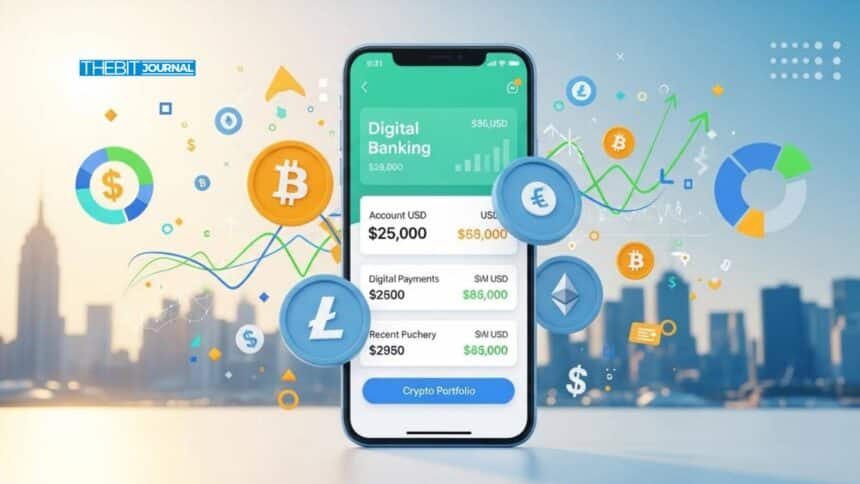
Digital banking and crypto adoption in the US are charging ahead in 2025, completely flipping the script on how finance is done.
Now more than ever, an astonishing 76-77% of American consumers are banking online, just using their smartphones or laptops rather than going into a branch.
Additionally, cryptocurrency use is fast becoming mainstream. Roughly one in five American adults now own some form of crypto and U.S. crypto trading volume has taken off by a healthy 50% in early 2025.
However, just how are digital banking and crypto adoption influencing each other in the US?
The Digital Banking Landscape in the US
It’s no secret that US banking customers are ditching branches for mobile apps and online banking.
Over three-quarters of users now use online or mobile banking, and as a result, banks seem to be closing down their physical branches. Reports show an average of 1,646 per year since 2018 as customers are tilting towards digital channels instead.
Both traditional banks and new fintechs are now offering mobile apps and online platforms to meet this preference.
Reports show that most users just want the ease and convenience of banking on their phone; and they value speed and lower fees. Digital banks get this, delivering fast easy services.
Fintech firms are making a real push to steal market share. As at 2024, fintechs and digital banks had snagged 44% of the new checking accounts opened compared to the 43% grabbed by big and regional banks.
However, some users still keep their main account at a traditional bank.
Based on reports, US digital banks like Chime, SoFi, Varo, Ally and others already have millions of customers on board. Reports claim the likes of Chime already have about 9.1 million active members on the books as at this 2025 ending, a 21% year on year growth.
These banks mainly target younger or underserved customers, with user-friendly apps and budgeting tools that users actually like.
Table: Digital Banking Adoption in the U.S.
| Metric | Statistic |
| % of U.S. using online/mobile banking | 77% |
| Annual physical branch closures (2018-2024) | 1,646/year |
| New checking accounts by fintechs (2024) | 44% of new accounts |
| Chime active members (Q3 2025) | 9.1M (21% growth YoY) |
Crypto Adoption in the US Market
Crypto adoption in the US is one of the highest in the world. A 2025 Chainalysis report ranked the US number 2 globally in crypto adoption and a TRM Labs study found US crypto activity is now the largest in the world by transaction volume.
Between January and July 2025, US crypto activity grew by about 50% compared to the same period in 2024. This growth is driven by both individual users and institutions under a more supportive regulatory environment.
Surveys show about 20-28% of American adults own cryptocurrency.
Many owners use crypto for investment. Notably 39% of US crypto holders already use it to pay for goods and services. Common assets are Bitcoin and Ethereum. In fact, products like spot Bitcoin ETFs have driven large trading volumes.
The crypto market cap hit $4 trillion in 2025. Stablecoins are driving a massive transaction volume of about $46 trillion annually, as they are used for cross-border payments and institutional flows.
In August 2025 alone, the stablecoin market reached nearly $270 billion in outstanding supply and is growing fast.
Improved blockchain infrastructure, such as faster, cheaper transactions and clearer US policy, has also lowered the barriers.
New laws like the GENIUS Act (proposed stablecoin regulation); and a pro-crypto White House have given banks confidence.
A16z’s 2025 State of Crypto report notes traditional finance giants like Visa; Fidelity, BlackRock and even JPMorgan; are now offering crypto products and tech firms (PayPal, Robinhood) are integrating crypto.
All of this means crypto is becoming part of mainstream finance.
Digital Banking Meets Crypto: Innovations and Integration
The biggest news is that digital banks and traditional lenders are integrating crypto into their platforms.
This convergence of digital banking and crypto adoption is making it easier for customers to manage both types of assets in one place.
A very good example is fintech SoFi Technologies which became the first nationally chartered U.S. bank to relaunch integrated crypto trading in late 2025.
SoFi launched “SoFi Crypto,” allowing customers to buy, sell, and hold dozens of cryptocurrencies within their FDIC-insured accounts.
This removes friction by linking crypto purchases directly to bank accounts. SoFi’s CEO, Anthony Noto, says blockchain can “fundamentally change every way finance is done” by making payments faster and cheaper.
Even crypto-native banks are adding fiat services. Anchorage Digital Bank added global USD wire transfers in 2025, letting clients hold and move cash and crypto on one platform.
Its CEO Nathan McCauley says this unified approach of holding crypto and USD together eliminates complexity for institutional users. This shows a future where digital banking platforms serve both crypto and traditional assets.
Large banks like U.S. Bank have resumed crypto services too. U.S. Bank just restarted its institutional Bitcoin custody program in 2025, and others like Citigroup are exploring similar offerings.
Banking executives note that having established banks manage crypto can give clients confidence in this new area.
These developments show digital banking and crypto adoption are converging. Customers who are comfortable with apps for banking can now see crypto as another app feature.
Expert Analysis: Digital Banks and Crypto Adoption
Financial analysts and industry leaders see the digital banking crypto connection as a big deal. Experts say offering crypto through digital banks lowers the barrier for mass consumers.
Similarly, research shows banks are essential to crypto adoption. A Boston Consulting Group report cited by FinTech Magazine showed business stablecoin use is up 30x in two years. Analysts predict that banks that adopt crypto services and stablecoin infrastructure will drive mainstream growth, providing the on/off ramps and credibility.
One deep dive by cryptocurrency experts notes that in 2025, financial incumbents from Visa to JPMorgan have crypto arms, and the network is stronger than ever in the U.S.. They also report an all-time high in crypto wallet users, up 20% in one year.
However, experts warn on volatility and education. Consumer interest is high but many are still concerned about security.
So banks must not only provide access but guidance. SoFi’s launch includes in-app education and hand-holding for crypto newbies.
According to fintech analysts; the success of digital banking and crypto adoption depends on making these services easy and secure for everyday users.
Challenges and Opportunities
While digital banking and crypto adoption opens opportunities; there are challenges:
Cryptocurrencies can be very volatile. Consumers used to bank apps for salaries and bills may not want to mix volatile assets without safeguards.
Banks often separate crypto holdings from deposit insurance which can confuse customers.
Despite progress; U.S. crypto law is still evolving. Any major change (positive or negative) in federal policy can speed up or slow down bank crypto plans.
Fintechs and crypto firms are innovating, and banks are too. Smaller digital banks may try to outflank bigger banks.
Traditional banks are also responding as many have stepped up their digital offerings to keep customers.
On the opportunity side, Digital banking and crypto adoption could reach the unbanked. Crypto can provide payment solutions where traditional banking is weak. Digital banks offering crypto could tap into underserved communities looking for alternative financial services.
Tokenized assets; crypto-backed loans, and programmable money are coming. Digital banks that build the infrastructure now may capture future demand such as instant crypto payments or interest on crypto savings.
Stablecoins and crypto enable near-instant cross-border payments with low fees. U.S. digital banks could use this for international remittances and business payments which is a fast growing market.
Overall, experts agree that digital banking and crypto adoption is becoming part of the mainstream financial system. If done right, it could simplify money management by combining bank accounts, credit and crypto assets under one platform.
Conclusion
Digital banking and crypto adoption is accelerating fast in the U.S. driven by technology and changing regulation.
U.S. consumers are already using online banking in record numbers and millions of Americans own cryptocurrency. Big institutions and fintech banks are responding by adding crypto to their digital banking services.
The convergence promises to bring new convenience instant transfers; integrated wealth management, but also requires careful handling of security and regulation.
Overall; the combination of digital banking and crypto will prop up the US financial market; making it more inclusive and innovative as experts project growth in both sectors.
Glossary
Digital Banking: online or mobile banking services offered by banks or fintechs; where users can manage accounts; pay bills, transfer funds etc. through apps or websites instead of physical branches.
Cryptocurrency (Crypto): a digital asset using blockchain for secure; decentralized transactions. Examples are Bitcoin and Ethereum.
Stablecoin: a type of cryptocurrency pegged to a stable asset (e.g. USD); to minimize price volatility.
Blockchain: a distributed ledger technology that supports cryptocurrencies; recording transactions in a secure; tamper-proof way.
Fintech: financial technology companies (often startups); that use digital tools to offer banking; payment, lending and other financial services.
FAQs About Digital Banking and Crypto Adoption
What is digital banking?
Digital banking means using online platforms and mobile apps to access banking services like checking accounts; payments, loans; instead of visiting branches.
How many Americans use cryptocurrency?
Estimates vary; but surveys say about 20-28% of US adults own some cryptocurrency.
Do U.S. banks offer crypto services?
Yes. In 2025; banks like SoFi, U.S. Bank and Anchorage are already offering cryptocurrency trading, custody or transfers in their banking apps.
What are the challenges for consumers buying crypto through banks?
Notable issues are understanding crypto’s volatility; platform security and regulatory clarity. 40% of crypto owners still worry about security so banks need to educate users and protect assets.