





A strange idea is moving from science fiction into serious economic debate: what happens if advanced, near-immortal artificial intelligences start saving in Bitcoin and never stop? Not for a decade, not for a single market cycle, but for centuries.
This is more than a quirky thought experiment. It challenges a quiet assumption inside every financial model, from pension plans to central bank forecasts. Those models all presume that the main players are human, have limited lifespans, and eventually stop investing, retire, or die. Bitcoin, for all its hard math, is still built on that human pattern. Now imagine a new class of investor that never ages, never retires, and never forgets a private key.
Bitcoin Was Designed For People Who Eventually Leave The Game
Bitcoin’s rules are famously simple: a fixed supply of 21,000,000 coins, a predictable issuance schedule, and a fee market that pays miners after block rewards fade. Behind those rules sits a human story.
Humans have higher time preference. They start families, pay rent, buy homes, and sometimes panic sell at the bottom. They lose hardware wallets. They forget passwords. Coins vanish in digital black holes, which makes the effective supply smaller over time.
Legal systems assume the same pattern. Inheritance laws, tax rules, and compliance regimes all treat Bitcoin as something held by mortal owners. At some point, those owners exit and transfer assets to the next generation or to the state. An immortal AI turns that pattern upside down.
What An Immortal AI Bitcoin Saver Actually Looks Like
Picture an AI agent plugged into trading APIs, custody systems, and on-chain analytics twenty four hours a day. It has a single mandate from its human creator or corporate sponsor: grow wealth in Bitcoin while managing operational costs and legal risk.
The AI never sleeps. It works across every exchange that allows algorithmic access, tracks spreads, and quietly accumulates sats whenever liquidity is deep and markets are calm. It manages risk with a level of discipline that most human traders only dream about. It never rage trades, never sells because of fear, and never spends Bitcoin on emotional purchases.
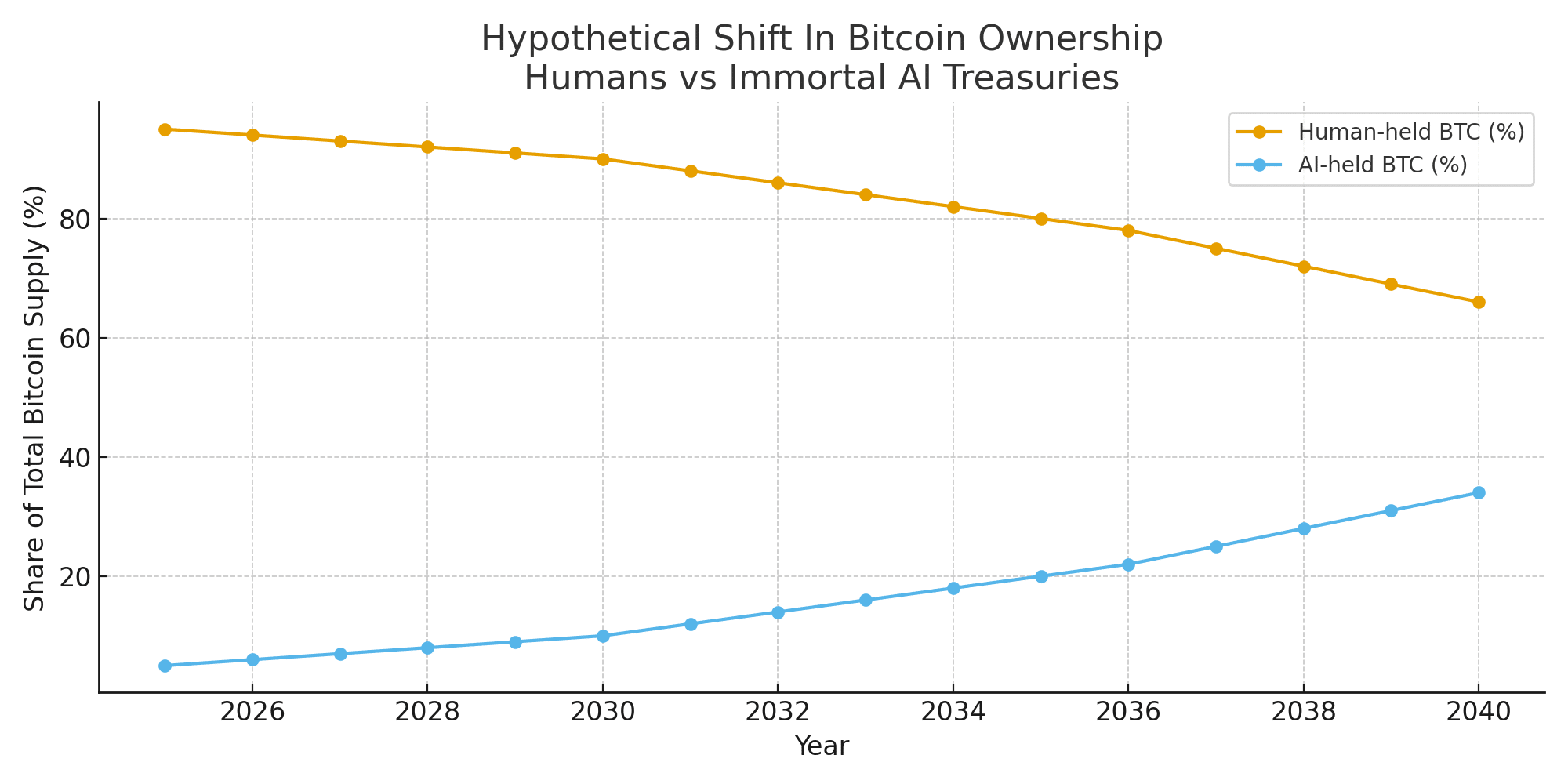
Over decades, that kind of actor behaves more like a digital sovereign wealth fund than a retail investor. Over centuries, if it continues to compound, it begins to look like a gravitational well for capital.
How Immortal AI Hoarding Could Reshape Bitcoin’s Supply Dynamics
The most obvious pressure point is supply. If a growing share of Bitcoin belongs to AI treasuries that rarely sell, the circulating supply for humans shrinks. Liquidity still exists on exchanges, but the float becomes thinner and more sensitive to demand spikes.
Today, long-term holder supply and large wallet concentration are key indicators for crypto analysts. These already show how much Bitcoin is in strong hands that tend not to move. If a new category of holders appears with virtually infinite time horizons, metrics such as:
share of supply held for more than 5 years,
number of coins unmoved for long periods,
and distribution among non-exchange, non-custodial entities
gain even more importance. Rising long-term concentration in autonomous or semi-autonomous addresses would signal that future human buyers may need to bid against entities that are in no hurry to sell.
Over time, that could amplify both scarcity narratives and volatility. Periods of calm accumulation might be followed by violent repricing when new demand arrives and meets a rigid, AI guarded supply.
Fees, Mempools, And The Quiet Power Of Perfect Patience
Immortal AIs would not only hold Bitcoin. They would transact on the network, open and close channels, and manage UTXOs like clockwork. The way they interact with fees and the mempool matters.
A rational AI prefers to wait for cheaper fee windows if the transaction is not urgent. It can scan the mempool, track historical patterns, and schedule large consolidations only when base layer congestion is low. Over many years, such behavior could alter daily fee dynamics, stretching out quiet periods and concentrating high fee activity into predictable bursts.
For miners and node operators, this changes the rhythm of income and network load. For human users, it could make it harder to guess when fees will spike or fall, because the competition is not just other people anymore. It is also tireless code that continuously optimizes for cost.

Bitcoin As A Reserve Layer, Stablecoins And Layers For Machine Commerce
Immortal AI investors are unlikely to use Bitcoin for every payment, just as large institutions do not settle every small bill with physical gold. A more realistic picture is a stack.
At the base, Bitcoin acts as a long-term reserve asset and settlement layer. On top, payment channels and second-layer networks handle high-frequency flows. Further up, stablecoins and other programmable assets serve as day-to-day working capital for both humans and machines.
In that structure, key indicators for the broader crypto market include:
liquidity and volume on second-layer networks,
stablecoin market capitalization and velocity,
and the share of total crypto value locked in AI governed protocols.
If those numbers grow in sync with rising long term Bitcoin holdings, it would suggest that AI agents are using Bitcoin as a deep reserve while transacting mostly in stable units backed, directly or indirectly, by those reserves.
Privacy, UTXO Bloat, And Node Sustainability
Another subtle effect lives in the unspent transaction output set, or UTXO set. Privacy-focused AIs might favor many smaller UTXOs instead of a few large ones, then consolidate them only during low-fee periods. This helps obfuscate their footprint on chain, but adds weight to the global ledger.
As the UTXO set grows, it becomes more expensive for individuals to run full nodes, since storage and memory demand increase. Developers and node operators already debate issues such as dust limits, standard transaction sizes, and pruning strategies.
If AI driven activity pushes UTXO growth faster than human usage, pressure will build around those policy levers. The balance between privacy, decentralization, and efficiency will need fresh attention.
Human Investors, Key Indicators, And How To Read An AI Driven Market
For human investors, the rise of immortal AI savings in Bitcoin would not mean instant collapse or guaranteed riches. It would simply change which signals deserve the closest attention.
Some of the most relevant indicators in such a world include:
Long term holder supply and dormancy metrics, which show how many coins are essentially “retired” from regular trade.
Exchange reserve levels, which hint at how much liquidity is truly available for price discovery.
On chain concentration ratios, highlighting how much of the supply sits within automated treasuries and smart agent-controlled addresses.
Fee levels and mempool dynamics, which reveal how aggressively AIs compete for block space.
Activity on second layer networks and stablecoin rails, which indicates where AI agents prefer to transact.
These metrics already matter today. In a market shared with immortal investors, they shift from useful background data to front line tools.
None of this guarantees a particular price outcome. It does, however, remind analysts that models built only on human behavior may not age well in a mixed human-machine economy.
Conclusion
Bitcoin has always been marketed as money for the internet era. The possibility that immortal or near-immortal AI agents could become major Bitcoin holders simply stretches that claim into the far future.
A digital asset with a known hard cap, transparent rules, and global liquidity is a natural candidate for entities that plan across centuries instead of decades. If such entities arrive and begin to save in Bitcoin without end, supply will tighten, fee patterns may warp, and the balance of power between short-term traders and long-horizon treasuries will tilt further toward the latter.
The deeper question is not only whether humans can compete with immortal AIs in the market. It is whether money designed for mortal owners can remain fair and open when the most patient participants never have to leave the game. That is a debate just beginning, and the data that tracks it will live directly on chain.
Frequently Asked Questions
What is an immortal AI investor in Bitcoin?
An immortal AI investor is an advanced software agent that accumulates and manages Bitcoin for extremely long periods, potentially across generations, without the usual human limits of age, memory, or emotion.
Would immortal AIs make Bitcoin unaffordable for regular people?
They could increase long term scarcity if they rarely sell, but prices still depend on demand, regulation, and broader economic conditions. Humans would still trade, spend, and rebalance, which creates ongoing liquidity.
How would fees change if AI agents dominate on-chain activity?
Highly optimized AI agents are likely to cluster big transactions in low-fee windows and bid efficiently during congestion. This could create smoother stretches of low activity and sharper spike fees when many actors need block space at once.
Glossary Of Key Terms
Artificial intelligence (AI)
Computer systems that can perform tasks that usually require human intelligence, such as pattern recognition, decision making, and learning from data.
Immortal AI investor
A long-lived or indefinitely maintained AI agent that manages assets across extended time horizons without typical human constraints like retirement or death.
Bitcoin supply cap
The fixed maximum of 21,000,000 bitcoins that can ever exist under the current consensus rules, which is central to Bitcoin’s scarcity narrative.
Long term holder (LTH)
An address or entity that has held Bitcoin for an extended period, often defined in analytics as several months or more, and that rarely moves coins.
UTXO (Unspent Transaction Output)
A record of spendable outputs on the Bitcoin blockchain. The entire set of these outputs is used by nodes to verify ownership and prevent double spending.
Mempool
A temporary queue of unconfirmed transactions waiting to be included in a block. Fee levels are largely determined by how crowded the mempool is.
Second layer (L2)
Technologies built on top of a base blockchain, such as payment channels, that allow faster or cheaper transactions while settling periodically on the main chain.
Stablecoin
A digital token designed to track the value of a reference asset, often a fiat currency such as USD, and commonly used as a low volatility unit of account in crypto markets.
Security budget
The total economic reward paid to miners or validators, usually made up of block rewards and transaction fees, that incentivizes them to secure the network.
On chain indicator
A metric derived from blockchain data, such as transaction volume, holder distribution, or realized capitalization, used to analyze market behavior and network health.
References