










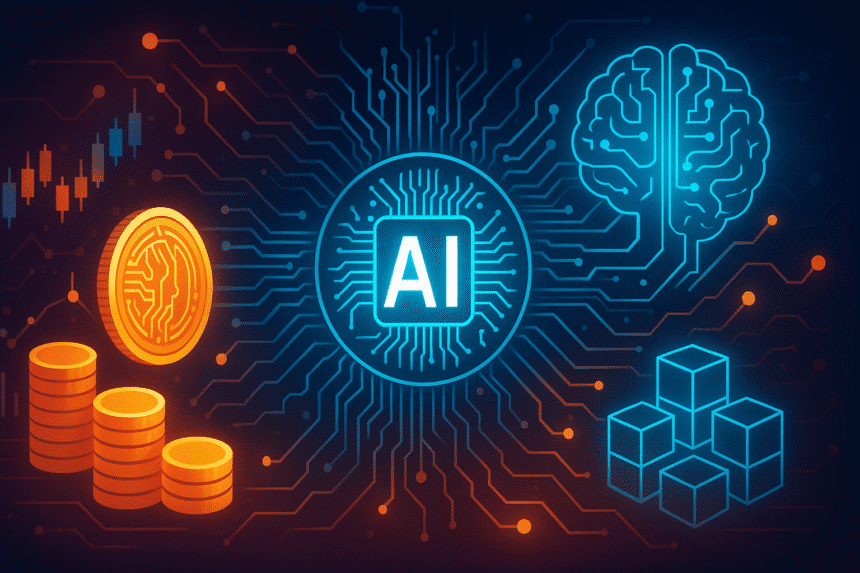

Artificial Intelligence, or AI, is changing almost everything around the world. From phones to hospitals, it is now even making its way into finance. AI tokens are the new type of digital assets that bring together the power of artificial intelligence and blockchain technology. These tokens are used to run AI platforms, trade data, and make automatic financial decisions.
AI tokens work like fuel for AI-based systems. They help connect investors, developers, and machines that use smart algorithms to learn and make better choices. In simple words, AI tokens let financial systems think smarter. This combination of AI and blockchain gives more security, faster results, and trust between users who never even meet.
In the last few years, the number of AI tokens has grown quickly. Projects like SingularityNET, Fetch.ai, and Ocean Protocol have shown how AI can be used for real financial tasks. People use them for automated trading, fraud detection, and even predicting market changes. Big financial companies are also starting to test them for smarter payments and investment services.

AI tokens are not just about crypto. They are about creating a smarter, faster, and fairer financial system where decisions can be made by code instead of only humans.
How Artificial Intelligence Is Changing the Financial Industry
AI is making the financial world much more advanced. It assists banks and companies in comprehending customer behavior patterns, detecting fraud, and better handling money. Numerous things before AI were done manually. This is because now computer systems are able to read thousands of records within seconds and identify mistakes, and make forecasts about what will happen next.
Simply put, AI serves as a brain in finance. It analyses market data, customer behaviour, and risk indicators in order to make improved financial decisions. A large-scale case is AI trading bots that purchase and sell assets at higher rates than humans with the help of algorithms. The other case is credit scoring, where AI assists banks in determining whether an individual is capable of repaying a loan. It is also used to identify fraudulent transactions by knowing how actual users conduct themselves.
All is more transparent when AI is combined with blockchain. All transactions are stored securely on the chain, and with that clean data, AI systems are able to make predictions with no human influence. These two minimize expenses and errors. This is why banks, fintech startups, and even governments are slowly moving toward AI-powered financial models.
The Rise of AI Tokens: From Concept to Financial Reality
AI tokens first appeared as small experiments. Developers wanted to create decentralized platforms where AI models could run, share data, and get rewarded. These projects started around 2018 but became popular after 2021 when AI technology grew faster and blockchain became more mature.
At the beginning, AI tokens did not get much attention. Many people thought they were too technical or risky. But now things are changing. Investors see them as the next generation of digital finance. These tokens are not only about trading, but they also give access to AI tools, services, and analytics platforms that make real profits.
Each AI token has its purpose. Some are used to train AI systems with data, some reward users for providing computing power, and some manage decentralized AI marketplaces. These tokens help build systems that can make decisions without human input. Because of this, AI tokens are now becoming part of fintech discussions in major conferences and research papers.
The value of AI tokens has also increased a lot in the last two years. With the rise of tools like ChatGPT and other AI platforms, people finally see how powerful AI can be. So, when AI meets blockchain, it creates a system where money and intelligence work together.
| Token Name | Blockchain | Main Use Case | Approx. Market Cap |
| SingularityNET (AGIX) | Ethereum | AI marketplace and model sharing | $900 Million |
| Fetch.ai (FET) | Cosmos | Autonomous agents and automation | $1.2 Billion |
| Ocean Protocol (OCEAN) | Ethereum | Tokenized data for AI models | $750 Million |
| Arkham (ARKM) | BNB Chain | AI-based analytics and reporting | $400 Million |
These projects show how AI tokens are not just hype. They are working tools used to automate real systems, create data markets, and increase the efficiency of digital finance.
Why AI Tokens Matter in Financial Services
AI tokens bring a lot of change to financial services. Traditional banking systems are often slow, costly, and require too many middlemen. AI tokens can automate many of those steps. For example, an AI token-based system can check a person’s credit score, approve a loan, or manage an investment fund in just a few minutes.
Smart contracts also play a big role here. These are automatic codes on blockchain that do things when certain conditions are met. For example, if an AI system predicts that a company is doing well, the smart contract can automatically trigger a buy order. This reduces human error and keeps the system fair for everyone.
Financial firms can use AI tokens to reward users for data, provide transparent AI-driven advice, and even track assets. With AI and blockchain together, the process becomes clear, automatic, and faster than normal banks.
As more companies adopt these systems, customers will get faster service, lower fees, and better predictions. AI tokens are also helping in making investment decisions based on logic and data instead of emotions. This is why both large institutions and small startups are exploring AI tokens as the future of digital finance.
Real-World Use Cases of AI Tokens in Finance
AI tokens are already being used in many financial applications. They are powering robo-advisors, data sharing platforms, and even decentralized credit systems. These tokens act as the fuel that makes AI-based financial tools run smoothly.
In the field of investment, some platforms use AI tokens to reward people for feeding market data or trading signals. These tokens help create an open ecosystem where anyone can contribute information that AI can use to make smarter predictions. For risk management, AI tokens are used to automate credit scoring and fraud detection, saving time for financial institutions.
Another big use case is in payments. AI tokens can make international payments easier and cheaper. They automatically detect the best exchange rates and execute transactions without needing several middlemen. It helps reduce both cost and delay.
Below is a table showing some common use cases and projects related to AI tokens in finance.
| Use Case | Simple Explanation | Example Project |
| Robo-Advisory | AI helps suggest what assets to buy or sell | Numerai |
| Risk Management | AI predicts loan default or fraud chances | Cortex |
| Cross-Border Payments | Automates currency exchange and transfers | Fetch.ai |
| Asset Tokenization | Tracks tokenized assets using AI data | Ocean Protocol |
These examples show that AI tokens are already making financial systems smarter, safer, and faster. They take away much of the manual work and replace it with automated decision-making powered by reliable data.
How AI Tokens Improve Security and Efficiency
Security is one of the most important things in finance. AI tokens help make systems more secure by using smart algorithms to detect unusual behavior. For example, an AI model can notice strange spending or trading activity much faster than humans. This helps stop fraud before it causes damage.
AI can also learn from millions of past transactions and recognize patterns that might show risk. When AI works with blockchain, every action is recorded permanently. This makes it almost impossible to change or delete a transaction. Together, they give stronger protection and a lower chance of human mistakes.
It is also more efficient since AI systems can work with a significant volume of information in a short time. Finsight applications and banks are capable of managing a larger number of customers simultaneously. Smart contracts are able to provide an immediate transaction without delaying the process pending approval by a human.
This combination saves time and money for all people. The middlemen, such as agents or brokers, are not always required, and this reduces the fee. AI tokens also ensure that everyone has equal access to a transparent picture of information, and trust in the system is greater.
On the whole, AI tokens ensure that the financial system is more secure, fast, and cost-effective. They are aiding in the funding of the transition through the manual world to a more intelligent and data-driven world.
The Role of Data in AI-Driven Finance
Data is the heart of every AI system. Without data, AI cannot learn, predict, or make smart choices. In finance, data comes from customer spending patterns, market movements, credit records, and thousands of transactions happening every second. AI tokens help connect all these data sources in a safe and organized way.
AI tokens make it possible to trade and share data between people and companies without giving away control. For example, Ocean Protocol lets users sell or share their data with others using tokens while keeping privacy. This means that even small businesses can use AI models to make better financial decisions without needing to spend millions on research.
In AI-powered finance, data tokens represent access to valuable datasets. AI systems can buy or rent these datasets with tokens and then use them to train new models. Everything happens through blockchain, so the system stays transparent and fair.
This is how AI and blockchain build trust in finance. People know their data is not being stolen, and businesses can be sure the data they use is real and verified.
Data and AI Token Relationship
| Element | Purpose | Benefit |
| Data Tokens | Represent ownership of data | Allows safe data trading |
| AI Models | Use data for learning | Makes predictions and decisions |
| Blockchain | Stores all records | Keeps system transparent |
| Token Incentives | Reward people sharing data | Builds a strong data network |
Data is becoming the new money in digital finance. The more accurate data AI gets, the better it performs. With AI tokens, data turns into an asset that can be used, shared, and rewarded fairly.
Institutional Adoption of AI Tokens
Large financial institutions are now starting to look at AI tokens seriously. Banks, hedge funds, and payment companies see how AI and blockchain together can help them lower costs and reduce fraud. In the past, these institutions relied on big data centers and long manual processes. Now they can run smart contracts and AI models that do the same work faster.
As one instance, JPMorgan has been testing AI to enhance trading forecasts, and Mastercard is applying AI to detect fraud and secure payments. In Asia and Europe, some banks are learning how AI tokens would facilitate cross-border payment and make it more transparent.
AI tokens are also being used to control portfolios by hedge funds. Rather than spending every day of day, humans analyze the charts; AI technology can scan thousands of financial records and market signs within seconds. This will give investors more opportunities to respond promptly and prevent risks.
The other fascinating fact is that decentralized finance (DeFi) companies act as mini banks. Their systems are being automatically operated using AI tokens. Code deals with loans, trade, and rewards, not human beings. It opens finance to be more transparent and not reliant on large companies.
The AI tokens might be used in KYC (Know Your Customer) and AML (Anti-Money Laundering) as well. AI has the capability of processing identity data, identifying false accounts and suspicious actions in real-time. This is and game-changer to institutions since it saves time, enhances compliance, and minimizes losses through fraud.
Challenges and Risks of Using AI Tokens
Even though AI tokens look very promising, they are not perfect. There are still many challenges that must be solved before they become a normal part of financial systems. One big issue is volatility. The prices of AI tokens can rise and fall very fast, making it risky for businesses that want to use them for long-term projects.
Another challenge is data privacy. AI models need a lot of data to work properly, but not everyone wants to share personal or financial data. There must be strong privacy rules to protect people while still allowing AI to learn and grow.
Regulation is another big concern. Governments are still learning how to control AI and blockchain together. Some countries treat AI tokens like securities, others like utility tokens. Without clear rules, big banks and investors stay cautious.
There are also technical limits like slow transaction speeds, high gas fees, and heavy computing costs. Running complex AI models on blockchain takes a lot of energy and can be expensive. Developers are working on better solutions like layer-2 scaling and efficient algorithms to fix these problems.
| Challenge | Description | Possible Solution |
| Volatility | Token prices change too fast | Connect with stablecoins |
| Data Privacy | Sensitive data can leak | Use encrypted or zero-knowledge systems |
| Regulation | Rules are unclear in many countries | Global blockchain standards |
| Energy Cost | AI processing takes high power | Use greener, lighter models |
Despite these risks, the demand for AI tokens keeps rising. Developers, regulators, and investors are working together to make this new technology safer and more reliable.
Regulation Around AI and Tokenized Finance
Regulation is now becoming one of the biggest topics around AI and finance. Governments and agencies across the world are trying to understand how AI tokens fit into current laws. Since AI tokens mix finance, technology, and automation, they are harder to classify than normal cryptocurrencies.
In the United States, the SEC (Securities and Exchange Commission) is looking closely at AI-based crypto projects that promise financial returns. They want to make sure people are not being misled by false claims. The European Union has already introduced the EU AI Act, which sets rules for how companies can use artificial intelligence, especially in sensitive fields like banking or healthcare.
Transparency is key for regulation. Lawmakers want AI systems to explain how they make decisions. This helps people trust the process and ensures fairness in automated financial systems. Blockchain makes this easier since every action can be tracked on the ledger.
Other regions like Singapore, the UAE, and the UK are also creating their own frameworks to attract AI-driven startups while keeping safety in mind. The idea is not to stop innovation but to guide it so that people can use AI tokens without fear of fraud or misuse.
Regulation might slow down progress at first, but it will also make AI tokens more stable in the long run. Clear laws bring investor confidence, and that’s what will help AI tokens become a real part of global finance.
Future of AI Tokens in Financial Services
The next few years look very exciting for AI tokens. Experts believe that by 2030, most major financial systems will use some form of AI automation. AI tokens could power these systems by handling payments, investment decisions, and even entire financial platforms.
DeFi is expected to grow much faster with AI. Imagine smart lending platforms that use AI to predict loan risks before giving out money, or insurance platforms that use AI tokens to pay claims automatically when conditions are met. That is already starting to happen.
AI tokens will also help financial inclusion. In countries where banking access is low, people could use AI-powered wallets and tokenized systems for saving and investing. Everything would run on code, not banks. It gives more control back to individuals and small businesses.
Many partnerships between AI and finance companies are already forming. Developers are working to make AI systems smaller, faster, and cheaper to use. When these systems become mainstream, AI tokens will play the same role in finance that credit cards once did. They will become the new tools that make transactions smart and safe.
The Road Ahead: Balancing Innovation and Regulation
The future of AI tokens depends on how well innovation and regulation work together. Innovation makes finance more efficient, while regulation makes it safe. Both are needed for AI tokens to reach their full potential.
Developers must focus on building transparent and ethical AI systems. These systems should be fair and explainable so that users and regulators can understand them. On the other hand, governments should make flexible laws that support creativity but still protect people from fraud.
Community involvement is also very important. Open-source AI projects and decentralized governance can help avoid monopoly control by a few large companies. This keeps the system balanced and democratic.
As technology improves, AI tokens will continue connecting data, money, and intelligence. The journey is still in the early stages, but the direction is clear. AI tokens are not a short-term trend. They are shaping what the next generation of finance will look like.
Conclusion
AI tokens are changing how the world thinks about money and data. In the past, people depended fully on banks, advisors, and manual systems to make financial choices. Now, with artificial intelligence and blockchain together, a new type of system is forming. It is smart, transparent, and runs automatically with fewer errors.
The main goal of AI tokens is to bring automation and intelligence to finance. They help machines understand financial data, detect fraud, manage investments, and even approve loans without needing a middleman. That saves both time and money. It also makes financial systems fairer and more open to everyone.
These tokens are part of a bigger movement toward decentralized and data-driven finance. They show that technology can make financial systems not only faster but also safer. While there are challenges like regulation and volatility, progress keeps moving forward. Every new partnership between AI and finance proves that this idea is not just a trend but a solid step into the future.
In the coming years, AI tokens could become as common as debit cards or mobile payments. As people learn more about them and governments set clearer rules, AI tokens will likely power new ways of trading, lending, and investing. Finance will no longer just be about numbers and accounts. It will be about learning systems that think and make choices, systems powered by AI tokens.
Frequently Asked Questions About AI Tokens
What are AI tokens in simple terms?
AI tokens are digital currencies that support artificial intelligence systems. They are used to pay for data, computing power, or AI services. For example, a company might use AI tokens to train a machine learning model or to buy access to data on a blockchain network.
How are AI tokens used in finance?
In finance, AI tokens help run smart systems that can make automatic decisions. They are used in robo-advisors, automated trading, and even fraud detection systems. Some financial apps use AI tokens to reward users for sharing data that helps AI systems learn.
What are some popular AI tokens right now?
Some well-known AI tokens include SingularityNET (AGIX), Fetch.ai (FET), Ocean Protocol (OCEAN), and Arkham (ARKM). These tokens are used for AI marketplaces, automation systems, and data-sharing platforms that support machine learning.
Are AI tokens a safe investment?
AI tokens can be useful but also risky. Their value can go up or down quickly, like other cryptocurrencies. However, they also have real-world use cases that give them more strength over time. Anyone thinking to invest should learn how each token works before buying.
Glossary
AI (Artificial Intelligence)
A type of computer technology that can learn, think, and make decisions like humans. It studies patterns and uses data to solve problems automatically.
AI Token
A digital coin or cryptocurrency used to power systems that run on artificial intelligence. It can be used to pay for AI services, access data, or run automated tools.
Blockchain
A secure digital record system that stores data in small blocks connected in a chain. It keeps transactions safe and transparent so no one can secretly change them.
DeFi (Decentralized Finance)
A new kind of finance built on blockchain that removes banks or middlemen. It lets people lend, borrow, and trade directly using digital assets and smart contracts.
Smart Contract
A piece of code that automatically performs an action when conditions are met. For example, it can release payment when a loan is paid or a service is completed.
Tokenization
Turning real-world items or data into digital tokens on a blockchain. These tokens can be traded, shared, or used in AI systems for automation.
Summary
AI tokens are not just another crypto trend. They are part of a much bigger change in how financial systems operate. By bringing together machine learning, automation, and blockchain, AI tokens could reshape global finance. They make things faster, fairer, and more secure.
The journey is still starting, but the direction is clear. As the line between AI and finance keeps getting thinner, AI tokens will likely become the bridge that connects both worlds, the brain and the wallet of tomorrow’s economy.