










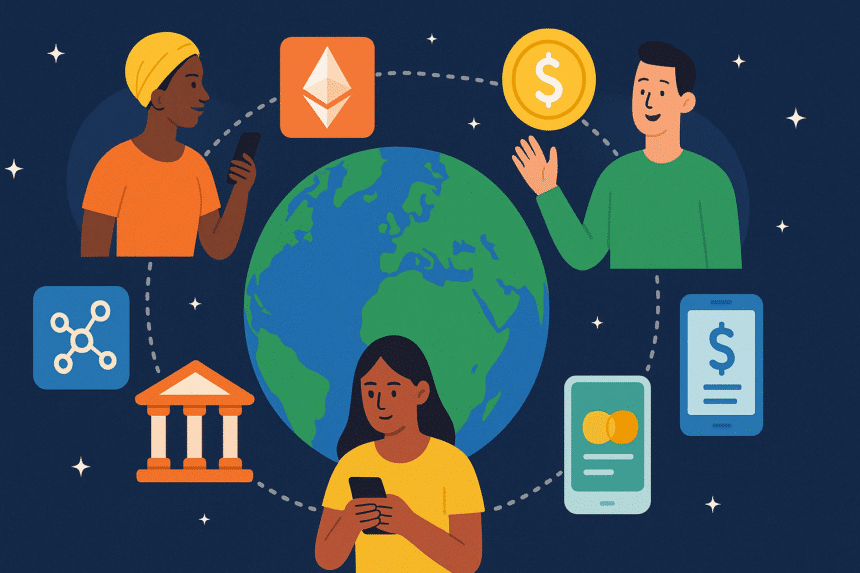

DeFi and Financial Inclusion sit at the heart of a simple idea. Everyone should be able to save, pay, borrow, and build wealth. Yet many people still cannot. The World Bank says about 1.4 billion adults remain unbanked. That is a large gap. DeFi offers open tools that run on public blockchains. Anyone with a phone and the internet can use them.
These tools could help close access gaps and reduce costs for many daily financial tasks. It pairs open networks with simple apps people already use on phones. DeFi and Financial Inclusion work together to cut friction so everyday money tasks feel easy and fair.
What DeFi Is

DeFi is short for decentralized finance. It uses smart contracts to run services like payments, savings, lending, and trading on public blockchains. No single bank or company controls the system. Users hold their own keys. Apps connect to wallets and perform actions based on code. This lowers entry barriers and can reduce fees. It also lets people interact across borders.
Why It Matters For Inclusion
Access is the first hurdle. Many people lack documents or live far from branches. DeFi apps run online and work 24/7. They serve anyone who can install a wallet. This can help migrants, gig workers, and small shops that need fast, low-cost payments.
The Link Between DeFi And Financial Inclusion
DeFi and Financial Inclusion align on three goals. Lower costs, broader access, and user control.
- Lower Costs: Traditional remittances still cost around 6 percent in major sending countries. Cutting costs by even a few points would save billions for families. DeFi rails aim to reduce middlemen and fees.
- Broader Access: Mobile money shows what digital access can do. In 2023 there were about 1.75 billion registered mobile money accounts worldwide. DeFi can plug into this digital habit and add new services like on-chain savings and credit.
- User Control: DeFi lets users hold assets directly in wallets. They do not need to open a bank account or meet strict branch-based rules. This can help people shut out of formal banking.
How People Use DeFi Today
Payments And Remittances
Migrant workers send money home each month. Fees eat into their wages. DeFi can route transfers on-chain, settle faster, and keep more value with families. Average remittance costs from G8 countries were about 5.99 percent in Q1 2025. The global target under the UN SDGs is 3 percent. Every step toward that goal matters.
Savings And Yield
Basic savings build resilience. DeFi offers tokenized savings, automated interest, and stablecoins. People can earn yield by supplying liquidity or staking, though risks exist. Returns are variable, and smart contracts can fail. Users must learn before they lock funds.
Credit For Small Sellers
DeFi protocols can assess on-chain history to extend credit. A street vendor can prove activity with wallet data rather than paper bank statements. This may open small working loans. It can also help build a portable, open credit record.
Who Benefits First
Early gains appear where digital habits already exist. Mobile-first markets in Africa and Asia lead in wallet use. DeFi can ride on that base. A low-cost stablecoin payment can replace cash for small merchants. Remittances can arrive in minutes. Governments and NGOs can deliver aid on-chain with better tracking.
- Unbanked adults: People who lack IDs or live far from branches. DeFi removes the branch step.
- Migrant workers: High remittance costs hit this group the most. Cheaper rails matter.
- Micro and small businesses: Faster settlement and transparent records improve cash flow.
- Women and youth: Digital access helps reduce historic gaps in account ownership.
Barriers To Inclusion And How DeFi Helps
| Barrier | Real-World Effect | DeFi Approach | Inclusion Impact |
| High remittance fees | Families lose income to charges | On-chain transfers, fewer intermediaries | More money kept by receivers |
| Distance to branches | Rural users lack access | Wallets on phones, 24/7 access | Wider reach with fewer touchpoints |
| Strict paperwork | Many lack documents | Wallet-based onboarding, self-custody | Easier entry for the unbanked |
| Slow settlement | Weeks for cross-border payments | Near real-time confirmation | Better cash flow for small shops |
| Limited credit data | Thin-file borrowers get rejected | On-chain history for reputation | Microcredit based on activity |
| Currency instability | Savings lose value | Use of reputable stablecoins | Store-of-value with lower volatility risk |
Stablecoins As A Bridge
Stablecoins link local users to digital dollars or euros. They offer a familiar unit of account for savings and pricing. Under new EU rules, stablecoin issuers face strict disclosure and reserve guidelines. Parts of the law took effect in 2024, with broader rules applying from late 2024. This push for clarity can help consumer trust.
Recent policy debate in Europe also focuses on risk gaps in stablecoin designs. Leaders have urged lawmakers to close any loopholes, including those tied to foreign issuers. These debates will shape how stablecoins support daily payments across borders.
Security And Regulatory Context
What The Rules Say
DeFi touches money, so it faces AML and consumer rules. The Financial Action Task Force sets global standards for virtual assets and service providers. It calls for controls like the Travel Rule, which asks firms to share sender and receiver data for certain transfers. Countries continue to roll out these rules at different speeds.
The EU’s MiCA regime is now in force. Stablecoin rules began applying in mid 2024. Other token and service provider rules started at the end of 2024. MiCA seeks more transparency, authorizations, and clear oversight. This aims to protect users and keep markets stable. Firms offering payment-like stablecoins in the EU may also need e-money or payment licenses under related laws.
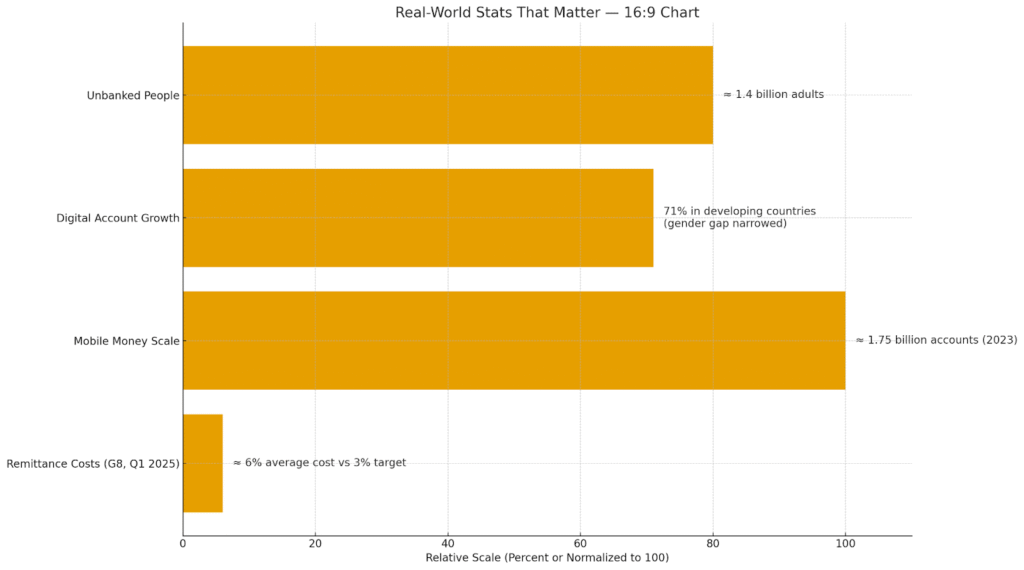
Real-World Stats That Matter
- Unbanked people: About 1.4 billion adults lack an account.
- Digital account growth: 71 percent of people in developing countries now hold an account, and the gender gap narrowed.
- Mobile money scale: About 1.75 billion registered mobile money accounts in 2023.
- Remittance costs: Average costs from G8 senders were near 6 percent in Q1 2025, still far from the 3 percent target.
What This Means For DeFi
Rules are getting clearer. User protection and AML controls are rising. DeFi teams that respect these rules will find it easier to partner with mainstream firms. Clearer guardrails also help users. People want strong consumer protections, plain fees, and redress paths. Inclusion improves when trust improves.
Design Principles For Inclusive DeFi
Keep It Mobile-First
Users already live on their phones. Interfaces should load fast on low-cost devices and slow networks. QR codes and local language support help. Offline cues and clear error messages reduce confusion.
Price With Clarity
Hidden fees push users away. Show network fees and expected final cost up front. Offer fee caps for small transfers. Present savings in simple terms.
Protect Users By Default
Wallet safety matters. Use clear risk prompts. Add allowlists, spending limits, and 2-factor approvals. Support social recovery that does not expose private keys.
Build With Local Partners
Work with mobile money operators, fintechs, and community groups. Local knowledge improves KYC flows, dispute support, and education.
The Risks Users Should Know
Smart Contract Failures
Bugs can drain funds. Code audits reduce risk but do not erase it. Users should favor well-reviewed protocols and start small.
Stablecoin Exposure
Not all stablecoins hold strong reserves or clear disclosure. Users should learn how the token holds value and who audits it. EU rules aim to raise the bar for issuers that serve the bloc.
Market Swings
Crypto prices move fast. People should avoid putting essential living funds in volatile assets. Stablecoins can help, but they carry issuer and regulatory risks.
Compliance Friction
KYC checks add steps. They exist to stop crime and protect users. Firms must store data safely and comply with local laws. FATF guidance continues to shape these duties.
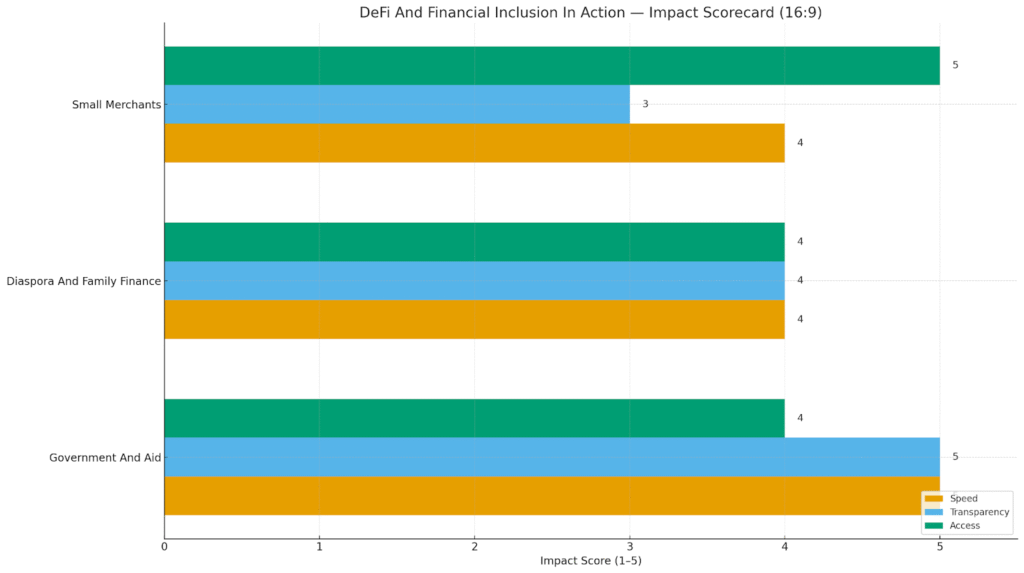
DeFi And Financial Inclusion In Action
Government And Aid
Aid groups can send tokens to wallets, with spend limits and merchant lists. This improves traceability and reduces leakage. Settlements clear fast, which helps in crises.
Diaspora And Family Finance
Families can split bills across borders in minutes. Parents can fund school fees on time. Transparent histories help with budgeting.
Small Merchants
A stall owner can accept stablecoin payments with a QR code. Funds arrive quickly. On-chain records help when applying for microloans.
Measuring Impact
What To Track
- Cost per transfer: Compare on-chain paths to old channels across key corridors.
- Settlement time: Track time from send to spend.
- User retention: Do people keep using the tool after the first try.
- Female adoption: Aim to narrow gaps in access and usage.
Sample Impact Scorecard (First-Year Targets)
| Metric | Baseline | Target | Why It Matters |
| Average transfer cost | 6% | 3–4% | More money to families |
| Settlement time | 1–3 days | Under 10 minutes | Cash flow for shops |
| Female user share | 40% | 50% | Close the gap |
| Active 90-day retention | 35% | 55% | Real adoption, not hype |
Building Trust At The Last Mile
Education First
Short videos and chat guides help people learn wallets and keys. Use simple language. Explain scams, recovery, and how to spot fake sites.
Local Cash Ramps
On- and off-ramps must fit local laws. Work with licensed partners. Keep KYC simple but safe. Publish fees and forex rates.
Support Channels
Offer hotlines, community coaches, and simple claim paths. People trust systems that help them when something goes wrong.
Challenges That Need Collective Action
Identity Without Exclusion
Many users lack formal IDs. Better digital ID systems can help. These systems must protect privacy and avoid bias.
Interoperability
Wallets and chains should talk to each other. Standards help reduce lock-in and improve user choice.
Clear, Consistent Rules
Regulators and industry need to align. EU MiCA is one path. Global standards like FATF guide AML work. As rules converge, cross-border use will get easier.
DeFi And Financial Inclusion Roadmap For Builders
Step 1: Pick A Use Case That Solves A Real Cost
Start where fees are high and pain is clear. Remittances, micro merchant payments, and school fees are good examples. Use stablecoins that follow strong rules.
Step 2: Work With Local Channels
Partner with mobile money and licensed fintechs. Respect KYC and local consumer laws. Keep refunds and dispute steps clear.
Step 3: Ship Safety Features First
Add transaction simulations, rate locks, and spending limits. Build scam warnings and allowlists into the flow.
Step 4: Measure Impact Openly
Publish fees, slippage, and outcomes. Share audits and security reports. This builds trust and helps regulators see value.
Final Words
DeFi and Financial Inclusion now move together. The unbanked still number in the billions, and remittance fees remain high. DeFi can help by cutting costs, widening access, and giving users more control. Strong rules like MiCA and FATF guidance add trust and push the sector to mature. The most impact will come from simple, safe tools that solve real pain. Build for phones. Price with clarity. Protect users by default. If DeFi does this well, more people will save, pay, and grow wealth on their terms.
FAQs About DeFi and Financial Inclusion
Is DeFi legal for cross-border payments?
It depends on the country. Many places apply AML and consumer rules to virtual asset firms. The EU’s MiCA adds specific rules for token issuers and crypto providers. Users and teams should check local laws.
Are remittances cheaper with DeFi?
Often, yes. On-chain routes can lower costs and speed up transfers. Average costs from G8 senders still sit near 6 percent, so there is room to save. Actual savings depend on ramps and fees.
How safe are stablecoins for savings?
It varies by issuer. Look for strong reserves, audits, and compliance with clear rules. EU rules set higher bars for tokens used in the bloc.
Can DeFi help people without bank accounts?
Yes. Users only need a phone and a wallet. This removes the branch requirement. It does not remove risks. Education and safe design remain key.
What about the Travel Rule and privacy?
Regulators ask firms to share sender and receiver data for certain transfers. This targets crime while seeking to protect consumers. Many groups still debate the right balance.
Glossary
- DeFi: Financial services built on public blockchains using smart contracts.
- Financial Inclusion: Access to useful, affordable financial services for everyone.
- Stablecoin: A token that seeks a steady value, often pegged to a fiat currency.
- Wallet: A tool that holds private keys and lets users send or receive tokens.
- On-Ramp: A service that converts fiat money into crypto.
- Off-Ramp: A service that converts crypto back into fiat money.
- Smart Contract: Code on a blockchain that runs agreements automatically.
- Travel Rule: AML rule that asks firms to share sender and receiver data for covered transfers.
- MiCA: EU law that sets rules for crypto assets and providers.
- KYC: Know Your Customer checks that verify identity.
Summary
DeFi can improve access to money for people left out of banks. It runs on public blockchains and uses smart contracts for payments, savings, and credit. This lowers costs and removes branch hurdles. Key needs remain. About 1.4 billion adults are unbanked. Remittances still cost near 6 percent in major sending markets. Mobile money shows strong digital habits that DeFi can build on. Stablecoins act as a bridge to familiar currencies, and the EU’s MiCA adds firm rules for issuers and providers. FATF standards guide AML controls like the Travel Rule. To drive inclusion, builders should focus on mobile-first design, clear pricing, and strong safety features. Real impact comes from lower fees, fast settlement, and trusted support.