



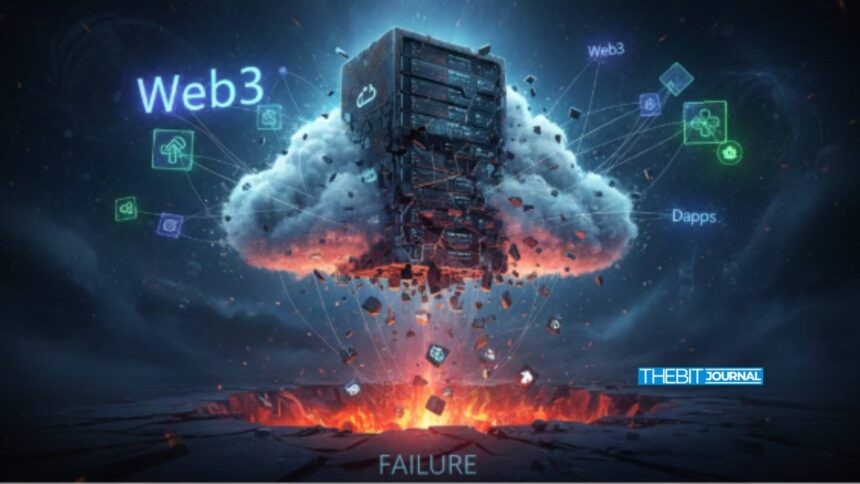

Web3 is sold as a trustless, unstoppable alternative to traditional finance. Blocks keep producing, nodes sync across continents, and smart contracts run on open networks. Yet a single regional outage at a major cloud provider on 20 October quietly turned parts of the crypto experience into a spinning wheel and a blank screen. Frontends failed to load, wallets timed out, and some rollup activity stalled, even as underlying blockchains continued to function.
This disconnect exposes an uncomfortable truth. The idea of decentralization is real at the protocol level, but the way users actually interact with crypto still depends heavily on a few centralized infrastructure providers. That gap between the narrative and the plumbing is becoming one of the most important indicators for judging the health of any Web3 ecosystem.
What really broke during the cloud outage
The October incident did not take down major blockchains. Consensus stayed intact. Validators kept proposing and attesting blocks, and transaction histories remained secure. The weak points were everything wrapped around that base layer: cloud databases, remote procedure call gateways, DNS services, indexers, custody systems, and rollup sequencers.
A typical DeFi or Web3 application relies on a long chain of services. The frontend is usually hosted on cloud object storage and served through content delivery networks. Domain names resolve through large DNS providers. Most read and write requests go through RPC platforms that run on the same big cloud infrastructure. Indexers make the data searchable.
Sequencers bundle transactions on layer 2 networks. Custody platforms handle signing for institutions and exchanges. If even a few of these services lose connectivity in one region, the end result for users is simple: the app appears broken.
The outage showed that many projects were effectively part of a single infrastructure monoculture. Different brands, different logos, but the same racks of servers behind the scenes. When that shared layer stumbled, redundancy evaporated.
The invisible monoculture behind “decentralized” apps
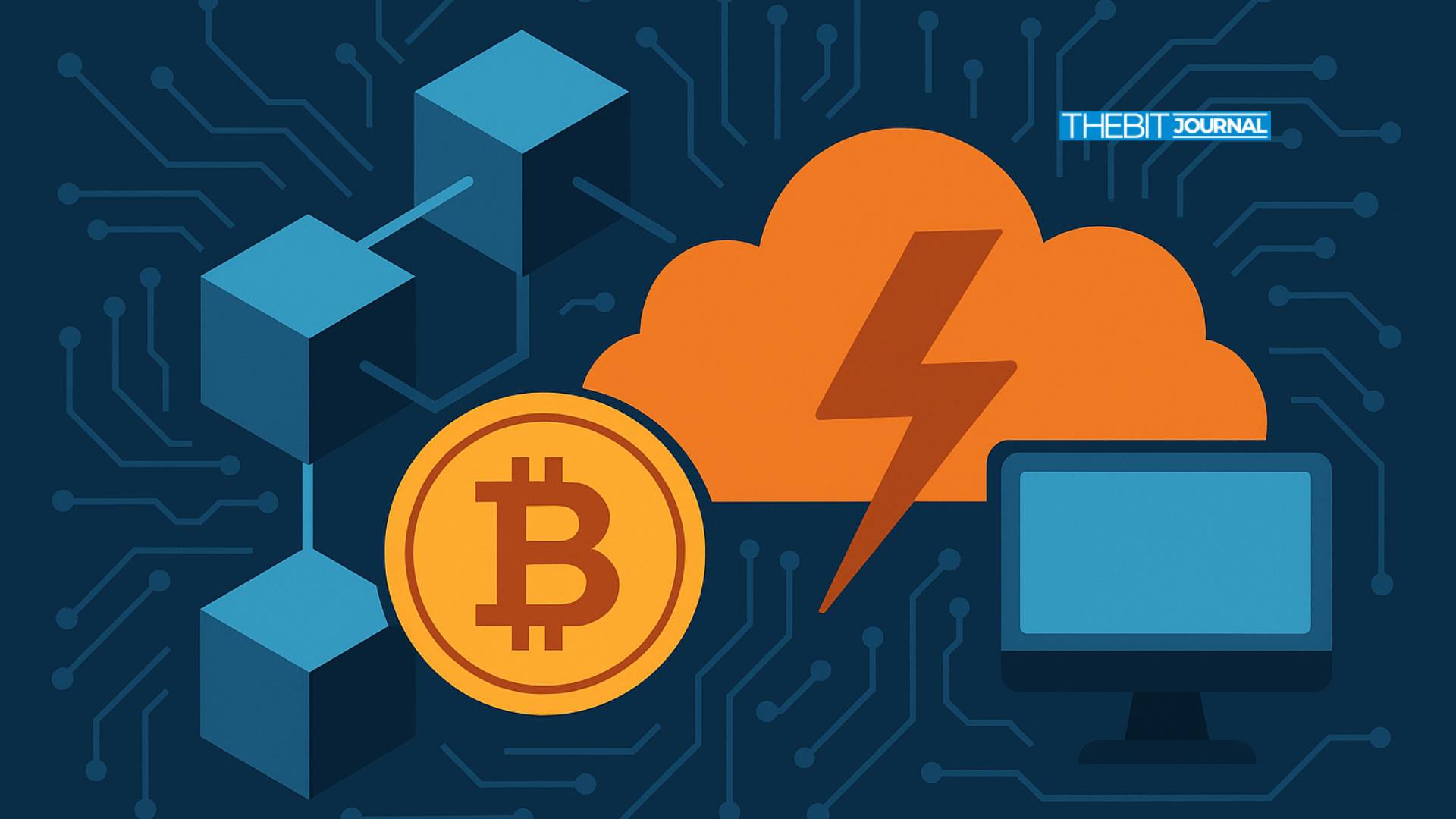
On paper, many teams proudly list multiple RPC providers, several storage options, and various analytics services. In practice, a large share of those providers run on the same set of cloud regions. A project might use two independent RPC platforms, but if both depend on the same cloud region for core databases, their failure patterns are strongly correlated.
In the October case, outages and degraded performance hit exchanges, node providers, wallets, and rollups at roughly the same time. Some sequencers needed manual intervention to resume posting batches. An indexer for a major layer 2 network had already demonstrated how fragile this setup can be when its gateway faltered weeks earlier.
This kind of concentration is not unique to crypto. Large cloud providers still control a significant share of global infrastructure, and a multi-hour disruption in a single region can ripple through DNS, storage, and database layers used by thousands of firms.
For crypto users, the effect is immediate. Between 10 % and 30 % of frontends or read functions can degrade during such events, and any write path that depends on sequencers or custodial signers can freeze entirely.
Why this matters for crypto’s key indicators
Traditionally, crypto investors and builders focus on familiar indicators: price, trading volume, total value locked, active addresses, and on-chain fees. Those metrics still matter. However, the October outage highlighted a new class of indicators that quietly shape long term resilience.
One critical indicator is infrastructure decentralization. This is not just the number of nodes, but how those nodes and their gateways are distributed across cloud providers, physical data centers, and jurisdictions. A network with thousands of nodes that relies on a handful of centralized RPC gateways is far more fragile than the headline node count suggests.
Another emerging indicator is dependency risk on sequencers and indexers. Layer 2 ecosystems live and die on sequencer uptime. If a single operator, running in a single region, has trouble posting batches, the entire user experience suffers. The design of shared or decentralized sequencer sets, and the degree of permissionless participation, is quickly becoming as important as block time or throughput.
A third indicator is operational diversity for frontends and storage. Projects that mirror their interfaces across multiple content delivery networks, use several DNS providers with active failover, and run their own gateways for decentralized storage have a very different risk profile than projects that host everything in one region.
Finally, there is regulatory alignment on resilience. Rules such as the Digital Operational Resilience Act in the European Union and upcoming critical third party regimes in the United Kingdom push financial entities to document and test third party ICT dependencies, including cloud providers. Because crypto custody, stablecoin platforms, and tokenized assets now overlap with regulated finance, infrastructure concentration is becoming a board level risk metric, not just a technical curiosity.
How builders are starting to reduce single points of failure
The fixes are not glamorous, but they are already appearing in production. Some teams are adopting provider quorum designs for RPC. A wallet or backend can query multiple endpoints and display a result only when at least 2 of 3 responses match. This reduces the chance of a single faulty gateway spreading incorrect balances or transaction data.
Light client technology is moving into browsers and mobile devices. Instead of trusting a central API, the client can verify block headers directly and cross check data with simple proofs. This approach does not remove cloud infrastructure, but it reduces the power of any one provider to mislead the user base.
On the networking side, infrastructure teams are rolling out multi-CDN and multi-DNS architectures with health checks and failover. For storage, they are running their own gateways, or mirroring assets across multiple decentralized storage networks. In the rollup ecosystem, new projects are experimenting with shared or decentralized sequencers and permissionless fault proofs that limit the control of any single operator.
Ethereum research is also pushing forward proposals for more efficient data availability sampling that can bring verification closer to the wallet itself. If successful, this would turn protocol-level resilience into something that users experience directly, rather than something that disappears behind centralized gateways.
What investors should watch in the next cycle
For anyone tracking digital assets, the next cycle will not be driven only by price charts and macro narratives. Infrastructure choices will sit quietly in the background, shaping which ecosystems can deliver during stress and which ones freeze the moment a cloud provider has a bad day.
Key crypto indicators are evolving. Alongside market cap and total value locked, serious analysis increasingly looks at node distribution, the share of nodes hosted on a single cloud, the diversity of RPC providers, sequencer architectures, and documented resilience plans. Networks and applications that invest early in multi-cloud and multi-provider setups may not see immediate price rewards, but they build the kind of reliability that keeps large capital comfortable during periods of volatility.
In simple terms, a truly decentralized application will not require every user to run a server at home. It will simply ensure that no single server, company, or region can take the system offline.
Conclusion
The October cloud outage did not prove that decentralization is a myth. It did something more subtle and more useful. It showed exactly where decentralization ends today and where Web2 infrastructure still quietly props up Web3.
Blockchains continued to function, but many of the services that make them usable bent under pressure. That gap between protocol resilience and application fragility is where the next phase of innovation will happen. As teams build provider quorums, light clients, multi cloud setups, and decentralized sequencers, infrastructure decentralization will become a core metric alongside price and volume.
Until those patterns become standard, one simple truth remains. When the cloud sneezes, too many Web3 applications still catch a cold.
Frequently Asked Questions
Why did some dapps fail while blockchains kept running during the outage?
The outage hit cloud based services such as RPC gateways, DNS, indexers, and sequencers, not the consensus layer, so blockchains kept producing blocks while many interfaces failed.
Is decentralization a myth if cloud outages can disrupt Web3?
Decentralization at the protocol level is real, but many user facing layers remain centralized. The outage highlighted an incomplete implementation of the decentralization ideal.
Which indicators show whether a crypto project depends too much on one cloud provider?
Key indicators include node distribution across providers, the share of RPC traffic handled by a single vendor, the location of sequencers, and the number of independent gateways for storage and data.
How are developers reducing the risk of future outages?
Developers are deploying provider quorum RPC, integrating light clients, adopting multi CDN and multi DNS setups, and exploring shared or decentralized sequencers, as well as self hosted gateways.
Glossary of key terms
Web3
A vision of an internet where applications run on public blockchains and users control keys and data, rather than relying on centralized platforms.
dapp (decentralized application)
An application that interacts with a blockchain through smart contracts, often using a web or mobile interface connected to wallet software.
RPC (remote procedure call) gateway
A service that forwards read and write requests to blockchain nodes, allowing wallets and dapps to query balances, send transactions, and access on chain data.
Sequencer
A component in many layer 2 networks that orders transactions into batches and submits them to the base chain for finality.
Indexer
Infrastructure that organizes blockchain data into searchable formats, enabling fast queries for balances, history, and protocol activity.
Light client
A node that verifies block headers and proofs without storing the full chain, allowing resource constrained devices to check data integrity.
Data availability
The property that transaction data is widely accessible for verification so that anyone can reconstruct the state of the blockchain if needed.
Multi cloud strategy
An approach where critical services are distributed across several cloud providers and regions in order to reduce single vendor risk.
References