




Public blockchains were designed to be open, neutral, and hard to censor. They were not designed, at first, for millions of trades, in-game moves, and tiny payments happening in real time. As usage has grown, many networks have felt the strain. Fees jump during busy periods, transactions pile up in mempools, and some everyday users quietly step away because the experience feels slow and expensive.
This is where Layer 2 scaling solutions step in. They keep the security guarantees of a major blockchain, but shift most of the transaction processing to another layer that sits on top of the base network. The result is a faster, cheaper experience that still anchors back to a trusted Layer 1 like Bitcoin or Ethereum.
Why Blockchains Struggle With Scale

To understand Layer 2 scaling solutions, it is useful to start with the base layer itself. A Layer 1 blockchain is the main network where blocks are produced, transactions are finalized, and consensus rules are enforced. Examples include Bitcoin and Ethereum, which validate every transaction directly on chain.
Each block has limited space, when demand spikes, users begin bidding against one another for that space. Fees rise, confirmation times stretch, and the user experience suffers. Developers can improve Layer 1 with protocol upgrades, but every change has trade-offs between decentralization, performance, and security.
Instead of forcing the base chain to handle every interaction, Layer 2 scaling solutions move most of the heavy work to separate networks that still rely on the original chain as the final source of truth. This approach aims to preserve the security and neutrality of Layer 1 while making everyday activity much more efficient.
How Layer 2 Networks Actually Work
In simple terms, Layer 2 scaling solutions behave like high speed side roads next to a crowded highway. Rather than send each transaction directly to the main chain, they group many operations together, process them in their own environment, and then submit a compressed summary back to the base blockchain.
That summary contains enough data and proofs for the Layer 1 chain to verify what happened without recalculating every single transfer. Because Layer 2 scaling solutions do most of the computation off chain, they can offer far lower fees and much higher throughput than the underlying network, then use Layer 1 as a settlement and security layer.
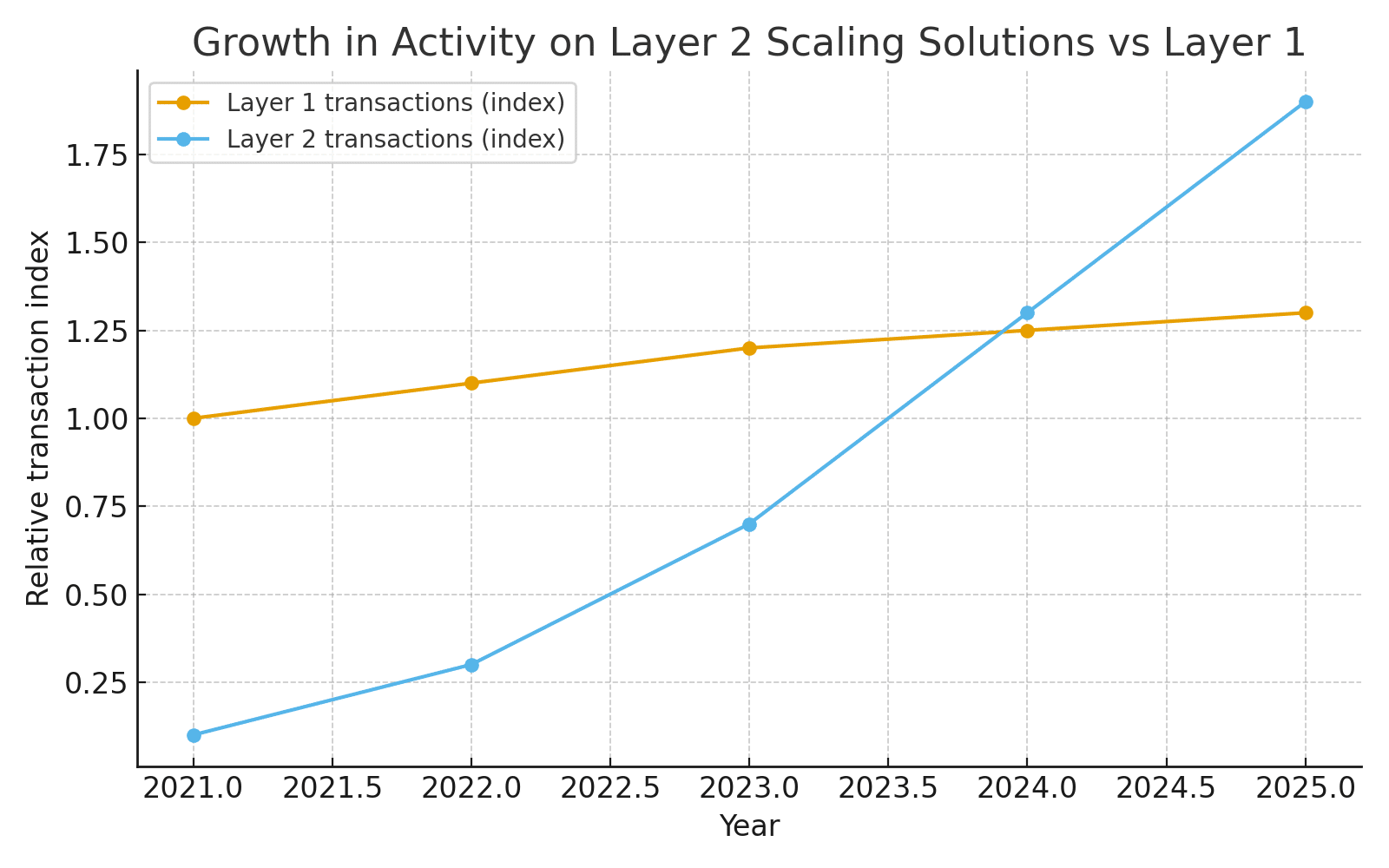
Recent research from analytics platforms shows how quickly this model is becoming central. Ethereum Layer 2 ecosystems now secure more than 40 billion dollars in total value and process well over half of all Ethereum transactions, while mainnet gas usage has dropped as activity migrates to the second layer.
Main Types of Layer 2 Designs
There is no single blueprint for Layer 2 scaling solutions. Several design families have become especially important, each with its own trade offs.
One leading group is optimistic rollups. These Layer 2 scaling solutions assume that each batch of transactions is valid by default. After the batch is posted to the base chain, there is a challenge period during which anyone can submit a fraud proof if they detect invalid activity. If a fraud proof succeeds, the network rolls back the bad transaction and penalizes the dishonest party. Optimistic rollups currently hold a majority share of total Layer 2 value, led by large ecosystems that specialize in DeFi and general purpose smart contracts.
Zero knowledge rollups, often called ZK rollups, form another powerful branch of Layer 2 scaling solutions. Instead of relying on a challenge window, ZK rollups use advanced cryptography to generate validity proofs that show a batch of transactions followed the rules. The base chain verifies the proof without seeing every detail, which improves privacy and efficiency. This model is gaining traction as toolkits mature and major protocols add support.
Some Layer 2 scaling solutions use state channels. In a payment channel, for example, two parties lock funds on Layer 1, then exchange an unlimited number of off chain updates between themselves. Only the opening and closing balances touch the main chain. The Bitcoin Lightning Network is the best known example, enabling fast, low fee payments through a routed network of channels that ultimately settle back to Bitcoin.
Sidechains and similar systems also sit in the wider family of Layer 2 scaling solutions, although some observers treat them as a separate category. These networks run in parallel with their own validators and rules, then connect to the base chain through bridges and checkpoints. They can target specific needs, such as gaming, social applications, or high-frequency trading, while still anchoring critical data back to a well-established Layer 1.
Real World Adoption And Market Reality
In the early days, Layer 2 scaling solutions sounded like a distant roadmap item. That phase is over. Today they are embedded in daily crypto activity. Industry trackers report that Ethereum Layer 2 networks collectively secure tens of billions of dollars in value and have seen year on year growth of more than 30 percent.
Optimistic rollup ecosystems still dominate Layer 2 total value locked, with individual networks such as Arbitrum and Optimism capturing a large share of liquidity. ZK based platforms, including zkSync and Starknet, are expanding quickly as developers search for higher throughput and stronger privacy guarantees.
On the Bitcoin side, payment focused Layer 2 scaling solutions that build on the Lightning Network and newer layering models allow instant, low cost transfers while the base chain focuses on long term settlement.
This shift has important implications for long term investors. As activity migrates to Layer 2 networks, demand for the base token can still increase, because every batch of Layer 2 transactions ultimately pays fees and settles security on the Layer 1 chain.
Why Layer 2 Matters for DeFi, Gaming, and Web3
Decentralized finance depends on predictable settlement, deep liquidity, and fees that do not eat away every strategy. Without Layer 2 scaling solutions, many smaller portfolios would find it difficult to rebalance positions, adjust collateral, or execute trades regularly, because each transaction on a congested base chain can become expensive.
By moving most activity to cheaper networks, DeFi protocols can support frequent swaps, automated strategies, and complex products that remain accessible to a wider range of users. The same story plays out in Web3 gaming and social platforms. Games need constant state updates, inventory transfers, and in game economy actions. Social and creator tools need low friction posting, tipping, and reputation changes. These experiences become far more realistic when they rely on Layer 2 scaling solutions instead of competing for block space on the main chain.
For builders, Layer 2 scaling solutions open room to experiment. Lower fees reduce the cost of testing new ideas, launching early versions, and learning from user feedback. A project can begin on a Layer 2, gain traction, and still inherit the security of a proven base chain beneath it.
Risks, Trade Offs, and Key Indicators
Despite their value, Layer 2 scaling solutions introduce fresh risks. Many rely on complex smart contracts and upgradeable components. Some networks are still controlled by a small group of sequencers or validators, which creates governance and censorship concerns. In certain designs, withdrawals back to Layer 1 can be delayed for days to accommodate fraud proofs or other safety checks.
Bridges between networks are another pressure point. Poorly designed or poorly secured bridges have suffered major losses in the past, and attackers continue to target them because they control large amounts of locked value. Risk aware users and institutions therefore pay close attention to bridge architecture, audit history, and bug bounty programs before committing serious capital to a new Layer 2 ecosystem.
Liquidity fragmentation is a practical challenge as well. Capital is spread across many Layer 2 scaling solutions, and not every token has deep markets on each network. That fragmentation can lead to price gaps, slippage, and difficulty exiting a position if sentiment turns against a particular platform.
When evaluating any project in this space, analysts look at several key indicators: how the network inherits security from Layer 1, how decentralized its sequencer or validator set is, how easy it is to exit back to the base chain, and how transparent its governance process has become over time. Mature platforms tend to publish clear documentation, share regular security reports, and outline credible paths toward greater decentralization.
The Future Of Scaling
All signs suggest that Layer 2 scaling solutions will become even more central as Web3 matures. The base chains will increasingly resemble high security settlement layers, while most day to day activity takes place across a network of specialized, interoperable Layer 2 environments. For many users, the technical details may sit under the surface. Their experience will feel like a fast, low cost internet application that happens to be backed by cryptographic settlement.
At the same time, the data and value that flow through these layers will remain transparent and auditable on public infrastructure. That combination of speed and openness is what gives Layer 2 scaling solutions such a strong role in the long term crypto story.
Conclusion
Layer 2 scaling solutions are no longer a niche experiment discussed only in developer forums. They now sit at the heart of how leading blockchains handle volume, control fees, and support real world use cases. By shifting computation off the main chain and settling the results back securely, they help networks grow without sacrificing the decentralization and security that give public blockchains their value in the first place.
For investors, developers, and end users, understanding how these layers work is becoming part of basic crypto literacy. As adoption of Layer 2 scaling solutions continues to grow, they are likely to serve as the primary bridge between everyday digital life and the deep security of global, permissionless settlement layers.
Frequently Asked Questions FAQ
What is the main purpose of Layer 2 scaling solutions?
The primary goal of Layer 2 scaling solutions is to raise transaction capacity and reduce fees while still relying on the security and consensus of the underlying Layer 1 blockchain. They aim to ease congestion without weakening decentralization.
Do Layer 2 scaling solutions replace the base blockchain?
They do not replace Layer 1 networks. Instead, they complement them. The base chain focuses on final settlement, censorship resistance, and long term data storage, while the Layer 2 environment handles most of the high volume everyday activity.
Are funds safe on Layer 2 networks?
Funds on Layer 2 networks depend on how well their smart contracts, bridges, and governance systems are designed. Many projects inherit strong security from Layer 1, but additional risks exist around contract bugs, centralized sequencers, and bridge vulnerabilities. Each platform requires its own risk assessment.
How do Layer 2 scaling solutions affect crypto investors and projects?
For investors and builders, Layer 2 scaling solutions can provide lower fee trading, more flexible DeFi strategies, and new categories of applications, all while keeping a link to major base chains. At the same time, they add another technical layer that must be monitored for security, liquidity, and governance risks.
Glossary of Key Terms
Layer 1
The main blockchain where transactions are recorded, blocks are produced, and consensus rules are enforced. It provides the core security and settlement for the network.
Layer 2
A secondary protocol or network that operates on top of a Layer 1 chain to increase throughput and reduce transaction costs while still depending on the base layer for security.
Rollup
A type of Layer 2 system that executes many transactions off chain, then compresses them into a single data set or proof that is posted to the base chain so that results can be verified efficiently.
Optimistic Rollup
A rollup design that assumes transactions are valid by default. During a fixed challenge period, participants can submit fraud proofs that demonstrate invalid behavior. If a fraud proof succeeds, the network reverses the bad transaction and penalizes the offender.
Zero Knowledge Rollup (ZK Rollup)
A Layer 2 approach that uses cryptographic validity proofs to show that a batch of transactions followed protocol rules without revealing all underlying data to the base chain. This method supports high throughput and strong security.