





Crypto brings freedom and risk. One mistake can drain a wallet in seconds. A Multi Signature Wallet cuts that risk. It spreads control across two or more keys. One bad link no longer breaks the chain. This model fits real life. Families protect savings. Teams control treasuries. DAOs add checks without slowing work.
This guide shows how to set it up the right way. It covers tools, policies, and drills. It explains rules in simple terms. Readers learn how to reduce single-key failure and stop common attacks. They also see clear steps for fast, safe spending with shared control.
What Is A Multi Signature Wallet
A Multi Signature Wallet needs more than one key to spend. People call this M-of-N. For example, 2-of-3 means any two of three keys can sign a transaction.
This model removes a single point of failure. It also creates clean checks and balances. Teams can assign roles. Families can share control. DAOs can protect treasuries.
Why It Matters Today
Crypto theft is still a major problem. Reports show that criminals stole more than $2.17 billion in the first half of 2025 alone, with one Bybit incident making up a huge share. That loss already topped all of 2024 in only six months.
Across that same period, researchers counted hundreds of incidents. Net losses after freezes or returns still reached about $2.29 billion. Compromised wallets and stolen keys drove most of the damage. Multi signature control breaks the common attack path. One phishing or one device hack will not be enough to steal funds. That extra step can stop a disaster before it starts.
Popular Multi Signature Wallet Sites
People often ask where to start. The options below are well known and active:
Safe (Formerly Gnosis Safe)
Safe is a popular Multi Signature Wallet for Ethereum and other EVM chains. It offers clear policy controls, spending limits, and modular add-ons. Teams and DAOs use it for smooth treasury workflows. Safe supports multiple signers, hardware wallets, and role-based approvals. The interface is clean and the activity log helps audits. It fits startups and large communities that want strong controls without losing speed.
Casa
Casa focuses on Bitcoin with simple, guided recovery. It supports 2-of-3 or 3-of-5 setups using hardware devices. Families and long-term holders value its concierge support. Casa offers step-by-step onboarding, key health checks, and recovery drills. It reduces stress around seed storage and device loss. It is a good choice for people who want personal help and predictable routines.
Unchained
Unchained provides collaborative Bitcoin custody. Clients hold the majority of keys, and Unchained co-signs when needed. It also offers business accounts and lending services. Unchained emphasizes key ownership and portability. Its tools work with common hardware wallets and clear PSBT flows. It fits companies that want service and control at the same time.
BitGo
BitGo serves institutions that need strict controls and reporting. It supports many chains, fine-grained approvals, and auditing. Exchanges, funds, and enterprises rely on it for scale. BitGo integrates with compliance tools and back-office systems. Policy engines and API access help automate treasury tasks. It suits teams that need high uptime and detailed oversight.
Blockstream Green
Blockstream Green uses a 2-of-2 model for Bitcoin. One key stays on the user’s device and one key sits with Blockstream, with options like time locks. It adds extra checks for mobile users. Green supports watch-only views, two-factor style approvals, and hardware wallet pairing. It is handy for small daily balances with a safety net. Travelers and new users like its quick setup.
Specter Desktop
Specter Desktop is a DIY tool for Bitcoin multisig. It runs locally, works with many hardware wallets, and gives full control over policies and labels. Power users appreciate its transparency. Specter pairs well with full nodes for privacy and reliability. It supports air-gapped signing and detailed coin control. It suits people who want open-source tools and clear on-device verification.
Caravan By Unchained
Caravan is a stateless coordinator for Bitcoin multisig. It lets users build, sign, and recover transactions without creating an account. Audits and key portability are its strengths. Caravan is useful for recovery scenarios and quick vault builds. It reads descriptors and PSBTs from many sources. It is a good option when a team wants no vendor lock-in.
Electrum
Electrum is a mature Bitcoin wallet with flexible multisig support. It enables watch-only setups, replace-by-fee, and detailed fee control. It suits desktop users who want proven tools. Electrum works with popular hardware wallets and supports custom policies. The plugin system adds features without heavy bloat. It fits users who value speed and control.
Sparrow Wallet
Sparrow Wallet offers a clean desktop experience for Bitcoin multisig. It supports PSBT, coin control, and hardware wallets with clear policy views. It balances usability with depth. Sparrow makes it easy to label UTXOs and track history. It plays well with full nodes and privacy tools. It is a strong choice for learners who want to grow into advanced features.
Ledger Or Trezor
Ledger and Trezor are hardware devices used with the tools above. They store private keys offline and sign transactions securely. They reduce single-device risk in any multisig plan. Both brands integrate with major wallets and multisig coordinators. They show addresses on screen for final checks. They are the backbone of most serious long-term setups.
How A Multi Signature Wallet Works
The core idea is simple. The wallet enforces a rule like 2-of-3 or 3-of-5. It will only broadcast a transaction after it collects enough valid signatures.
Each key sits on a separate device or with a separate person. A thief would need several keys at once. That is harder to pull off than a single device hack.
Typical Roles For Keys
- One key on a personal hardware device at home
- One key on a second device in a safe place
- One key with a trusted partner or provider
Keep each key in a different place. Never carry two keys together.
Planning The Right Setup
A good plan starts with simple questions. Who needs access? How fast must funds move? What risks matter most?
Sample M-of-N Patterns
| Scenario | Suggested Policy | Why It Works |
| Solo saver | 2-of-3 | Loses one device? Two keys still move funds. |
| Family | 2-of-3 | Two adults sign. Teen’s key can be the third backup. |
| Small business | 2-of-3 | CEO plus CFO can pay. Third key stays in escrow. |
| DAO core team | 3-of-5 | Any three leads approve. No single person controls funds. |
| Nonprofit | 3-of-5 | Board oversight. Smooth continuity during staff changes. |
Step-By-Step Setup Guide
Follow these steps for a safe and clean build. The steps fit Bitcoin and EVM flows with slight tool changes.
1) Choose The Tooling
Select a wallet that supports your chain. Confirm it offers native multisig, clear backups, and export tools. Check that hardware devices you own are supported.
2) Decide The Policy
Pick M-of-N and assign owners. Write the policy down. Keep a copy offline. Use short, clear labels for each key and role.
3) Prepare Hardware
Use new hardware wallets where possible. Update firmware. Verify addresses on screen. Set strong PINs. Store recovery phrases in sealed, separate places.
4) Create The Vault
Create a new multisig vault in your chosen app. Enroll each device. Name each key. Confirm the policy before funding.
5) Test A Small Send
Make a tiny test transaction. Sign with the required number of keys. Verify on each device screen. Confirm that the receive address matches.
6) Document Everything
Record where each key lives. Note who can reach it and how. Keep a sealed envelope with the plan in a safe or safety deposit box.
7) Fund The Vault
Only fund after a successful test. Start small. Scale up after two or three clean sends.
8) Review Quarterly
Run a quarterly drill. Move a small amount. Check that people and devices work as planned. Update notes if someone leaves the team.
General Best Practices
- Keep keys apart. Do not store two keys in the same home or office. Do not put all backups in one safe.
- Use durable backups. Consider steel plates for long-term storage. Protect against fire and water.
- Track changes. When a person leaves the team, rotate keys. Replace compromised devices at once.
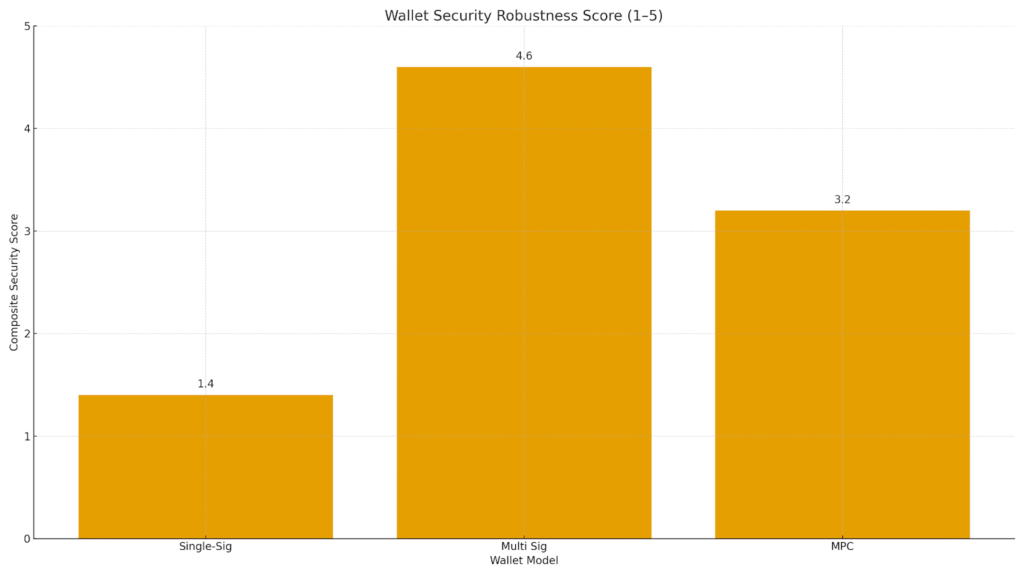
Single-Sig vs Multi Sig vs MPC
| Feature | Single-Sig | Multi Sig | MPC (Multi-Party Computation) |
| Single key failure | Catastrophic | Contained | Contained |
| Human oversight | Low | High | Medium |
| Speed of spend | Fast | Fast if coordinated | Fast |
| Setup complexity | Low | Moderate | Moderate to high |
| Hardware support | Broad | Broad | Varies by vendor |
| Auditability | Simple | Clear by policy | Often opaque |
| Best for | Small spends | Savings, teams, DAOs | Exchanges, fintechs |
Costs, Speed, And Fees
Multi sig does add a bit of overhead. Bitcoin transactions may need more bytes to include extra signatures. EVM gas use may also rise a little for policy checks.
These costs are usually small next to the safety gains. For large balances, the trade is worth it. For active trading, use a smaller hot wallet and keep the treasury in multi sig.
Recovery Planning And Human Factors
A strong plan assumes bad days. People move. Devices fail. Jobs change. Write a clear playbook in plain language.
List who to call first. Describe where each key sits. State the steps to replace a key. Keep a sealed copy with the attorney or board chair for teams. Practice once each quarter. Practice again after any staff change.
Common Mistakes And How To Avoid Them
Putting two keys together. Fix it by moving one key to a new site.
No test transactions. Send a tiny amount first. Confirm the whole flow.
Unlabeled devices and seeds. Label cleanly. Use short names that match your notes.
All backups in one safe. Split backups across at least two secure locations.
No policy for travel. Never travel with two keys. Move only one key across borders at a time.
Regulatory And Compliance Context
Rules for custody continue to evolve. In the US, the SEC has focused on how advisers and broker-dealers hold digital assets. Staff and outside legal notes point to stricter custody controls and clearer net capital treatment for broker-dealers that handle crypto. Multi sig can support these controls by adding human oversight and better logs.
In the EU, MiCA now sets a full framework for crypto-asset service providers. It requires authorization, governance controls, and strong safekeeping measures for client assets. These duties apply to custody flows and record keeping. Multi sig helps meet segregation and control expectations by removing single-operator risk.
Crime trends also shape best practice. 2024 saw about $2.2 billion stolen via hacks. 2025 has already passed that pace. These numbers justify simple, layered defenses for any serious holder.
Use Cases That Work
Families And Individuals
A 2-of-3 policy fits most savers. One key stays at home. One key sits in a bank box. A third key lives with a trusted relative or service. A mult-isig crypto wallet setup like this blocks common theft paths and still keeps access simple.
Small Companies
A 2-of-3 or 3-of-5 policy fits most small firms. Two officers can pay vendors. A third key stays in legal or with the board. Rotate keys when roles change.
DAOs And Communities
DAOs hold public funds. A 3-of-5 policy among elected signers adds trust. Publish the policy. Document signers and rotation dates in a public repo.
Nonprofits And Schools
A 3-of-5 policy lets boards oversee spending. It also protects funds during staff turnover.
Step-Down Hot And Cold Design
Split funds by purpose. Keep a small hot wallet for daily use. Keep most funds in a cold multi sig vault.
Move funds up and down the stack. Fill the hot wallet on a schedule. Sweep excess back to the vault. This keeps daily risk low.
Testing And Auditing
Logs matter. Export transaction histories often. Store them alongside the policy document.
Use checksums and signed notes where possible. For larger treasuries, run a light internal audit each quarter. Confirm keys, locations, and people.
Troubleshooting
A signer lost a device. The group can still spend with the remaining keys. Replace the lost key at once. Update the document.
A signer left the team. Rotate keys and update who can sign. Record the date and the reason for the change.
A device shows a mismatch address. Stop and verify. Only proceed when the on-device address matches the expected address.
Conclusion
A multi signature wallet turns fragile, single-key control into strong, shared security. It blocks simple hacks and adds human checks. It also brings order to team spending and long-term storage. The setup is not hard. Pick a clean M-of-N policy. Keep keys apart. Test small sends. Record who holds which key and where. Review the plan each quarter and after any staff change.
This approach fits families, firms, DAOs, and nonprofits. It reduces stress and prevents large losses. With a clear plan and steady habits, anyone can protect funds without giving up speed or control.
Frequently Asked Questions About Multi Signature Wallet
What is the main benefit of a Multi Signature Wallet?
It removes the single point of failure. A thief needs multiple keys, not one.
Is a Multi Signature Wallet slow to use?
No. It is fast if the signers coordinate. Most payments clear as usual.
How should a solo user set it up?
Use a 2-of-3 policy. Keep keys in different places with clear labels.
What happens if one key is lost?
The group can still move funds with the remaining keys. Replace the lost key soon.
Does multi sig replace good backups?
No. Keep strong backups and a written plan. Practice small sends often.
Glossary
- Multi Signature Wallet: A wallet that needs two or more keys to approve a spend.
- M-of-N: A rule that says how many keys must sign out of the total.
- Hardware Wallet: A device that holds a private key offline.
- Seed Phrase: A list of words that can restore a wallet.
- Policy: The rules for who can sign and how many signatures a spend needs.
- Cold Storage: Keeping keys offline in safe places.
- MPC: Multi-party computation that splits one logical key across several parties.
- Recovery Drill: A test that checks people, devices, and backups.
- DAO: A decentralized group that uses on-chain voting and shared funds.
- Custody: How an entity holds and controls client assets.
Summary
A Multi Signature Wallet protects crypto by requiring two or more keys for each spend. This model blocks common theft paths and adds human checks. The guide explains how it works, why it matters in 2025, and how to set it up for families, teams, DAOs, and nonprofits. It covers planning M-of-N policies, preparing hardware, building the vault, testing small sends, and documenting roles. It also compares single-sig, multi sig, and MPC, and outlines recovery drills and common mistakes to avoid. The security and regulatory context shows rising theft totals and evolving US and EU rules, which make stronger custody and oversight essential. With clear policies, split keys, and regular tests, users gain simple, durable protection for long-term funds.