
The crypto market has a habit of changing tone before most people notice. First Bitcoin does the heavy lifting as it pulls in attention, absorbs liquidity, and starts making headlines again. Then, somewhere after the first wave of excitement, money begins to spread outward. Traders grow less defensive. Risk appetite returns.
Capital that had been sitting in the largest asset starts rotating into Ethereum, then into other large caps, and eventually into smaller names further down the board. That rotation is what market participants usually mean when they talk about altcoin season, but the phrase gets thrown around too loosely. In practice, it is not just a stretch where random tokens pump.
It is a market phase with visible signals, repeated historical patterns, and a few indicators that tend to flash before the crowd fully catches on. As of April 17, 2026, the data still points more toward a Bitcoin-led market than a broad alt breakout, which makes this a good moment to explain what the setup really looks like and what would need to change before the wider field takes control.
What Exactly Is Altcoin Season? Definition and History
In plain terms, altcoin season is the part of a crypto cycle when a large share of non-Bitcoin assets outperform Bitcoin over a sustained period. It is not defined by one meme coin doubling in a week, and it is not confirmed by a single green day across the market. A widely used market gauge defines that phase as a period in which 75% of the top coins outperform Bitcoin over the previous 90 days.

Historically, this rotation has tended to appear after Bitcoin has already delivered a strong move and the market begins searching for higher beta opportunities. That pattern was visible in 2017, when capital spread from Bitcoin into Ethereum and then into smaller caps, and again in parts of 2021, when smart contract platforms, DeFi names, and meme tokens started outrunning Bitcoin for stretches of the cycle.
The logic is simple enough. Bitcoin usually attracts the first serious wave of money because it is the most liquid, most established, and easiest for institutions to justify. Once traders feel that the main move is no longer “early,” they start hunting for catch-up trades elsewhere. That is when leadership broadens.
Still, history also shows that not every Bitcoin rally turns into a full market-wide rotation. Sometimes capital moves only into a few majors. Sometimes Ethereum catches a bid while the rest of the field remains thin. Sometimes sentiment improves, but Bitcoin dominance refuses to break lower in a meaningful way. That is why serious traders watch structure, not slogans.
The Bitcoin Dominance Indicator: How to Track It
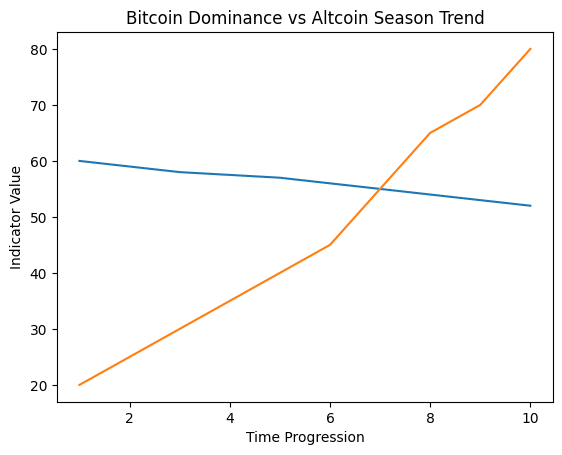
Bitcoin dominance measures Bitcoin’s share of the total crypto market cap. In simple terms, it shows whether Bitcoin is taking a larger slice of the market or giving some of that share back to the rest of the field. Both major chart providers describe it as Bitcoin’s market cap divided by the total crypto market cap.
This matters because dominance often acts like a pressure gauge for risk appetite. When the number rises, it usually suggests capital is clustering in Bitcoin and avoiding the wider alt market. When it falls while total market cap is rising, that is usually a healthier sign for alts. That second part is important. A falling dominance reading is not automatically bullish for altcoins. It can also fall because Bitcoin is dropping faster than everything else in a weak market. In other words, traders should not read dominance in isolation.
Sentiment data backs that up as one widely followed crypto sentiment model explicitly treats rising Bitcoin dominance as a sign of fear and shrinking dominance as a sign that traders are becoming more willing to move into riskier alt positions.
Right now, the picture is still fairly Bitcoin-heavy. One market dashboard shows Bitcoin dominance at 57.02%, while another current market snapshot places it near 58.9% to 59.0%. That is still a high reading by recent standards and suggests Bitcoin continues to hold the steering wheel for now.
How Altcoin Season Follows Bitcoin Bull Runs
The sequence usually starts with Bitcoin doing the hard part. It breaks out first, attracts headlines first, and becomes the main destination for fresh capital. That first stage often feels narrow and obvious at the same time. Bitcoin rises, major exchanges see stronger flows, institutions prefer the cleanest exposure, and retail interest begins to return.
After that comes the second stage as Ethereum often becomes the first major beneficiary because it sits in the middle ground. It is riskier than Bitcoin, but still large enough to be treated as a core market asset. If Ethereum starts outperforming Bitcoin on a sustained basis, it often hints that the market is widening its risk tolerance.
The third stage is where things get interesting. Capital moves beyond the two biggest assets into sector leaders, then into lower-cap names. Layer 1 networks, DeFi protocols, AI-linked tokens, gaming names, and faster-moving narratives start to outperform. That is when altcoin season becomes visible not just on price charts but across market psychology. Traders stop asking whether rotation is happening and start asking how long it can last.
The catch is that this sequence only works cleanly when Bitcoin is either consolidating after a strong advance or rising in a more controlled way. If Bitcoin is exploding vertically, it often keeps sucking liquidity toward itself. If Bitcoin is falling sharply, traders usually become defensive again. The sweet spot tends to be a period where Bitcoin has already proven strength but no longer needs every dollar in the room.
The Altcoin Season Index: How to Read It
How to Read Altcoin Season Signals
The Altcoin Season Index is one of the simplest ways to check whether alt outperformance is broad enough to matter. A popular version of the index defines the threshold clearly: if 75% of the top 50 coins beat Bitcoin over the last 90 days, the market is in that phase. Another version tracks the top 100 altcoins against Bitcoin over the same 90-day window.
This is useful because it filters out noise. One coin going vertical proves very little. Twenty or thirty major names outperforming Bitcoin across three months tells a different story. It says the market is not just chasing one headline. It is repricing risk more broadly.
As of April 17, 2026, one live reading shows 43, while another major dashboard shows 37 out of 100 and labels the market as Bitcoin Season. That does not mean altcoins cannot rally in bursts. Some already are. It means the outperformance is not yet broad or durable enough to call the whole market rotated.
Which Altcoins Outperform Most During Alt Season?
The assets that tend to outperform are rarely random as large-cap leaders usually move first because they are liquid enough for bigger capital to enter without too much friction. Ethereum has often been the first major tell. After that, high-conviction Layer 1 assets, exchange-linked tokens, and sector leaders with strong liquidity often take over.
Then the market starts reaching further down the curve. This is where performance can become explosive, but also much less reliable. In earlier cycles, smart contract platforms, DeFi leaders, and infrastructure plays often delivered some of the sharpest gains. Later in the phase, speculative names, smaller caps, and trend-driven tokens can post even larger percentage moves, though the failure rate also rises fast.
That is why smart traders usually separate “coins to watch” from “coins to blindly chase.” In 2026, the names worth watching are generally the ones sitting at the center of active sectors, with real liquidity, visible usage, and a reason to attract fresh rotation if the market broadens.
Sectors That Lead in Altcoin Season: DeFi, L1s, AI Tokens
Sector leadership matters because capital usually rotates by theme before it rotates by pure randomness. In the current market, the three most watched groups remain DeFi, Layer 1 networks, and AI-linked tokens.
DeFi still matters because it is one of the clearest expressions of on-chain activity. Lending, DEX volume, yield markets, and collateral systems give investors something concrete to measure. One category tracker currently places DeFi market cap at about $54.8 billion.
Layer 1s remain central because they are still the base layer for a huge share of crypto activity. One live category page places Layer 1 market cap above $2.13 trillion, which shows how much of the broader market still depends on smart contract infrastructure.
AI-linked tokens are the newer wild card. One category tracker places the AI token market near $22 billion, and recent sector data shows this group among the more resilient or faster-moving areas of the market. Research published in late March also noted that AI and tokenization stood out relative to other sectors during a rough quarter, even though returns were negative across all six broad crypto sectors.
That does not mean every token in those sectors deserves attention. It means those categories have enough narrative strength, liquidity, and investor focus to lead if the market transitions into a wider rotation.
How Long Does Altcoin Season Last? Historical Data
In some cycles, broad alt leadership runs for a few weeks. In others, it stretches across several months in waves. That is one reason people get chopped up trying to trade it as a single clean event. It is usually more like weather than a switch. Conditions build, momentum spreads, sectors rotate in sequence, and then exhaustion eventually sets in.
The best way to think about duration is not by calendar length but by market behavior. As long as Bitcoin remains relatively stable, dominance trends lower, liquidity broadens, and sector leaders keep handing off strength to the next group, the environment can keep going. Once leadership narrows again, BTC.D stabilizes or rises, and the weakest high-fliers start breaking down, the phase is usually aging.
Are We in Altcoin Season Right Now? 2026 Indicators
The short answer is no, not yet as the market has seen pockets of strong alt performance, but the broader data still says Bitcoin is leading. One live dashboard shows the Altcoin Season Index at 37 and labels conditions as Bitcoin Season, while another widely followed reading sits at 43, still well below the 75 threshold typically used to confirm a real broad-based rotation. Bitcoin dominance is still around 57% to 59%, which is high enough to suggest that capital has not decisively moved away from Bitcoin.
That said, the market is not dead either. Total crypto market cap is around $2.62 trillion to $2.63 trillion, and sentiment has improved from earlier fear readings. The market is in a transition zone, not a confirmed alt breakout. If dominance begins to trend down while total market cap expands and Ethereum starts taking relative leadership, the case becomes much stronger. Until then, traders are looking at an early setup, not a confirmed regime shift.
What Traders Should Watch Next
The cleanest signals are still the old ones, just interpreted more carefully. Traders should watch whether Bitcoin stays firm without monopolizing inflows. They should track whether Ethereum begins outperforming on a relative basis. They should watch whether sector strength broadens beyond one pocket of speculation. And they should keep an eye on whether leadership comes from liquid, higher-quality names first. When that happens, the market usually has stronger legs.
They should also be careful with the phrase altcoin season itself. It sounds tidy, but real markets rarely are. Rotation can begin in fragments. One sector can run early and then stall. Small caps can front-run the move and then collapse before the broader market catches up. In crypto, the tape often gets messy before it gets obvious.
Conclusion
The idea is simple, but the real signal is more demanding than the headline suggests. A true alt-led phase is not just about green candles across random charts. It is about broad outperformance versus Bitcoin, falling dominance in a rising market, stronger risk appetite, and leadership spreading from majors into sectors and then into smaller names.
In April 2026, the market is showing hints of rotation, but the full confirmation is still missing. For now, the wiser approach is to treat this as a watch phase. Bitcoin still leads. Altcoins are stirring. The next move will depend on whether capital merely flirts with risk or commits to it.
FAQs
What is the simplest way to tell if the market has rotated beyond Bitcoin?
The clearest starting point is to watch Bitcoin dominance together with a 90-day alt outperformance index. If dominance falls while total market cap rises and a large share of top alts beat Bitcoin, the market is broadening in a meaningful way.
Does Ethereum usually lead before smaller alts move?
Often, yes. Ethereum tends to act as the bridge between a Bitcoin-led market and wider risk-taking because it is large, liquid, and central to multiple sectors.
Can a few hot sectors make it look stronger than it really is?
Yes, short bursts in AI, memes, or DeFi can create excitement without proving that the whole market has rotated. That is why breadth matters more than isolated pumps.
Is high Bitcoin dominance always bad for alts?
Not always, alts can still rally while Bitcoin dominance stays elevated, but sustained broad outperformance is harder when Bitcoin continues to absorb most of the market’s capital.
Glossary of Key Terms
Bitcoin Dominance: Bitcoin’s share of the total crypto market cap. It helps show whether capital is concentrating in Bitcoin or spreading into the wider market.
Altcoin Season: A market gauge that compares top altcoin performance against Bitcoin over a 90-day period.
Market Breadth: The number of assets participating in a rally. Better breadth usually means a healthier move.
Layer 1: A base blockchain network that processes transactions directly and supports apps and smart contracts.
DeFi: Blockchain-based financial applications such as lending, trading, and borrowing without traditional intermediaries.
AI Tokens: Crypto assets linked to artificial intelligence themes, products, or infrastructure.
Risk Appetite: The willingness of investors to move into more volatile assets in search of higher returns.
Sources
Disclaimer:
This article is for educational and informational purposes only and does not constitute investment advice, financial advice, or a recommendation to buy or sell any digital asset.