




For years, the internet has felt free, fast, and endless, but not always fair. People create posts, build audiences, share data, buy digital goods, and move money through platforms they do not truly control. That is the gap Web3 is trying to address. At its simplest, what is web3 means a new internet model where users can own digital assets, verify online activity, and interact through blockchain-based networks instead of relying only on large centralized platforms. It is not magic, and it is not finished, but it is one of the most important technology shifts in crypto.
What Is Web3 in Simple Terms?
What is web3 can be explained as an internet where accounts, money, digital items, identity, and online communities can exist on open networks. In Web2, a person may have access to a social profile, a payment account, or a gaming item, but the company behind the platform usually controls the rules. In Web3, the user can hold assets in a crypto wallet, sign transactions directly, and move value between applications.
That does not mean every Web3 product is decentralized or safe. Some are half-built, some are overhyped, and some are simply regular businesses with tokens attached. Still, the core idea matters because it changes the user from a renter of digital space into a potential owner of digital rights.
Web1, Web2, Web3: A 30-Year Evolution of the Internet
The first internet era, often called Web1, was mostly read-only. People visited static pages, read information, and clicked links. It felt like a giant digital library. There was little interaction and almost no user-generated economy.
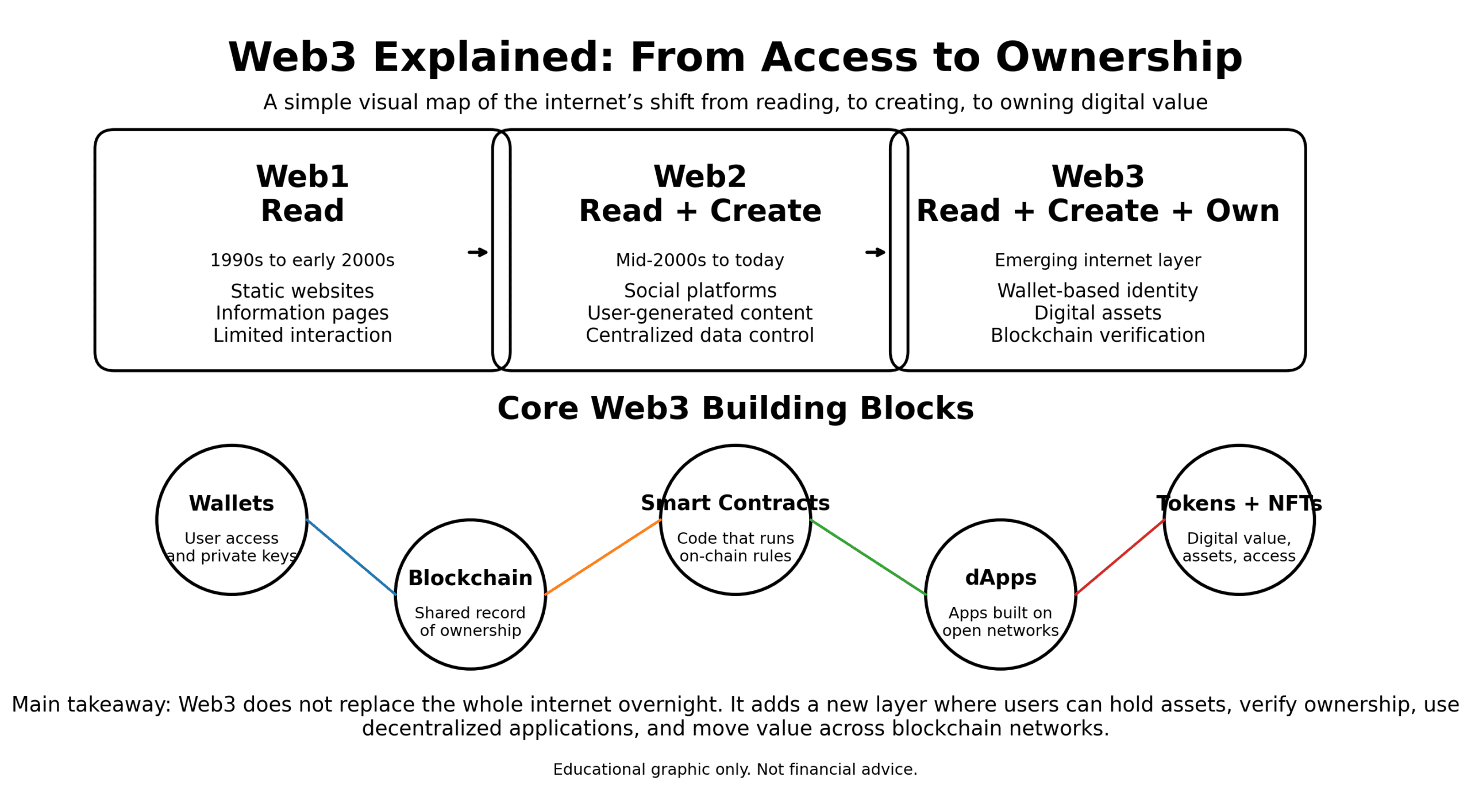
Web2 changed that. Social media, streaming, online shopping, mobile apps, cloud storage, and digital advertising turned the internet into a participation machine. Users could post, comment, sell, subscribe, and build audiences. The tradeoff was control. Platforms collected data, shaped discovery, and owned the main rails of online identity and payments.
What is web3 in this timeline? It is the attempt to add ownership to the internet’s next phase. Instead of logging in only with a username and password, users can connect with a wallet. Instead of trusting one company’s database, activity can be recorded on a blockchain. Instead of platform points that cannot leave an app, tokens and digital assets may move across networks.
The Core Promise of Web3: Ownership, Not Just Access
The strongest Web3 pitch is not speed or style. It is ownership. A wallet can hold crypto, NFTs, governance tokens, stablecoins, gaming items, and access credentials. That matters because the asset is not meant to live inside only one company’s server.
What is web3 really promising here? It is promising a web where users can prove ownership without asking permission from a platform every time. A musician could sell digital membership passes. A gamer could own an in-game asset. A borrower could access DeFi lending without a bank branch. A community could vote through a DAO.
The promise is powerful, but it also comes with responsibility. If a user loses a private key, there may be no help desk. If a smart contract has a bug, funds can be lost. Ownership cuts both ways.
How Blockchain Enables Web3 Applications
Blockchain is the shared record system behind most Web3 applications. It stores transactions on a public or permissioned ledger, verifies them through network rules, and allows applications to run using smart contracts. These smart contracts are pieces of code that execute when conditions are met.
What is web3 without blockchain? Mostly a slogan. Blockchain gives Web3 its backbone because it allows users to verify balances, transfers, ownership, and application logic without needing one central database. Public networks also allow developers to build on existing infrastructure, much like earlier internet developers built on open protocols.
By 2026, this infrastructure has become more practical. Stablecoins now represent a major part of blockchain activity, with market data showing total stablecoin supply above $322 billion. That gives Web3 a usable payment layer, especially in markets where dollar access, settlement speed, or cross-border transfers matter.
Key Web3 Concepts: Wallets, DAOs, dApps, NFTs, and DeFi
A wallet is the user’s gateway to Web3 as it stores private keys and allows the user to sign transactions. It does not literally store coins inside the app. Instead, it gives access to assets recorded on blockchains.
A dApp, or decentralized application, is software that uses smart contracts for part of its function. A DeFi app may allow trading, lending, borrowing, or yield strategies without a traditional bank. NFTs are unique blockchain tokens that can represent art, access passes, game items, loyalty rights, tickets, or real-world asset claims. DAOs are internet-native organizations where token holders or members may vote on treasury spending, upgrades, or community decisions.
What is web3 for beginners looking at these terms? It is an ecosystem of tools. The wallet is the key, the blockchain is the record, the dApp is the interface, and the token is often the economic unit.
The Biggest Web3 Projects Actually in Use in 2026
In 2026, the Web3 sector is less about abstract promises and more about active networks, payment flows, and applications that people actually use. Ethereum remains central because of its DeFi base, smart contract security, stablecoin settlement, and layer-2 networks. The Ethereum data hub tracks live ecosystem metrics across network activity, DeFi, stablecoins, tokenized assets, and layer-2 systems, showing how broad the network has become.
Tron remains important in stablecoin payments, especially for USDT transfers. Solana is widely used for low-cost transactions, consumer crypto apps, DeFi activity, and high-volume token trading. Base, Arbitrum, Optimism, and Polygon are key scaling networks because they make transactions cheaper and faster while connecting to larger liquidity pools. Chainlink continues to serve as a major oracle network, helping smart contracts use external data. In DeFi, protocols such as Uniswap and Aave remain important because users continue to trade, lend, and borrow on-chain.
What is web3 in this practical 2026 view? It is not one chain or one app. It is a stack of networks, wallets, exchanges, stablecoins, smart contracts, and data systems that are slowly becoming normal financial and digital infrastructure.
Web3 Criticism: Is It Decentralization Theater?
Web3 has a credibility problem, and serious readers should not ignore it. Many projects speak about decentralization while relying on centralized teams, hosted interfaces, venture-backed token allocations, or admin keys. Some communities vote, but real power may still sit with insiders. In other cases, users are told they own assets, but the app experience still depends on one website, one company, or one marketplace.
That is why critics call some of it decentralization theater. The phrase fits when a project uses Web3 branding without meaningful user control. What is web3 at its weakest? It is marketing dressed as infrastructure.
There are also security risks. Chain analysis research continues to show that crypto is used in both legitimate finance and criminal activity, which means users, companies, and regulators have to treat wallet safety, compliance, and transaction monitoring as serious issues.
AI + Web3: How the Two Technologies Are Converging
AI and Web3 are starting to overlap in useful ways. AI can help users read smart contracts, detect wallet risks, summarize DAO proposals, build trading dashboards, and automate on-chain actions. Web3 can help AI systems with payments, identity, data provenance, and ownership of digital outputs.
The strongest use case may be machine-to-machine payments. If AI agents need to buy data, access compute, pay for APIs, or settle tiny transactions, blockchain rails and stablecoins may give them a cleaner payment path. That does not mean every AI crypto token has value. Many will not. But the convergence is real because both technologies deal with coordination at scale.
What is web3 in an AI-heavy internet? It could become the ownership and settlement layer for autonomous software, digital identity, creator rights, and verified data.
Key Crypto Indicators Readers Should Understand
A proper Web3 education also needs basic crypto indicators. Price alone is not enough. Market capitalization shows the total value of a token’s supply, while fully diluted valuation estimates value if all tokens eventually enter circulation. Trading volume shows market activity, but it can be noisy. Liquidity is more important because thin liquidity can cause sharp price moves.
Total value locked, known as TVL, is often used in DeFi to estimate how much capital sits inside protocols. Active addresses can show network usage, although one person can control many addresses. Fees and revenue show whether people are paying to use a network or protocol. Stablecoin supply can signal payment demand, liquidity, and risk appetite. Developer activity matters because active builders often support long-term ecosystem growth.
What is web3 from an investor’s lens? It is not just a trend word. It is a market where usage, security, liquidity, token design, regulation, and real demand should be studied together.
How to Get Started in Web3: Your First Steps
A beginner should start slowly. The first step is learning how wallets work, including seed phrases, private keys, gas fees, and common scams. The second step is using a small amount of crypto on a reputable network to understand sending, receiving, and signing transactions. The third step is exploring stablecoins, DeFi, NFTs, and DAOs without rushing into risky tokens.
What is web3 for a first-time user? It is best treated like learning online banking in a new language. The tools are powerful, but one careless click can be expensive. Users should avoid unknown links, never share seed phrases, test small transactions first, and understand that high yields usually carry high risks.
Conclusion: Web3 Is Not Finished, But It Is Not Going Away
What is web3 at its core? It is the internet’s push toward digital ownership, programmable money, open applications, and user-controlled assets. The vision is still uneven. Some projects are useful, some are speculative, and some are little more than polished branding. Yet the underlying shift is hard to dismiss because stablecoins, DeFi, layer-2 networks, tokenized assets, and wallet-based identity are already part of the market’s working infrastructure.
The best way to understand Web3 is neither blind excitement nor automatic rejection. It is careful attention. The next internet chapter will likely be built in pieces, with regulation, AI, better wallets, stronger security, and real user demand deciding which parts survive.
Frequently Asked Questions
What is web3 and why does it matter?
What is web3 means an internet model built around user ownership, blockchain records, smart contracts, and digital assets. It matters because it gives people a way to hold and transfer value online without depending only on closed platforms.
Is Web3 the same as crypto?
Web3 and crypto are connected, but they are not exactly the same. Crypto usually refers to digital assets and blockchain networks, while Web3 refers to applications, identity, communities, and services built on those networks.
Is Web3 safe for beginners?
Web3 can be useful, but it is not risk-free. Beginners should start with wallet safety, small transactions, trusted applications, and basic scam awareness before using DeFi or buying tokens.
Are NFTs still part of Web3 in 2026?
Yes. NFTs are still part of Web3, but the market has moved beyond profile pictures. They can support gaming assets, memberships, tickets, loyalty systems, digital identity, and real-world asset records.
Can Web3 replace Web2?
Web3 is unlikely to replace Web2 completely in the near term. A more realistic outcome is a mixed internet where Web2 apps add wallets, tokens, digital identity, and blockchain payments where they make sense.
Glossary of Key Terms
Blockchain
A digital ledger that records transactions across a network and allows users to verify activity without relying on one central database.
Smart Contract
A blockchain-based program that runs when specific conditions are met, often used in DeFi, NFTs, DAOs, and dApps.
Wallet
A tool that lets users manage private keys, sign transactions, and access crypto assets recorded on a blockchain.
dApp
A decentralized application that uses smart contracts for part or all of its function.
DAO
A decentralized autonomous organization where members may vote on decisions, treasury use, or protocol changes.
NFT
A non-fungible token that represents a unique digital or real-world-linked asset.
DeFi
Decentralized finance, which includes blockchain-based trading, lending, borrowing, and yield services.
TVL
Total value locked, a metric used to estimate how much capital is deposited in DeFi protocols.
Stablecoin
A crypto asset designed to track the value of another asset, usually the US dollar.
Layer 2
A scaling network built to make blockchain transactions cheaper and faster while relying on a main chain for security or settlement.
Sources
Disclaimer:
This article is for educational and informational purposes only. It is not financial, investment, legal, or tax advice. Crypto assets are volatile and risky, and readers should do independent research before making any financial decision.