





This article was first published on The Bit Journal.
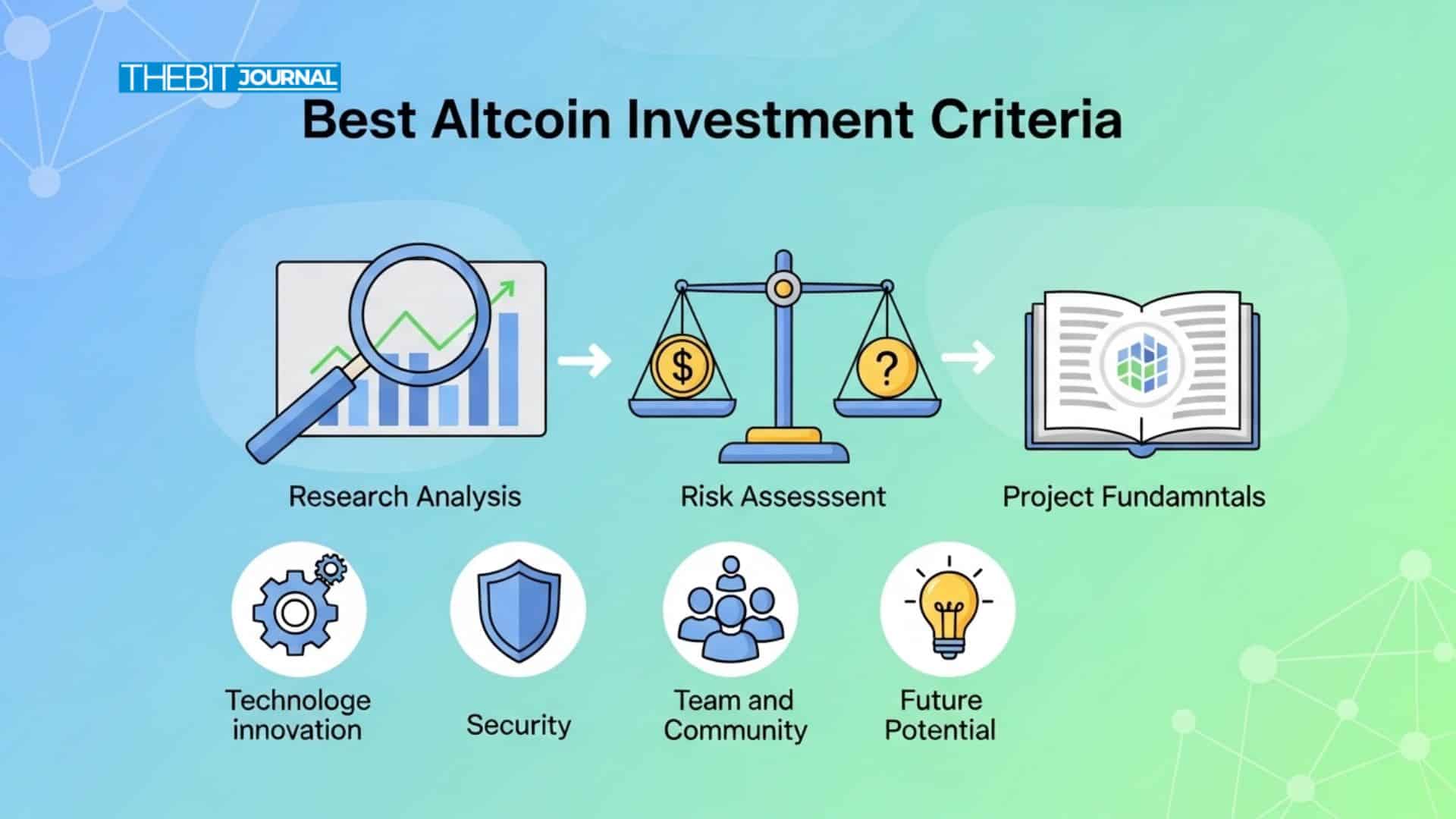
Investing in altcoins can offer big rewards but also big risks. With more than 18,000 altcoins currently in existence, it can be easy to fall for scams or get lost in the hype. This is why the best altcoin investment criteria are so important. This means doing a lot of due diligence on each project.
There are many altcoins with no fundamentally valuable features and lots of hype around them, so it is important for investors to dig into the technology, development team, use case and tokenomics before adding any tokens to their portfolio.
Why Rigorous Altcoin Criteria Matter
Altcoins can provide portfolio diversification beyond Bitcoin and Ethereum. Yet, the speculative nature of these markets means that prices swing wildly. Without a solid checklist, investors might chase trends or get caught in rug pulls and scams.
In fact, billions have been lost to non-transparent crypto projects that disappeared after fundraising. The antidote is due diligence, an organized evaluation of each coin’s fundamentals. This begins by asking questions like: what problem does this coin solve, who is behind it, and does its token economics make sense?
The closer a project is to actual utility and transparency, the better it can withstand market swings. In short, traders should only invest in an altcoin if it meets the best altcoin investment criteria so as to know if the coin has potential value long term.
Team and Execution Signals
The strength of a cryptocurrency is proportional to the wisdom and innovation of its creators and their team. Investors should thoroughly check out the founding team and developers. Research each leader’s background on LinkedIn and any past projects.
A good indication is a team that has some experience and reputation which they have built from past work in the blockchain space. Red flags include anonymous or “white-label” founders who have no proven track record, or leaders selling off their tokens early.
It is advised to check if the project is backed up by a highly-skilled and high-respected team with strong prior experience and strong credibility. One should also look for active developer updates and code commits: a team that keeps shipping code (even during downturns) is committed.
Investors need to judge technical depth and team execution over hype.
Check: Do the founders’ LinkedIn/GitHub profiles and track records inspire confidence? Is there evidence they’ve delivered on past projects?
Avoid: Projects with unknown teams or a history of failure, and projects where developers disappear after a token sale.
Token Utility: Real-World Use Case
A token must serve a clear purpose or solve a real problem. Ask, what is this altcoin even for? Use cases could range from smart contracts, DeFi lending, privacy, gaming or asset tokenization. Stay away from coins that are “just a payment token” with no unique function. It is important to focus on projects that are actively solving a real problem or adding meaningful innovation.
For instance, an altcoin for decentralized identity or real-world asset tokenization has tangible utility, whereas a coin that is merely copycat hype does not.
Check: Does any real service or product use the token today (e.g., payment fees, governance, staking)? Are people actually using it?
Avoid: General promises or things to come without proof of concept. Projects that rely on buzzwords (like “we use AI”) but have no products are very risky.
Tokenomics: Emissions, Unlocks, and Incentives
Tokenomics is the structure of the cryptocurrency: how many will there be, and how they are created, the inflation rate, and issuance schedule. It is good to understand how new tokens are born and who receives them. Important things to examine are:
Supply schedule: Is the token inflationary or deflationary? (A capped supply or mechanism for burning tokens can increase the value if demand goes up.)
Vesting/unlocks: When do the team and investor tokens unlock? Dumping can be induced by large unlock events.
Incentives: Are there incentives for holders (e.g. staking yield) or is the incentive to use the network (reward the validators)?
Transparent, conservative tokenomics are good. Tokens with deflationary aspects (like the burn procedures of Binance Coin, can create upward price pressure.
Conversely, one should be cautious if the majority of supply is locked with insiders or if annual inflation is extremely high. Opaque tokenomics are a warning as they can be an indicator of centralization risk, where a few wallets hoard most tokens.
Check: Are tokenomics clearly defined (often in a whitepaper or chart)? Is the model supportive of holding for the long run?
Avoid: Projects with Infinite minting or vague Distribution. A warning sign is when the team or VC control most of the supply, these insiders can dump on retail investors.
Distribution: Insider Concentration and Whale Risk
Tokenomics is tightly bound to token distribution. Check the top holders, if a few addresses control most of the coins, that’s risky. A small whale or insider could tank the price by selling. Look for public blockchain explorers or market analysis showing holder distribution. A project should have wide participation ideally through early public sales or fair launch. More even distribution of owners should help avoid sudden dumps.
Check: How much of the tokens was distributed to the team and advisers, or private investors? Are there vesting schedules for these parties?
Avoid: High concentration (e.g. more than 50%) in a few wallets, or no lockup for large holders.
Liquidity and Volume: Can You Enter and Exit Safely?
Great liquidity lets one buy or sell without causing the price to swing sharply. Check the trading volume and number of markets: is there a fair enough volume and a good number of reputable exchanges on which this coin is traded? A strong coin is consistent in volume on places like Binance, Coinbase, etc. Check that the coin has adequate liquidity, multiple trade pairs and listing on multiple credible exchanges. Low liquidity is a risk as investors may not be able to close their position or could suffer massive slippage.
Check: Is there significant 24-hour trading volume? Is the coin traded on bigger exchanges or only small ones/DEXes?
Avoid: Coins that are only listed on exchanged with little volume, or too low daily volume. If a coin is thinly traded, even a small sale can crash the market.
Revenue/Fees: Does the Protocol Generate Real Activity?
Real projects often have on-chain activity: transaction fees, protocol fees, service sales. For instance, decentralized exchanges collect fees on their trades, lending protocols collect interest and so forth. A project should have a business or utility model that, ideally, generates cashflow. Vet the revenue model of the project from the whitepaper or website. If a token’s value is speculative, it’s risky.
Check: What users or developers are paying for. Inspect the white paper/documents for a fee structure or token-burn for utility. Is there a product or service that people pay for (e.g., network usage, subscriptions)?
Avoid: A token that just exists for trading without any use. Avoid coins where the sole aim is to pump-and-dump trade.
Adoption Signals: Users, Transactions, and Retention
Growing use is one of the best signals of an active project. Check on-chain metrics and market stats: active addresses, daily transactions or total value locked (TVL). These naturally should be increasing, meaning people are using it.
One clear way is to examine if the project has shown strong growth in transaction volume, active users and trading volume. If the number of users is holding steady or increasing, that means demand, while flat or declining use is a cause for concern.
Check: On blockchain explorers or analytics (such as CoinMarketCap, Dune, or the project’s own dashboard) for trends around users and transactions. Is usage growing each month? What is the number of holders of the token?
Avoid: Metrics flatlining or trending downward. If the project has run out of daily transactions, it just might be that the project is dying.
Security Posture: Audits, Bug Bounties, and Admin Keys
Crypto remains a domain for hackers. One of the most important safety check is smart contract security. Make sure the project was audited by well-known companies, if possible with public audit reports. An unaudited or weakly audited protocol is a red flag. Also check if the project features a bug bounty program; offering rewards for discovering flaws is a sign of dedication to security.
Also, who has control keys? Some tokens have “admin keys” that give developers the authority to upgrade contracts or freeze transfers.
Admin keys could put the platform at risk if it falls into the wrong hands. In general, more decentralization is better: projects should employ multi-sig or community governance for important transactions.
Check: Was the smart contract subjected to an audit? Are audit reports public? Is there a bug bounty for the team?
Avoid: No audits, or hidden admin keys. If a single user can change the rules or create tokens out of thin air, it adds risk to a project.
Governance and Decentralization: Who Can Change What?
Closely related to security is governance structure. With a fully decentralized project, token holders can vote on upgrades and policy changes. Assuming those who make it keep control, one trust them not to act maliciously. Search for information on governance tokens, voting mechanisms or DAOs. Community-driven governance involving users in decision-making, promotes transparency and lowers the risk of centralized mistakes.
Check: Do they have governance tokens or on-chain voting? Can the protocol parameters like fee rates or issuance only change if approved by the community?
Avoid: Projects in which the team can alter the rules. Centralization of control even if the founders are noble, makes for one point of failure.
Ecosystem Strength: Integrations and Developer Activity
A good crypto project tends to have an ecosystem of applications or developers that surrounds it. Look for the number of integrations or partnerships. Is the token integrated into wallets, third-party apps, DeFi platforms? Also look at developer activity: many commits, contributors, or GitHub stars is a signal for momentum.
According to CoinShares research, the level of developer activity remains one of the most important checks for the health of a blockchain. In fact, a project that has lots of builders working from the get go can often outperform its peers.
Check: What are the active developers and commits in GitHub? How frequently does the code change? Also note industry reports: projects with increasing dev counts often show long-term promise.
Avoid: A deserted codebase. If there are no recent commits, or if it’s maintained by one person, it might get abandoned.
Competition and Differentiation
Even if everything else looks good, a crowded competitive space is another issue to consider. Ask how this project distinguish itself from competitors? Even in a crowded niche, there’s still need to have a clear differentiator.
For instance, two coins both doing decentralized storage, which one has better tech or adoption? A special feature, a patent, or a strong network effect can set a coin apart. If there are dozens of copycats that don’t do anything special, the upside for the token is limited. In summary, make sure the altcoin has a defensible niche or innovation.
Check: Who are the main rivals? What is the difference between this and other projects out there (lower fees, new protocol, partnerships)?
Avoid: Copycat projects of bigger coins with nothing new. In a competitive race, only the brand new or the best solutions survive.
Community: Signal vs Noise
A lively, engaged community is itself a powerful asset. Look at social media channels like X, Discord, and Telegram. Is the project being talked about in a constructive way and do the discussions generate productive conversation? Are Moderators active? Real projects have contributors who discuss ideas, share code, and receive feedback.
Always interact with community channels to catch warning signs. Community sentiment can reveal red flags: if moderators shut down criticism or if Twitter is filled with bot-like shills, that’s a caution sign.
Check: Numbers of followers are one thing, but also check engagement: active chatrooms, developer Q&As, frequent updates.
Avoid: Communities that solely hype prices or censor dissent. If the social media presence is more noise than actual conversation, proceed with caution.
Regulatory and Compliance Risk (Sector-Dependent)
Cryptocurrencies face evolving regulations worldwide, so ensure the altcoin’s legal standing is clear. For instance, other stablecoins and DeFi platforms as well as privacy coins have come under scrutiny. New rules in 2026 like those of the EU’s MiCA, GENIUS Act and CLARITY Act will bring many projects under compliance and transparency requirements.
In the U.S., the SEC continues to determine what it means by a security. Investors should check if there have been any regulators who’ve gone after the project, or projects like that. A notable case is XRP.
Check: Is the token designed to bypass securities laws? Is the team getting legal opinions or compliance checks? Are there active regulatory actions against it?
Avoid: Projects that defy explicit regulations or are involved with active lawsuits. If it is determined to be an illegal token, or classified as an unregistered investment contract, the value of such a cryptocurrency may drop extremely, get delisted or become worthless.
Final Decision Checklist
Having considered all of the above, investors can use the following checklist to assist in pulling that final call.
| Criterion | Good Sign (Indicator) | Red Flag (Warning Sign) |
| Team & Execution | Experienced, transparent founders with track records | Anonymous/team with failed history; lack of communication. |
| Token Utility | Solves a real problem; active use-case (payments, DeFi, NFTs, etc.) | No clear use-case; merely speculative without a product. |
| Tokenomics & Supply | Capped supply or controlled inflation; deflationary mechanics | High inflation, no burn; unclear issuance schedule. |
| Distribution | Wide holder base; locked/vested team tokens | Huge insider/whale holdings; no vesting (high dump risk). |
| Liquidity & Volume | High trading volume; listed on major exchanges | Low volume; only on obscure exchanges or one trading pair. |
| Revenue & Fees | Real fees or revenue streams from protocol usage | No business model; relies only on speculative buying. |
| Adoption (Usage) | Growing active users/transactions | Stagnant or declining user base and transaction counts. |
| Security (Audits) | Third-party audits done; bug bounty program | No audits; undisclosed code; single key control over functions. |
| Governance | Decentralized decision-making (DAO or token-vote) | Centralized control by founders; arbitrary protocol changes. |
| Ecosystem/Dev Activity | Frequent code commits; active developer community | Little development; few developers; no partner integrations. |
| Competition | Clear advantage or unique niche | Overcrowded space with many similar projects. |
| Community | Engaged, technical community on Discord/Twitter | Hype-only community; more memes than technical discussion. |
| Regulatory | Compliant structure; legal clarity (e.g. following new rules) | Facing lawsuits or regulators’ negative attention. |
Armed with this table, and analysis above, investors now have an organized way of checking for any altcoin. Always weigh the factors, a weakness in one area may be balanced out by strength in another, but not if there are glaring red flags.
Conclusion
Considering the best altcoin investment should not be on hype but on fundamentals. In 2026, the crypto market now values real utility, transparent tokenomics, solid teams and active communities.
Investors should verify that any altcoin they are eyeing ticks important boxes like demonstrated use cases, reasonable supply, decent liquidity, audited security and adherence to impending regulations.
If Investors can adhere to these best altcoin investment criteria; from assessing the founding team, and checking in on governance, to competition, they will be able to make a well-informed, risk-aware decision before purchasing any altcoin.
Glossary
Altcoin: A general term for any cryptocurrency that is not Bitcoin.
Token Utility: How a crypto or token is being used (fee payment, staking, governance). Tokens that have real usage inside a network tend to have value.
Tokenomics: The economics of a crypto token, which includes total supply, distribution model (inflation/deflation), and token release schedule.
Liquidity: The relative ease with which a token might be purchased or sold without moving its price.
Decentralization: a system is decentralized when no single party has complete authority.
Rug Pull: A scam in which developers abandon a project and make off with investors’ money, usually by selling their tokens unexpectedly.
Audit: A security inspection of the code in a smart contract by an independent firm.
Governance Token: cryptocurrency that gives holders voting rights over changes to a protocol or project, enabling decentralized decision-making.
Frequently Asked Questions About Best Altcoin Investment Criteria
What is an altcoin?
An altcoin is any cryptocurrency that isn’t Bitcoin. like an Ethereum, Cardano, or Litecoin.
Why is it important that the founding team be strong in crypto?
The team’s track record and reputation shows what they are capable of executing. Failure or fraud is more likely if the team is unknown or has unsuccessful previous projects.
What does “tokenomics” mean?
Tokenomics describes how the economics of a token operate: its supply, distribution rate, inflation rate and incentives. Good tokenomics consist of a predictable supply and rewarding users for participation; bad tokenomics can cause hyperinflation or see wealthy insiders dumping tokens.
How much does liquidity matter in an altcoin?
Very important. High liquidity allows for entering/exiting positions without slippage. Low liquidity can trap investors or cause big price swings if one large order hits the market.
What is the purpose of security audits for altcoins?
Audits by trusted companies can review the code for weaknesses. They are a safety net too important to lose. A contract with publicly released audit reports (and bug bounties) is infinitely more reliable than unaudited code.
References
Investopedia
Ainvest
Financial Express
Telcoin Support
CoinShares
Hashlock