






Updated on 25th October, 2025
This article was first published on The Bit Journal.
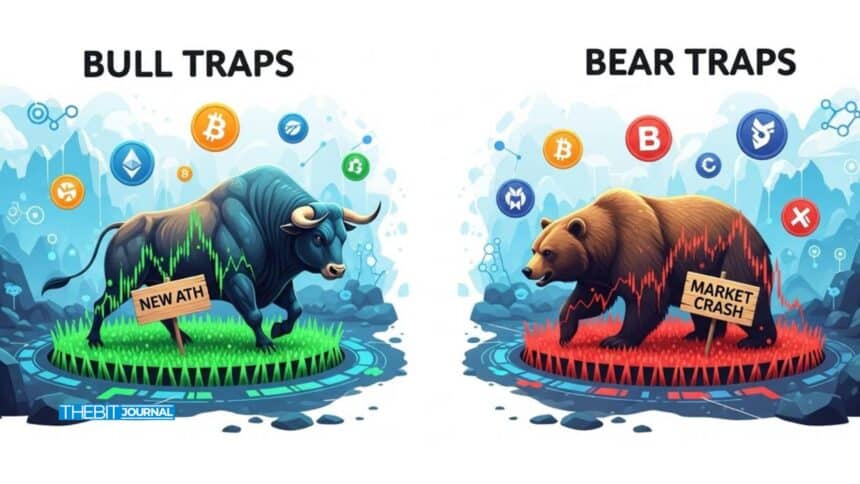
Bull and bear traps in crypto are deceptive price patterns that can catch traders in volatile markets. These traps lure traders into false breakouts or breakdowns, causing big losses.
In crypto with thin liquidity and high volatility; spotting bull and bear traps early is essential to protecting one’s capital.

A bull trap is a fake breakout above resistance that reverses sharply down. A bear trap is the opposite; a fake breakdown below support that snaps back up.
Why Do Bull and Bear Traps in Crypto Happen?
Market psychology and manipulation are the main culprits. Whales or institutions can move crypto prices with big orders that create fake trends. Sudden news or events can also trigger temporary moves that look like real breakouts. Fear and greed play big roles. FOMO can get traders to buy into a fake rally, while panic can get them to sell into a fake dip.
The crypto market’s 24/7 nature and often-low liquidity amplify traps. For example, an altcoin with a small market cap can drop on one big sell order (a bear trap) or spike on a big buy (a bull trap).
Traders have noted that these engineered moves often serve to calm the bears or rack up stop losses. In other words, what looks like a new trend may be an attempt by insiders to feed on retail traders’ emotions.
Cryptos often swing 10-20% in a day and big players known as whales sometimes exploit this. Whales can push price above a key resistance, in other words, create a bull trap and then dump their holdings, forcing price down.
Conversely, whales can engineer a quick sell-off below support (a bear trap) to trigger panic selling, then buy the dip as price bounces back.
These maneuvers capture stop-loss liquidity and prey on FOMO (fear of missing out) or panic. Real crypto market examples show this. In June 2023, Solana (SOL) dropped 42% before a sudden rally caught shorts off-guard.
Likewise, Bitcoin had a false breakout in April 2021; briefly topped $54K then dropped 17%, trapping late buyers.
How to Spot Bull and Bear Traps in Crypto
These bull and bear traps in crypto can be spotted by watching technicals and context. Key signs include:
False Breakouts/Breakdowns: If price pops above resistance and then quickly drops, it’s a bull trap; if it drops below support and then bounces; it’s a bear trap. These fake moves often don’t hold.
Volume Divergence: Real breakouts have big volume. A breakout on low volume is to be suspected.
Indicator Divergence: Check RSI or MACD. If price makes a new high but RSI is flat or falling, that could be a bearish divergence and a bull trap. If RSI is oversold on a fake breakdown, it’s a bear trap.
No Retest: Real breakouts retest the broken level as new support or resistance on breakdowns. If price breaks a level and never comes back, it is important to be cautious. No retest can mean the breakout isn’t real.
Whale/On-Chain Signals: Watch on-chain data and large transfers. Unusual crypto inflows or outflows to exchanges may precede traps. For example, a large withdrawal or whale accumulation before price dips can be a bull trap, while a massive exchange inflow before a bounce can be a bear trap.
Advanced traders also use indicators like VWAP, On-Balance Volume (OBV) and on-chain analytics to confirm moves. If price goes far above the volume-weighted average price (VWAP), it may be an overbought move (bull trap).
How to Avoid Bull and Bear Traps in Crypto
Trade with Confirmation: Don’t act on a breakout immediately. Wait for the price to hold above resistance or below support and ideally retest the level as new support/resistance before entering.
Smart Stop-Losses: Place stop orders outside obvious trap zones. For example; set a stop just beyond a second support level rather than right at the first breakdown to avoid stop hunts.
Multiple Indicators: Don’t rely on one signal. Cross-check breakouts with volume; RSI/MACD, VWAP and on-chain data. Only go with moves that line up across several analyses.
Risk and Emotions: Trade smaller positions or go 50% size when in doubt. Avoid chasing breakouts driven by hype (FOMO) or panic. Use conservative leverage; since traps can trigger liquidations.
Stay Informed: Monitor crypto news and social media. If a price move lacks solid news or follows hype cycles; be cautious. Sometimes pausing trading for a bit after big news and watching how price behaves can prevent falling for a trap.
Learn from Experience: Keep a trading journal of setups. Reviewing past bull and bear traps in crypto helps train recognition skills and discipline when these patterns reappear in the market.
| Signal/Indicator | Bull Trap | Bear Trap |
| Price Action | Spike above resistance then quickly fall | Drop below support then rapidly bounce up |
| Volume | Breakout on low volume (weak rally) | Breakdown on low selling volume |
| RSI/Indicators | Overbought reading, bearish RSI divergence | Oversold reading, bullish RSI divergence |
| Trader Psychology | FOMO-driven buying at highs | Panic-driven selling at lows |
| Crypto Example | Altcoin hype peak followed by crash | Sharp crypto dip that’s swiftly bought back |
Expert Insights on Bull and Bear Traps in Crypto
Market analysts emphasize vigilance and context. A crypto strategist had previously said there could be a 2024-style bear trap in Bitcoin, when local highs aren’t broken, market makers might be setting shorts up for a squeeze.
His analysis had suggested traders should be skeptical of quick dips without fundamentals, as price can calm the bears with a sudden bounce.
Other experts also agree. Traders say bull/bear traps are all about herd behavior. Whales sometimes pump or dump prices to lure retail traders into buying at highs or selling at lows.
Experts advise waiting for confirmations such as a retest or multiple green indicators; before assuming a breakout is real.
Crypto trader Tokoni Uti suggests combining chart analysis with sentiment and on-chain data; since crypto can move on rumors. If a price move has no support, be it volume or on-chain activity, then it most likely a trap.
Conclusion
Bull and bear traps in crypto require caution from traders. By knowing what these traps look like and using multiple confirmation signals; investors can avoid being fooled by false breakouts or breakdowns.
Vigilance; strong risk management like stop-losses and small position sizes, and waiting for confirmation are really needed to surviving these unpredictable crypto moves. Remember; no strategy is foolproof; always be prepared to cut losses if a trap is suspected.
Glossary
Bull Trap: A deceptive breakout to the upside that reverses swiftly; catching the late buyers at the peak.
Bear Trap: A deceptive move downwards below support that reverses fast; catching the late sellers at the dip.
FOMO: “Fear Of Missing Out”; hype-induced buying; very frequent in bull traps, buyers are quite aggressive.
Liquidity: The degree of ease in buying/selling an asset.
Whales: The big players in the crypto market whose huge trades can influence the market direction.
Frequently Asked Questions About Bull and Bear Traps in Crypto
What is a bull trap in crypto?
A bull trap in crypto is when the price breaks above a resistance level; it looks like an uptrend but then reverses hard down; trapping traders who bought into the breakout.
What is a bear trap in crypto?
A bear trap in crypto is when the price breaks below a support level; it looks like a downtrend; then reverses up, trapping traders who sold or shorted expecting more down.
How do traders know if a breakout is a bull trap?
Look for low volume and no momentum. If price breaks resistance but on low volume, or if indicators like RSI don’t confirm the move, be suspicious. A quick reversal back below the breakout point is a bull trap.
How do whales create traps in crypto?
Whales create traps by placing big buy/sell orders. In a bull trap, they buy heavy to push price above resistance to lure buyers; then sell off, and price collapses. In a bear trap, they sell to push price below support to lure sellers; then buy back on the bounce.
Can news events cause bull and bear traps?
Yes. Sudden news or announcements often trigger quick; temporary moves. Traders may jump in on a headline-driven breakout; which then fizzes. It is important to wait and see if the move is supported by volume and price action before acting.