






Every few years, the same headline gets dusted off like an old joke: crypto is finished. It usually shows up after a brutal drawdown, a round of layoffs, or a fresh regulatory squeeze, and it always sounds confident.
The problem is that the market does not behave like a single product that either succeeds or fails. It behaves more like electricity in the early 1900s, awkward at first, mocked often, and then quietly woven into everything people do until nobody even calls it “new” anymore.
A recent opinion essay made that exact argument, not by claiming that speculation is healthy or that every token deserves attention, but by pointing to something more concrete: the plumbing is getting installed. Exchange-traded products, bank-led token rails, and corporate-grade payment tooling are pushing crypto deeper into the financial stack, even as the cultural narrative swings between hype and fatigue.
That shift matters for anyone watching the crypto market outlook because it reframes what “adoption” looks like. It is less about new memes each week and more about whether money can move faster, cheaper, and more reliably across borders, platforms, and institutions.
Crypto Market Outlook: What the Live Market Tape Says Today
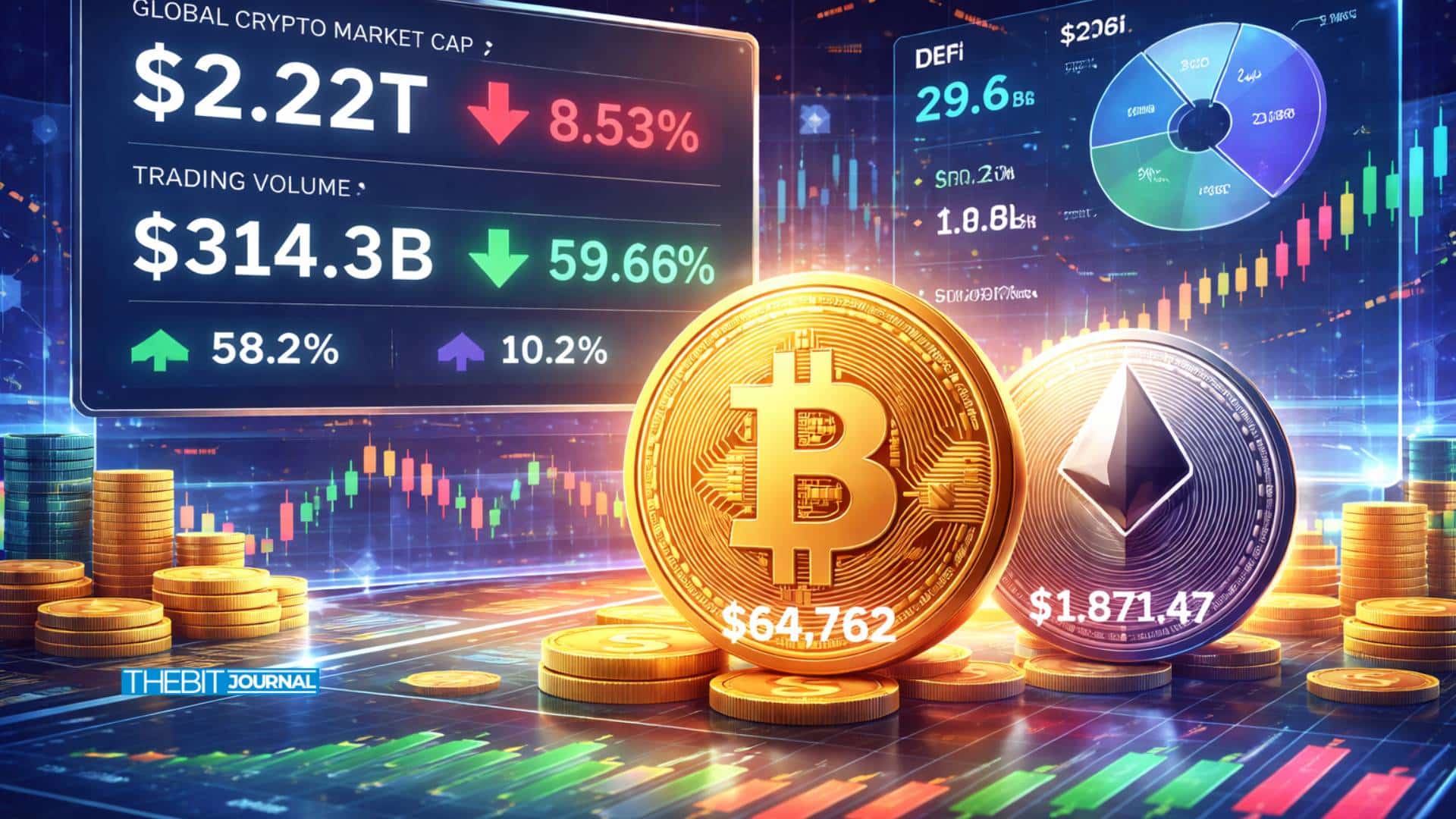
Market structure is telling its own story right now, and it is not subtle as the global crypto market cap sits at $2.22T, down 8.53% over the last day, while total market volume over the last 24 hours is $314.33B, up 59.65%.
That volume spike is even more revealing when it is broken down. DeFi volume is $29.63B, or 9.43% of total 24-hour volume, while stablecoin volume is $308.82B, or 98.25% of total 24-hour volume. That is not a side plot. That is the market admitting, in numbers, that stablecoins are the bloodstream of liquidity even when risk assets are bleeding.
Bitcoin dominance is 58.24%, down 0.37% on the day, and ETH dominance is shown around 10.2%. Dominance shifts matter because they reveal where capital is hiding and where it is willing to take risk. When Bitcoin holds a majority share, it often signals a market that is still cautious, even if traders are active.
The price board adds more context. Bitcoin is listed around $64,762.36 with a market cap of nearly $1.29 T, while Ethereum is around $1,871.47 with a market cap near $225.86B. Those numbers can move quickly, but the broader pattern is steady: Bitcoin remains the primary liquidity hub, while Ethereum continues to anchor the smart contract economy.
Crypto Is Not “Winning” by Staying Pure, It Is Winning by Becoming Infrastructure
The strongest version of the “crypto is dead” argument is not that blockchains stopped working. It is that the original dream gets diluted when large incumbents adopt the rails while keeping their own controls and tolls. The essay pushes back on that binary thinking, arguing that progress in finance is usually incremental, and incremental changes compound.
The numbers cited in the piece are not subtle. A major U.S. spot Bitcoin ETF product has been large enough to sit in the top tier of ETFs by assets at points in the cycle, showing that traditional wrappers can pull new demand into the same underlying asset exposure. Meanwhile, J.P. Morgan’s Kinexys has publicly described more than $1.5T in notional value processed since inception, with an average daily volume above $2B, which is the kind of scale that stops sounding like a pilot and starts sounding like operations.
This is where the crypto market outlook gets practical. When institutions allocate through regulated vehicles and banks run token-based settlement rails, the center of gravity shifts toward reliability, compliance, and predictable liquidity, which changes what assets get rewarded.
Why stablecoin payments Are Moving From Hype to Habit
The most important point in the essay is that the biggest real-world usage is not always Bitcoin or NFTs. It is stablecoins, because they act like digital dollars that can move over public networks without waiting for bank hours, correspondent chains, or card settlement cycles.
In 2025, total stablecoin transaction volumes reached $33T, according to data compiled by Artemis Analytics, a figure that puts stablecoins in the same conversation as the world’s largest payment networks by annual volume. For comparison, Visa reported $16T in total payments and cash volume in fiscal 2024, which is massive, but it also highlights why payments incumbents pay attention when a new rail grows quickly.
That is why stablecoin payments are increasingly framed as an economic story, not just a crypto story. When settlement becomes faster and fees compress, business models change at the edges first. Microtransactions start making sense. Cross-border treasury moves stop feeling like paperwork marathons. Freelancers get paid without losing a chunk to friction. The consumer might never care what chain was used, but the merchant and the platform definitely care about cost, chargebacks, and speed.
It also explains why firms with merchant distribution are building for stablecoin payments in a way that looks boring on the surface and powerful underneath. Stripe has rolled out stablecoin payment products for businesses, and PayPal has promoted PYUSD utility, including a 3.7% annual rewards program to encourage balances.

Two Signals That the Next Cycle Is About Rails, Not Just Risk
When analysts talk about the crypto market outlook, they often default to price charts, and those do matter, but the deeper signals come from market structure.
One signal is liquidity quality: In a healthy market, liquidity is broad, spreads tighten, and large orders do not move price much. In a fragile market, price whips around on thin books, funding rates flip quickly, and liquidations do more work than conviction. That is why indicators like perpetual futures funding, spot-to-derivatives volume mix, and ETF flows can be more revealing than a single candle on a chart.
The second signal is stablecoin supply and velocity: When stablecoin circulation expands and on-chain settlement volume rises, it usually indicates demand for digital dollars, whether for trading, cross-border payments, or treasury operations. Reporting around USDT and USDC market sizes has continued to track this expansion in recent months, reinforcing how central stablecoins have become to onchain activity.
Put together, those signals support a calmer read of the crypto market outlook: speculation still drives headlines, but infrastructure adoption drives staying power.
The New Corporate Blockchains, and the Fight Over “Neutral” Money
The essay also claims the next phase includes payment-native blockchains built around commerce workflows like refunds, disputes, and compliance. That idea is no longer theoretical. Reporting and company commentary have pointed to efforts such as Circle’s Arc and Stripe’s Tempo as payments-oriented networks designed to make stablecoins feel like a native financial primitive rather than a bolt-on token.
Here is the part that matters for the crypto market outlook: commerce wants neutrality, or at least predictable rules. Developers want composability and shared standards. Regulators want accountable intermediaries. If private payment chains become too controlled, the market will gravitate toward environments that balance enforcement with openness, because businesses do not want their settlement layer to become a single point of corporate censorship. That is why the essay argues that even if payment-focused chains start as standalone networks, they may still converge with broader ecosystems over time.
Emerging Markets Are Not Waiting for Perfect Infrastructure
The opinion piece makes a bold claim about stablecoins in Mexico and across Latin America, framing them as infrastructure rather than a niche tool. Independent context supports the broader direction, even if exact splits are hard to verify across every corridor.
Mexico’s overall remittance scale is enormous, with 2024 remittances reported at $64.7B, which helps explain why any efficiency gain in that channel attracts attention. Meanwhile, industry reporting and regional payment commentary continue to describe stablecoins as a meaningful part of cross-border flows and business settlement in Latin America.
For the crypto market outlook, this matters because it is adoption driven by necessity, not novelty. In places where banking access is expensive, slow, or unpredictable, a dollar-pegged token that settles quickly can feel less like “crypto” and more like survival-grade finance.
Conclusion
The “crypto is dead” narrative survives because it is emotionally satisfying after a crash, and because the industry has earned skepticism through excess. But the more useful view is that crypto as a subculture can cool off while crypto as infrastructure keeps spreading. Stablecoins, tokenized settlement rails, and regulated access points are not a victory lap for the original ethos, yet they are evidence that the technology is becoming part of how money moves.
In that sense, the crypto market outlook looks less like a single boom-bust story and more like an integration story. The loudest debates will still be about price, but the lasting change will be about rails, and rails do not need hype to keep working.
Frequently Asked Questions (FAQs)
What does “crypto becoming invisible” mean?
It means users may not notice blockchains at all, because wallets and apps hide complexity while still using token rails for settlement.
Why are stablecoins seen as more “real” than many tokens?
Because stablecoins map to everyday money needs like payments, savings, and transfers, while many tokens mainly map to speculation.
Do ETFs change crypto adoption, or just packaging?
They mostly change access, because they allow traditional investors to gain exposure through familiar brokerage rails.
Are payment-focused blockchains replacing Ethereum?
Not necessarily. Some are designed for commerce, but broader ecosystems still offer liquidity, composability, and network effects that are hard to replicate.
Glossary of Key Terms
Crypto market outlook: A forward-looking view of market conditions based on liquidity, regulation, adoption, and risk appetite, not just price.
Stablecoin: A token designed to track a stable value, usually a fiat currency like the U.S. dollar.
Onchain settlement: Final transfer recorded on a blockchain, where balances update without relying on bank ledgers.
ETF: An exchange-traded fund that trades like a stock and can hold assets directly or track them through regulated structures.
Funding rate: A periodic payment in perpetual futures markets that shows whether traders are leaning long or short.
Liquidity: The ability to buy or sell without moving price too much, usually measured through spreads and market depth.
Composability: The ability for apps and protocols to connect like building blocks, which increases network effects over time.
Credible neutrality: The idea that a settlement network should enforce rules consistently and resist arbitrary exclusion, which matters for large-scale commerce.
Sources