



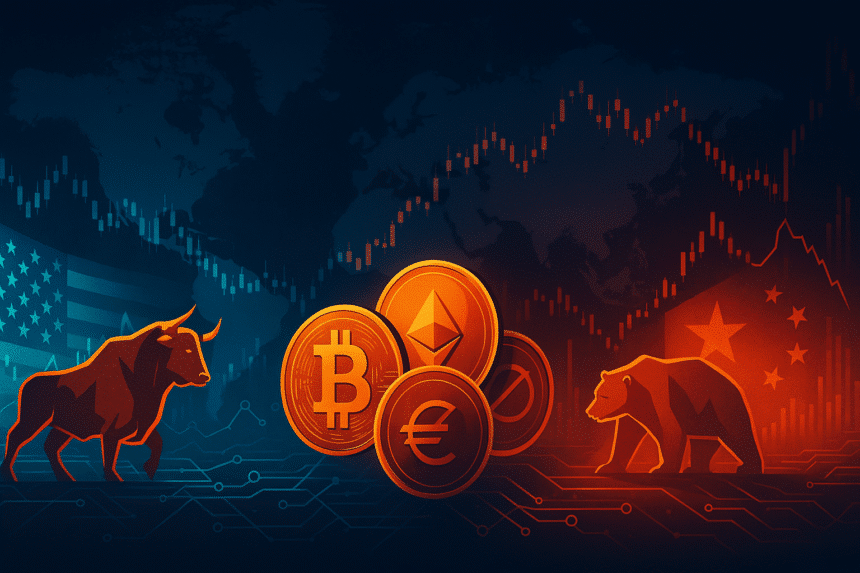

The cryptocurrency market has always been sensitive to politics, but what happened this week was beyond what most traders expected.
The world crypto market experienced one of the largest crashes ever after U.S. President Donald Trump declared a 100 percent tariff on all imported goods of Chinese origin. In one day nearly 19 billion dollars had been wiped off. This huge occurrence not only appalled investors but also posed a larger question. What are the actual impacts of geopolitical sanctions and trade policies on the use of cryptocurrencies?
This article aims to know how a digital currency such as Bitcoin, Ethereum, and Solana can be shaking due to government decisions such as sanctions or tariffs. We are also going to examine the way individuals in approved areas utilise crypto in various ways; some to live, others to gamble.
What Are Geopolitical Sanctions?
Geopolitical sanctions refer to rules or punishments that a given nation imposes on another. These sanctions are usually used to penalize governments or companies based on such acts as war, human rights or unfair trade actions. These may be monetary bans, trade restrictions, travel restrictions or even a freeze of assets.
Such sanctions usually prevent a country to access the international banking system, particularly, SWIFT, the international system of payments. When this occurs, international trade, banking and investment is lost by countries or businesses.
How Cryptocurrencies Fit Into This Picture
Politics did not prepare cryptocurrency, and it tends to be part of it.
Cryptocurrency is not reliant on financial institutions or governments since it is based on decentralized networks. Individuals are able to transfer funds internationally without intermediaries. This is why it is that in the sanction periods or political pressure, crypto is instantly a hot spot again.
To citizens of repressed nations such as Iran or Russia, crypto has been their savior.
They pay the imports with Bitcoin or stablecoins, receive money to do remote work, or use it to save their funds in case their domestic currency is weakening.
Nonetheless, it is not necessarily the straight and narrow way. Governments are also able to monitor transactions, freeze exchange accounts or block-internet access to slow down things.
A Look Back: Sanctions and Crypto Before 2025
Crypto has reacted to sanctions many times before this.
| Year | Country | Type of Sanction | Crypto Response |
| 2018 | Iran | Banking and oil restrictions | Bitcoin mining boom and P2P trading growth |
| 2020 | Venezuela | Financial isolation | Petro launch and rise of local BTC trading |
| 2022 | Russia | Full-scale economic sanctions | Surge in ruble to USDT conversions |
| 2023 | North Korea | Technology export bans | Reported increase in crypto hacking and laundering |
| 2024 | Afghanistan | Frozen central bank assets | Locals used USDT for remittances |
Each of these moments shows how people turn to decentralized systems when traditional banking is blocked.
But 2025 has shown something even more interesting — how sanctions can now hit crypto itself by shaking market confidence worldwide.
Trump’s Tariffs and the 2025 Crypto Market Crash
On October 11, 2025, President Trump announced a 100 percent tariff on all imports from China. He said it was a response to China’s aggressive trade stance and restrictions on rare earth exports. That single tweet from his Truth Social account was enough to create chaos across markets.
Within hours, Wall Street fell by more than 1.5 trillion dollars, and the crypto market followed. According to CoinGlass, nearly 19 billion dollars in leveraged positions were liquidated.
Bitcoin dropped almost 10 percent, Ethereum lost 14 percent, and Solana crashed close to 20 percent.
This became the largest liquidation event in crypto history. What’s important here is not just the numbers but the message, politics and global sanctions now have a direct, powerful link to crypto behavior.
Why Sanctions and Tariffs Affect Crypto So Much
It might seem strange that a trade war between two nations can shake Bitcoin.
But crypto markets are global and highly connected to investor psychology. When traders fear global conflict, they sell risky assets first — and crypto is still seen as one of the riskiest ones.
Also, liquidity in crypto markets often depends on big trading desks, hedge funds, and exchanges that are linked to traditional finance.
When sanctions or tariffs hit imports, exports, or currencies, liquidity drops. That means fewer people buying, fewer holding, and more panic selling.
Finally, crypto is used globally, so any trade restrictions can slow the flow of capital between countries. A U.S.–China trade freeze impacts miners, blockchain developers, and even hardware exports.
Immediate Impact of Trump’s 2025 Tariffs on Crypto Market
| Asset | Price Before Tariffs | Lowest Price After | 5-Day Change | Notes |
| Bitcoin (BTC) | $123,000 | $103,000 | -10% | Largest single-day dip since 2022 |
| Ethereum (ETH) | $4,320 | $3,742 | -14% | Trading volume doubled |
| Solana (SOL) | $225 | $178 | -20% | Heavy leveraged liquidations |
| Binance Coin (BNB) | $680 | $635 | -6.6% | Lesser but steady decline |
| XRP | $0.78 | $0.61 | -22% | Biggest altcoin loser |
The table shows that even without direct sanctions on crypto, political shocks can still wipe billions from the market in hours.
How Sanctions Change the Way People Use Crypto
Sanctions don’t just affect prices. They change behavior. When sanctions are placed on a country or trade partner, both ordinary people and companies start looking for alternative payment methods.
Here’s what usually happens:
- People move money into stablecoins like USDT or USDC to protect value.
- Businesses start using peer-to-peer (P2P) platforms instead of centralized exchanges.
- Some shift to privacy-focused coins like Monero or Zcash.
- Developers work on local exchanges or decentralized apps that can’t be blocked.
So, while sanctions try to limit financial power, crypto often becomes a tool for financial freedom, though not without big risks.
How People React to Sanctions Using Crypto
| Reaction | Common Platform | Reason |
| Use of stablecoins | Binance, OKX, P2P apps | To avoid currency collapse |
| P2P trading | LocalBitcoins, Telegram groups | No need for banks |
| Privacy coins | Monero, Zcash | Hide identity or transaction trail |
| Decentralized exchanges | Uniswap, PancakeSwap | Avoid KYC restrictions |
Governments’ Response: Tracking and Control
Governments don’t ignore this behavior. In fact, since 2022, most large exchanges have added KYC (Know Your Customer) systems and stricter compliance checks. Some crypto wallets and exchanges have even blocked IP addresses from sanctioned countries.
The U.S. Treasury’s OFAC list now includes hundreds of crypto addresses linked to sanctioned individuals or groups. Thus, blockchain makes it free, but it also offers transparency, and regulators can use it to monitor the transactions. This tug-of-war has not ended yet, between freedom and control, decentralization and regulation.
When Sanctions Affect Crypto Supply Chains
There is one more hidden angle. Mining gear and equipment are also subject to tariffs and sanctions. Majority of crypto mining chips and GPUs are made either in China, Taiwan or South Korea. In case trade restrictions are tightened, the price of mining increases.
Some mining companies based in the United States reported delays in receiving equipment parts in 2025 following a threat to impose tariffs by Trump. This restrains the mining capacity of Bitcoin, raises the cost and indirectly impacts on network security and the speed of the transaction.
| Area | Resource Affected | Impact on Crypto |
| Mining hardware | ASICs, GPUs | Reduced efficiency, slower hash rate |
| Software licensing | AI chips, firmware | Costly imports, updates delayed |
| Cross-border cloud hosting | Servers, maintenance | Slower DeFi operations |
| Semiconductor trade limits | Chips | Shortage in crypto hardware |
How the Current Crash Might Change Regulations
The October 2025 crash could lead to a new wave of crypto regulation. Since billions were wiped out in hours, governments might call for more stability controls. This could mean new laws for margin trading, new capital requirements for exchanges, or even bans on over-leveraged futures.
But the crash also reminded people why decentralization exists in the first place. Many traders moved their assets from centralized exchanges to personal wallets soon after.
This moment could push crypto toward a more mature stage, where users care about safety, not just profit.
Long-Term Takeaway: Politics and Crypto Can’t Be Separated Anymore
Five years ago, most people thought crypto lived outside traditional politics. That idea doesn’t fit anymore.
The 2025 tariff shock proved that trade wars, sanctions, and government announcements have the power to make or break the crypto market. It also proved that people still see crypto as both a risk and a refuge.
For now, the best view is this: crypto will continue to rise and fall with the waves of global politics.
FAQs
Why do sanctions affect cryptocurrency markets?
Because sanctions disrupt trade, banks, and investor confidence. Crypto reacts when money flow between countries becomes limited.
Did Trump’s China tariffs really cause the crypto crash?
Yes. His 100 percent tariff announcement triggered panic selling and over 19 billion dollars in liquidations, according to CoinGlass.
How do people use crypto under sanctions?
They use stablecoins, peer-to-peer trades, and decentralized exchanges to move or save money when their national currency weakens.
Can governments block crypto?
They can restrict access to exchanges and wallets, but they can’t fully stop blockchain transactions.
What happens next after this crash?
Markets may slowly recover, but the event will likely push for tighter crypto regulation and more talk about trade-linked financial risks.
Glossary
Sanction: A punishment or restriction placed by one country on another for political or economic reasons.
Tariff: A tax on imports or exports between countries.
Stablecoin: A type of cryptocurrency tied to a fixed asset like the U.S. dollar.
DeFi (Decentralized Finance): Financial apps built on blockchains that allow users to trade, lend, or borrow without banks.
KYC: Know Your Customer, a process used to verify user identities on exchanges.
Summary
The crash of the crypto market in 2025 when President Trump decided to impose 100% tariffs on Chinese imports was the revelation of the extent to which geopolitical sanctions have entered the world of cryptocurrencies. In hours, leveraged trades valued at more than $19 billion were forced to be sold off as Bitcoin, Ethereum and Solana crashed.
The panic revealed that the world politics and digital assets are currently closely interconnected. Trade wars and sanctions render the use of traditional banking less reachable, driving individuals and companies to the stablecoins, peer-to-peer trading, and decentralized finance to conduct cross-border transactions. Meanwhile, governments have intensified the surveillance and enforcement of KYC to detect the evasion of sanctions by blockchain.
The crash showed the weakness and the need of crypto during a political conflict. The regulation is expected to become more stringent, but the incident also established crypto as the alternative financial system of people who are locked out by global sanctions due to the new context in which the world perceives the digital currencies as a way of surviving in the politically uncertain times.