

The modern internet concentrates control within large platforms and advertising engines today. Users swap privacy for convenience and accept shifting policies without early warning. Creators endure lock-in, opaque fees, and limited distribution that changes without notice. The decentralized web offers an alternative that moves control closer to people.
Web3 technology combines portable identity, programmable money, and durable storage into software. Wallets protect private keys, contracts enforce rules, and receipts stay auditable. Ownership travels across applications while aligned incentives reward long-term contributions. This article explains what web3 is and why it matters now. It keeps the focus practical while grounding claims in clear technical basics.
A futuristic digital network glowing with decentralized energy, symbolizing how Web3 reconnects identity, value, and data under user control.
What Is Web3: Definition, Scope, And Design Goals
Web3 describes applications that record important state on public blockchains today. Wallets secure keys that authorize actions and transfers across compatible networks. Smart contracts execute transparent logic that anyone can read and verify. These elements create shared rails for markets, identity, and automated settlement.
The decentralized internet extends those rails with portable credentials and resilient storage layers. People carry assets and proofs between products without brittle custom integrations. Design goals prioritize user control, credible neutrality, and permissionless access for builders. Security and governance remain central through audits, disclosures, and constrained permissions. Those choices support durability and reduce the chance of costly surprises.
How Web3 Works: From Wallet To Network Finality
A wallet stores private keys that sign transactions for on-chain accounts. Those signatures authorize contract calls on base chains and modern rollups. Validators check transactions and advance blocks according to the chain’s rules. Rollups bundle actions, post proofs, and settle onto base layers.
Bridges move value and messages between networks with well-designed safeguards. Indexers read events and return clean, developer-friendly data interfaces. Storage uses content addressing, so files resolve by cryptographic hashes. Identity relies on decentralized identifiers and credentials that users present selectively. Payments settle globally with programmable flows and transparent receipts for audits. That stack pushes control outward while maintaining strong security assurances.
Web3 Vs Web2: Control, Data, Money, And Governance
Web2 optimizes engagement and stores data inside proprietary centralized databases. Identity, payments, and policy choices sit behind private internal processes. Integrations often break when priorities change without notice or consultation. Web3 flips defaults and makes both data and money programmable.
Users hold tokens and keys that travel across chains and applications. Developers compose on public standards rather than unstable private gateways. Governance moves on-chain with incentives and verifiable accountability structures. The decentralized web compounds value as more participants join and build. Adoption still depends on safe onboarding and predictable operating costs for users. The differences become obvious when comparing core properties side by side.
Web3 Vs Web2 At A Glance
| Dimension | Web2 Approach | Web3 Approach |
| Identity | Platform accounts control access and portability | Wallets and DIDs enable portable identity across applications |
| Data | Centralized storage with proprietary formats and terms | Content addressing with open schemas and durable references |
| Payments | Cards and banks with regional rules and chargebacks | Native settlement with programmable money and instant revenue splits |
| Ownership | Licenses grant revocable limited access rights | Tokens grant enforceable property-like rights through contracts |
| Governance | Private policies and internal moderation tools | Token voting and credential-based community stewardship |
| Extensibility | Closed APIs that change without early notice | Open standards and composable contracts across networks |
Side-by-side snapshot comparing Web2 and Web3 across core dimensions
The Decentralized Web Stack: Four Practical Building Blocks
The decentralized web stands on four practical pillars used by builders. These pillars cover identity, storage, compute, and programmable payments end to end. Each pillar replaces a brittle chokepoint found in the traditional web. Together they improve resilience, neutrality, and user aligned incentives. Teams should start here before adding complex secondary features anywhere.
Wallets And Identity: Keys Over Passwords With Clear Recovery
Wallets hold keys and present warnings that explain requested permissions clearly. People confirm actions with signatures that contracts can verify consistently. Decentralized identifiers provide anchors for portable identity and credentials. Users present proofs without leaking unnecessary personal information to services.
Account abstraction improves recovery, sponsored fees, and predictable signing flows. Human-friendly design reduces confusion while maintaining strong security boundaries everywhere. When wallets feel safe, everyday users try new web3 applications confidently. The decentralized web benefits when wallets reduce mental overhead for everyone. Better identity tools support cleaner onboarding and faster repeated daily usage.
Storage And Content Addressing: Durable Files Across Many Hosts
Web2 links can rot when domains change rules or vanish suddenly. Content addressing pins files by hash on distributed storage networks globally. IPFS provides routing while pinning services keep content available widely. Filecoin and Arweave add economics for long term durable data storage.
Gateways bridge browsers and storage with caching and reliable performance worldwide. Subgraphs reference content hashes inside contract-readable mapping structures. This design improves integrity while reducing dependency on single providers. The decentralized internet gains resilience and useful long-term provenance for data. That shift protects creators and enterprises from silent policy changes.
Compute And DePIN: Work Markets For Useful Global Infrastructure
Applications need compute for rendering, indexing, and periodic heavy tasks. Decentralized compute networks rent CPU and GPU capacity with transparent rewards. Providers compete on price, reliability, and independently verified outputs. Attestations confirm results while slashing discourages malicious or lazy behavior.
DePIN projects pay contributors for bandwidth and helpful real-world coverage. This model grows supply without central capital and procurement bottlenecks. It complements storage networks and reduces single vendor concentration risk. The decentralized web gains elasticity that tracks changing demand patterns. That elasticity keeps experiences responsive during seasonal or viral spikes.
Payments And Settlement: Money Becomes A Native Web Primitive
Card rails add latency, disputes, and fragmented regional rules for merchants. Web3 uses tokens and stablecoins for fast global programmable settlement. Streaming payouts reward continuous work like indexing or live media. Split contracts route revenue to teams, creators, and partners automatically.
Subscriptions renew through permissions that users can revoke at will. Accounting improves with on-chain receipts and predictable audit trails. Businesses gain clarity while creators gain direct monetization channels immediately. The decentralized internet finally treats money like software and data. That shift unlocks simpler products and leaner global business models.
Decentralized Web Use Cases: Everyday Value, Not Hype
Creators sell passes that unlock communities, drops, and collaborative spaces. Holders keep portable status and benefits across many supported products. Gamers hold items they can trade or lend across titles. Royalties settle automatically without monthly reconciliations or manual reports.
Supply chains log milestones on shared ledgers for partner verified audits. Receipts reduce disputes and speed trade finance in global corridors. Healthcare pilots use credentials for claims while protecting private data. Education credentials help employers confirm skills without slow manual checks. Media companies license content with wallets and contracts, not spreadsheets. Cities test proofs for benefits without surveillance of normal citizen behavior.
Architecture For Teams: A Reference Production Blueprint
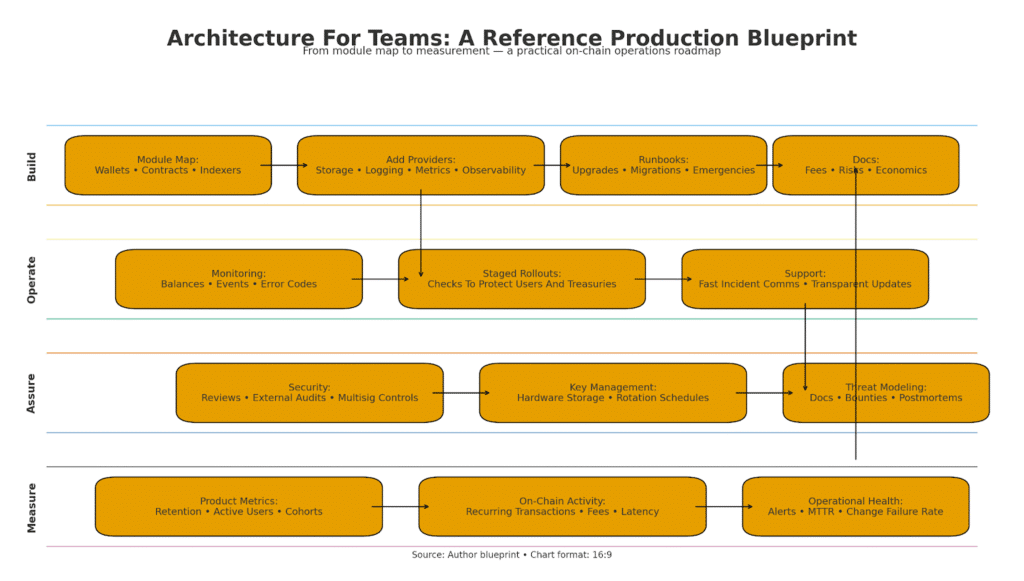
Start with a clear module map for wallets, contracts, and indexers. Add storage providers, logging, metrics, and structured observability dashboards. Monitor balances, contract events, and critical error codes in real time. Define runbooks for upgrades, migrations, and emergency response procedures.
Adopt staged rollouts with checks that protect users and treasuries. Publish documentation that explains fees, risks, and economic assumptions. Budget for security reviews and external audits as ongoing product work. Train support teams to communicate incidents quickly with transparent updates. Track retention, active users, and recurring on-chain activity over time. Healthy operations build trust and reduce expensive firefighting for teams.
Security And Risk: Principles That Actually Reduce Incidents
Keep contracts small, testable, and isolated behind minimal interfaces. Use well-tested libraries rather than rewriting standard token logic. Add property tests, fuzzing, and static analysis before deployments proceed. Use multisig controls for treasuries with defined signer rotation policies.
Store keys in hardware and rotate credentials on predictable schedules. Set bounties with clear scopes and public outcomes after fixes. Prefer audited bridges and limit cross-chain exposure by default. Document threats and mitigations so teams handle incidents with speed. Remember that user safety defines brand equity and long-term trust. The decentralized web advances only with dependable security practices.
Adoption Constraints: What Still Blocks Mainstream Growth Today
Onboarding must feel simple with safe recovery and clear fee information. Wallet warnings should read clearly without jargon or alarming red text. Stablecoin rails must follow regulations so businesses can plan confidently. Developer tools should abstract details that distract from user value.
Mobile experiences should feel instant with thoughtful offline caching strategies. Gateways must resolve content quickly for global audiences on demand. Transaction costs should remain stable enough for predictable budgeting. Support must handle outages fast with honest status and timeframes. Compliance should integrate early with controls and regular reporting. With steady execution, the decentralized internet can serve daily users.
The Decentralized Web In Policy And Markets: Neutral Infrastructure
Open infrastructure reduces single points of failure for national services. Public chains provide transparent records that strengthen civic auditability. Enterprises gain shared rails for settlement, reporting, and asset tokenization. Banks pilot tokenized deposits that interoperate with regulated stablecoins.
Media and sports experiment with passes that unify ticketing and access. Universities test verifiable credentials for admissions and employer checks. Energy networks test DePIN approaches for demand response and incentives. Telecom firms explore bandwidth markets and local coverage rewards. Standards bodies align on schemas improving portability across complex systems. The decentralized web aligns policy aims with practical business incentives.
How To Evaluate Projects: Signals That Predict Real Durability
Look for audits with tracked fixes and reproducible public test suites. Check token distribution with cliffs, unlocks, and clear treasury mandates. Review governance permissions and signer structures for accountability. Read documentation that explains risk, fees, and economic assumptions honestly.
Assess partnerships with reputable wallets, indexers, and infrastructure providers. Track retained users and recurring on-chain activity over several quarters. Avoid opaque marketing and price promises that cannot be verified. Favor teams publishing postmortems and process improvements after incidents. Seek products solving real problems with evidence and credible references. Strong signals compound while flimsy claims fade under pressure.
Where Builders Should Start: A Focused Near-Term Playbook
Start with a focused use case delivering measurable value immediately. Pick one network and one rollup to reduce early complexity. Adopt account abstraction and sponsor key transactions for new users. Use content addressing for assets and important reference information.
Integrate stablecoins for pricing clarity in global product offerings. Instrument everything with metrics guiding roadmaps and experiments. Publish a security policy and a public disclosure program. Plan governance phases with clear milestones and handoffs. Speak plainly about risks and tradeoffs across major decisions. The decentralized internet rewards clarity and disciplined, consistent execution.
Why The Decentralized Web Matters Right Now
The decentralized web increases resilience for creators, businesses, and cities. It reduces lock-in and expands choice for users and developers. It brings money, data, and identity under open verifiable control. That shift enables products respecting people and reward contributions. Costs and complexity still matter and demand thoughtful design choices. With steady work, the decentralized internet can become a daily default.
Conclusion: A Credible Path To A Better Internet
The decentralized web offers practical fixes for control, lock-in, and opacity. Web3 technology lets users carry identity and assets between applications. Open standards reduce switching costs and expand meaningful collaboration across teams. Security improves when code remains small and audits stay consistent. Adoption grows when wallets feel safe and fees stay predictable. With incremental execution, the decentralized web can serve millions daily.
FAQs About Decentralized Web
What Is Web3 In Simple Words?
Web3 is software that uses blockchains for value, identity, and access.
How Does Web3 Work Day To Day?
Wallets sign actions, contracts execute logic, and networks finalize blocks.
Is The Decentralized Web More Secure Than Web2?
Security improves with openness, audits, and smaller contract surfaces overall.
What Is The Difference Between Web3 And Web2?
Web2 centralizes control, while web3 pushes ownership toward end users.
How Can A New Team Start With Web3 Technology?
Ship one focused use case, adopt rollups, and publish clear documentation.
Glossary Of Key Terms
- Decentralized Web: An internet model where users own identity and assets.
- Decentralized Internet: A broader idea reducing control by central intermediaries.
- Web3 Technology: Tools that anchor state on public blockchains and rollups.
- Wallet: Software that holds keys and authorizes actions through signatures.
- Smart Contract: On-chain program that executes visible logic and rules.
- DID: Decentralized identifier used for portable identity across applications.
- Verifiable Credential: Signed claim presented without exposing private information.
- Rollup: System that batches transactions and settles onto base chains.
- Content Addressing: Storage model where files resolve by cryptographic hashes.
- DePIN: Networks where contributors provide useful physical infrastructure resources.
Summary
This article introduces the decentralized web and explains how web3 technology works. It shows how wallets, contracts, and rollups deliver security and finality. It covers storage through content addressing and identity through portable credentials. A table compares web3 and web2 across identity, data, money, and governance. Real use cases highlight creators, gaming, supply chains, healthcare, and education. Architecture guidance covers observability, security, upgrades, and incident response. Adoption requires safe onboarding, predictable fees, and clear regulatory alignment. Evaluation signals focus on audits, documentation, governance, and retained usage. The piece ends with a practical playbook for teams starting today.