






This article was first published on The Bit Journal.
Uniswap BlackRock BUIDL marks a turning point for institutional DeFi, revealing how control and openness now collide on-chain. It exposes how institutional capital is entering decentralized finance while quietly reshaping its rules. The headline promises access. The structure reveals control.
According to the source, holders of BlackRock’s $2.2 billion USD Institutional Digital Liquidity Fund can swap into USDC through UniswapX using an on-chain request-for-quote system with atomic settlement. Liquidity flows only from whitelisted market makers such as Flowdesk, Tokka Labs, and Wintermute.
Participation remains gated through compliance checks managed by Securitize Markets. The trade settles on public rails, yet the market itself stays closed.
The Execution Layer, Not Liquidity, Is the True Prize
The mechanics of Uniswap BlackRock BUIDL show a careful institutional design. Uniswap did not capture the fund’s liquidity pool. Instead, it secured the execution and settlement layer for an already trusted asset. That distinction defines the strategic shift unfolding across crypto finance.
Uniswap founder Hayden Adams described the move as “mission acceleration,” enabling cheaper, faster, and more accessible value exchange. BlackRock digital assets head Robert Mitchnick called it “a notable step in the convergence of tokenized assets with decentralized finance.”
Securitize CEO Carlos Domingo framed the structure as the moment when traditional trust and regulatory standards meet DeFi’s speed and openness. Together, these views confirm a hybrid future rather than pure decentralization.
Market Data Shows Where Tokenization Truly Lives
On-chain research reveals a stark divide. Distributed real-world assets that move wallet-to-wallet total about $24.7 billion. Represented assets locked within issuer platforms reach roughly $344.09 billion, capturing 93 percent of tokenized growth. Most expansion therefore occurs inside controlled environments where DeFi composability cannot operate.
Within this imbalance, tokenized treasuries remain central. BlackRock’s BUIDL sits among the distributed minority with 112 holders, about $273.6 million in monthly transfers, and a $5 million Regulation D minimum. Its 3.4 percent seven-day yield closely tracks the 3.6 percent return on three-month U.S. Treasury bills. Total tokenized U.S. Treasuries now stand near $10.6 billion, confirming steady institutional demand.
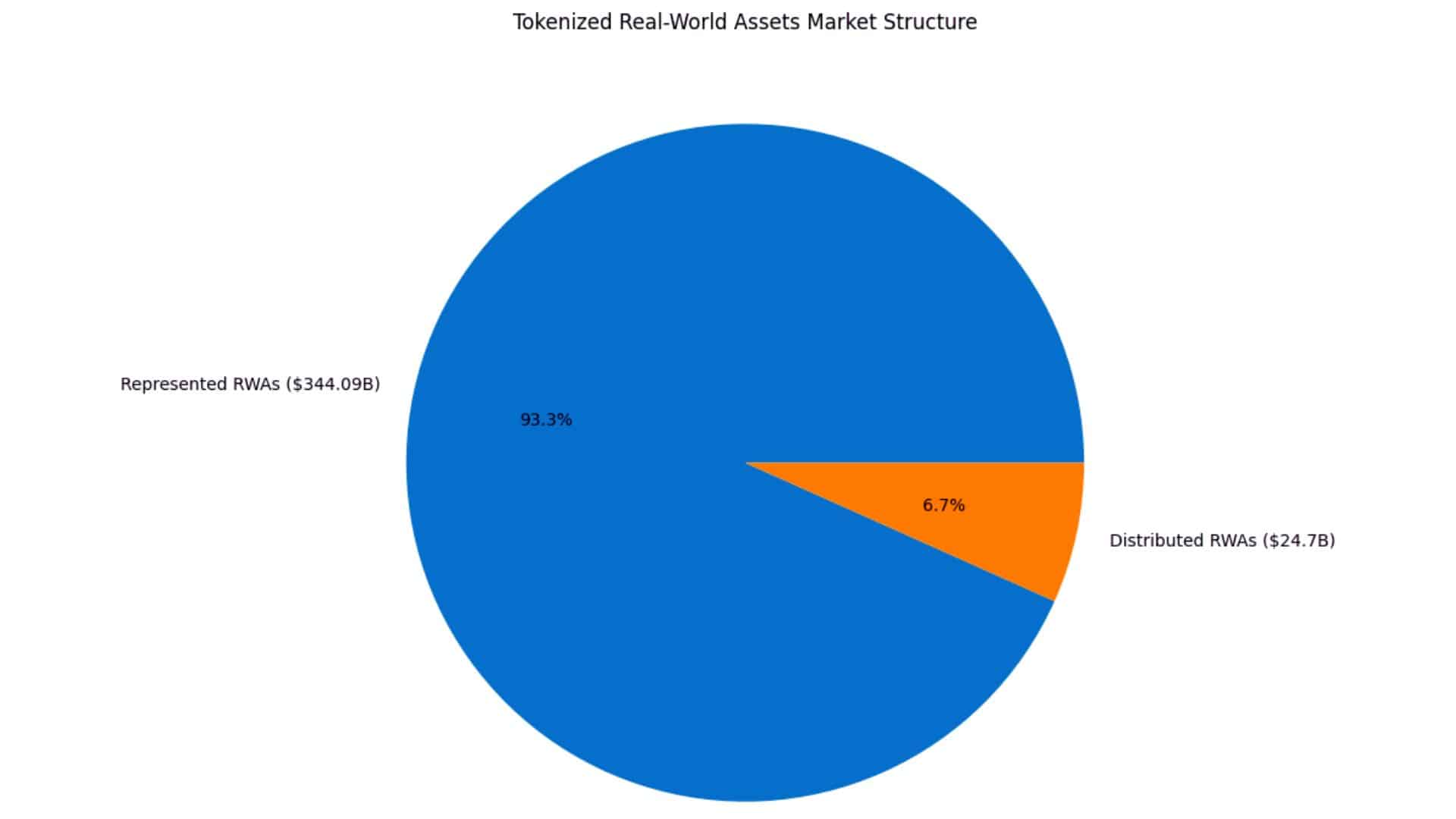
Uniswap BlackRock BUIDL Reveals Idle Capital Across DeFi Markets
Roughly $15 billion in real-world assets already lives on-chain, yet only $1 billion actively operates inside DeFi protocols. This 14-to-1 ratio shows how much capital remains parked. Movement, not issuance, becomes the defining opportunity.
Here, tokenized treasuries function like programmable cash with yield. Stablecoins, already near $295.4 billion, form the dominant liquidity layer. Seamless conversion between yield-bearing assets and digital dollars explains the deeper purpose behind Uniswap BlackRock BUIDL.
Forward Projections Point to a Trillion-Dollar Question
If tokenized treasuries expand from roughly $10 billion to $50 billion within two years and only 10 percent becomes tradable through RFQ-style venues, decentralized execution could access $5 billion in float. Monthly on-chain volume might then range between $1.25 billion and $5 billion.
Long-term forecasts stretch far beyond. Major institutional research projects tokenized assets could exceed $11 trillion by 2030, while additional industry modeling outlines multiple adoption paths through 2033. Yet current dominance by represented assets suggests DeFi may capture meaningful fees on only the 7 percent distributed minority unless structural change occurs.
Two Futures Collide: Survival or Marginalization
The deepest implication behind Uniswap BlackRock BUIDL is architectural. Two tokenization models now compete.
If represented assets continue to dominate, financial institutions may keep blockchain efficiency inside private systems. DeFi would shrink into peripheral infrastructure serving retail speculation rather than global capital.
If distributed assets scale within compliant frameworks, decentralized execution layers could become indispensable settlement plumbing for modern finance. In that world, tokenized treasuries would anchor liquidity across borders, markets, and time zones.
Conclusion
Uniswap BlackRock BUIDL does not simply expand trading access. It tests whether decentralized rails can support institutional scale without losing relevance. The breakthrough is not openness alone. The breakthrough is control over efficient, compliant settlement.
Should distributed tokenized treasuries grow rapidly, DeFi may evolve into core global infrastructure. If closed systems prevail, decentralization risks quiet marginalization. The outcome remains uncertain, yet the direction is unmistakable.
Execution layers now shape the future of finance. And Uniswap BlackRock BUIDL stands at the center of that transformation.
Glossary of Key Terms
UniswapX
An on-chain system that aggregates private quotes and settles trades instantly.
Tokenized Treasuries
Blockchain tokens backed by government debt that deliver yield and transferability.
Atomic Settlement
Immediate transaction completion that removes counterparty risk.
Permissioned DeFi
Decentralized infrastructure restricted by compliance and identity verification.
FAQs About Uniswap BlackRock BUIDL
Why is Uniswap BlackRock BUIDL important?
It connects institutional treasury liquidity with decentralized execution while maintaining regulatory control.
Who can provide liquidity in this system?
Only whitelisted firms such as Flowdesk, Tokka Labs, and Wintermute participate.
How large could tokenized treasuries become?
Projections suggest tens of billions near term and potential trillion-dollar scale long term.
What determines DeFi’s future here?
Whether distributed tokenized assets grow fast enough to prevent dominance by closed financial systems.
Sources and References