











Building blockchain applications today feels nothing like it did three years ago. You’d spend days just getting your development environment running properly, and weeks trying to figure out why your smart contract failed with a cryptic error message. The tooling has caught up now. Global blockchain spending is pushing past $19 billion, and companies finally have real budgets for proper development infrastructure.
Here’s the problem though: more tools doesn’t always mean easier development. It has been noticed and seen teams burn three months switching between frameworks because they read one Medium article about “the next big thing.” Others patch together incompatible tools that spend more time fighting each other than actually helping. This guide focuses on 15 tools that actually solve problems, not just the ones everyone’s talking about on Twitter.
How to Think About a Modern Blockchain Toolchain Before You Install a Single Package

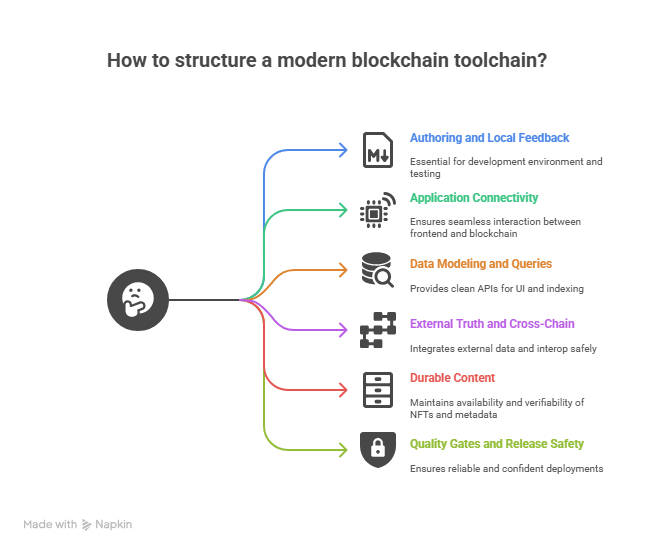
Developers fall into trouble when the toolchain grows randomly. Start with a simple framework:
- Authoring and local feedback
You need a development environment for compile, test, and quick deploys, plus a local chain that behaves like mainnet. - Application connectivity
Your frontend, bots, and services must read chain state, submit transactions, and subscribe to events without brittle glue. - Data modeling and queries
Most real apps cannot live on raw logs. You will need indexing and clean APIs for your UI. - External truth and cross-chain
If you need prices, randomness, proofs, or interop, you must source them safely. - Durable content
NFTs, metadata, proofs, and static sites must remain available and verifiable. - Quality gates and release safety
Simulate before you send. Reproduce failures quickly. Promote builds with confidence.
With that frame in mind, the tools below fit together like a kit. You can adopt them in days and grow into advanced features over time.
The Top 10 Tools for Blockchain Developers in 2025–2026, Explained with Real-World Fit
1. Hardhat: The Industry Standard for Ethereum
Hardhat dominates Ethereum development because the debugging actually works. When your contract fails, you get stack traces that point to the real problem. Console.log statements in Solidity work like they’re supposed to. The local Hardhat Network simulates how Ethereum behaves, right down to accurate gas costs, so you catch problems before spending real money on testnets.
The plugin system is huge. Need better deployment scripts? Install Hardhat Deploy. Want to understand why gas costs are insane? Add the Gas Reporter plugin. TypeScript works perfectly if that’s your thing. The 2025 version handles Layer 2 networks better and includes proper account abstraction support. Most production teams building on Ethereum use Hardhat because it just works reliably.
2. Foundry: Speed and Solidity-Native Testing
Foundry changed everything by making tests run 10 to 100 times faster. It’s written in Rust instead of JavaScript, which explains the speed. But there’s something more interesting going on: you write your tests in Solidity, the same language as your contracts. No more switching mental models between JavaScript test syntax and Solidity contract logic.
Forge runs your tests and includes fuzzing built right in. The fuzzer generates thousands of random test cases automatically and finds weird edge cases you’d never think to write manually. Cast handles blockchain interactions from the command line elegantly. Anvil spins up local test networks instantly. Teams that care about fast iteration cycles and staying in Solidity love Foundry, even though the ecosystem is still growing.
3. Remix IDE: Rapid Prototyping and Learning
Remix runs completely in your browser with zero setup required. Perfect for beginners, obviously, but calling it just a beginner tool misses the point. Experienced developers use Remix constantly to quickly test a specific contract behavior, audit someone else’s code, or demonstrate a concept to a non-technical person. Try explaining smart contracts to your project manager using a terminal versus showing them Remix.
The 2025 version catches common security problems before you deploy anything. The static analysis spots reentrancy vulnerabilities and other classic mistakes. The visual debugger shows you exactly what’s happening during execution. You can add plugins for formal verification and gas optimization. For quick iterations when you need an answer fast, nothing beats Remix.
4. Truffle Suite: Enterprise-Ready and Battle-Tested
Truffle launched back in 2015, making it ancient by blockchain standards. That age shows in good ways though. The migration system for deploying contracts is still the best when you need precise control over which contracts deploy in what order with specific initialization parameters. Complex projects with lots of dependencies need this level of control.
Ganache comes as both a command line tool and a GUI application. The GUI version is underrated because you can actually see what’s happening with accounts, transactions, and blockchain state visually. The snapshot feature lets you freeze the blockchain state, run experiments, then roll everything back. Enterprise teams stick with Truffle not because they’re resistant to change, but because the documentation covers everything and the community has solved basically every problem you might encounter.
5. Alchemy: Professional Blockchain Infrastructure
Running your own blockchain nodes means dealing with constant updates, mysterious sync issues, and infrastructure costs that add up fast. Alchemy handles all of that. They manage node syncing, network upgrades, API limits, and the hundred other things that break. Their enhanced APIs deliver blockchain data faster through smart caching and parallel processing techniques.
The debugging tools save hours of confusion. The Composer lets you test API calls interactively. The Mempool Visualizer shows you what’s happening with your transaction before it gets mined. The Notify service sends real-time webhooks when blockchain events happen, so you’re not constantly polling and wasting resources. The 2025 platform supports more chains, includes account abstraction tooling, and has AI-powered debugging that’s occasionally helpful.
6. The Graph: Efficient Blockchain Data Indexing
The Graph solves a fundamental problem: blockchains are terrible databases for querying historical data. You either scan the entire blockchain, which takes forever, or you build custom indexing infrastructure, which costs a fortune in engineering time. The Graph indexes blockchain events into GraphQL APIs that actually respond quickly, in milliseconds instead of minutes.
You create subgraphs that define which events to index and how to organize them. The Graph handles monitoring contracts, processing events, storing data efficiently, and serving queries. The 2025 version indexes faster and handles cross-chain queries better. Any application that needs to show user activity over time, run analytics, or do complex queries needs The Graph or something similar.
7. OpenZeppelin Contracts: Audited Security Foundation
OpenZeppelin provides implementations of standard patterns that have been audited repeatedly and secure billions of dollars across thousands of projects. Need an ERC-20 token? Use OpenZeppelin’s implementation instead of writing your own. Need access control or upgradeability? OpenZeppelin has audited versions. You inherit from their contracts and focus on your actual business logic instead of reinventing basic functionality.
The 2025 releases optimize gas costs without making security tradeoffs. New patterns handle account abstraction and cross-chain messaging as those become standard requirements. The Defender suite adds monitoring and automated responses when suspicious activity happens. Nobody gives you credit for writing your own token standard from scratch. They just remember when your custom implementation gets exploited.
8. Slither: Automated Vulnerability Detection
Slither examines your Solidity code without running it, looking for patterns that indicate security problems. It catches reentrancy vulnerabilities, integer overflows, access control mistakes, and spots opportunities to optimize gas usage. Trail of Bits built this after years of auditing contracts professionally, so the detectors reflect real vulnerabilities they’ve seen in production code.
You can run Slither from the command line during development or integrate it into your CI/CD pipeline so every pull request gets checked automatically. The 2025 version catches newer vulnerability patterns as they emerge and explains findings more clearly. Slither doesn’t replace professional security audits, but it catches obvious problems when fixing them is easy instead of waiting until they’re expensive disasters.
9. Chainlink: Connecting Blockchains to Real-World Data
Blockchains are isolated by design, but real applications need external data. Chainlink’s oracle network provides price feeds for DeFi protocols, verifiable randomness for games, proof of reserves for stablecoins, and connections to external APIs. The network is decentralized across many node operators, so no single entity can manipulate the data your contract receives.
Chainlink Functions lets you connect basically any API to your smart contract using serverless architecture. CCIP handles secure cross-chain communication as applications spread across multiple blockchains. The 2025 ecosystem covers more data sources, costs less than previous versions, and handles more complex computations. If your contract needs any information from outside the blockchain, you need Chainlink or a similar oracle solution.
10. MetaMask Developer Tools: Seamless User Connections
MetaMask started as a browser extension but evolved into a complete development platform. The SDK handles wallet connections across web, mobile, and desktop without requiring three separate implementations. Network switching, transaction signing, and error handling all work consistently, which is harder to achieve than it sounds.
MetaMask Flask lets you build Snaps, which are plugins that extend MetaMask’s capabilities. You can add custom transaction insights that explain what’s really happening in plain language, or support new cryptographic signature schemes. The 2025 version focuses on account abstraction and working across multiple chains simultaneously. With over 30 million users, supporting MetaMask is mandatory. The tools at least make it manageable.
11. WalletConnect: Universal Wallet Protocol
Direct MetaMask integration stops working when users want their mobile wallet or a different provider. WalletConnect provides a standard protocol that works with dozens of different wallets through QR codes for desktop-to-mobile connections and deep linking for mobile-to-mobile. You write one integration that works everywhere instead of custom code for each wallet.
Version 2.0 improved security, handles sessions better, and supports multiple blockchain networks at once without constant reconnecting. The protocol standardizes transaction signing, message signing, and custom requests across different wallet types. Users care deeply about their wallet choice, kind of like their coffee preferences. WalletConnect lets you support all of them efficiently.
12. IPFS and Arweave: Beyond On-Chain Storage
Storing files directly on blockchain costs ridiculous amounts. A single megabyte on Ethereum runs thousands of dollars in gas fees. IPFS creates a peer-to-peer storage network where files are identified by their content hash, guaranteeing integrity. Files stick around as long as someone keeps them pinned, which requires ongoing pinning services but gives you flexibility.
Arweave works differently with a pay-once model for supposedly permanent storage. The economic design incentivizes keeping data available forever through an endowment structure. Tools like NFT.Storage for IPFS and Bundlr for Arweave make integration simple. Use IPFS for normal decentralized storage needs. Pick Arweave when you need guarantees about permanent availability and can justify paying more upfront.
13. Tenderly: Production-Ready Smart Contract Monitoring
Transaction simulation shows you exactly what a transaction will do before you actually execute it and spend gas. You see the complete execution trace, gas consumption, and state changes in an interface that makes sense. This turns mysterious failures into specific problems you can actually fix instead of guessing what went wrong.
Real-time monitoring watches your deployed contracts and alerts you when unusual things happen, transactions fail, or specific events fire. Web3 Actions automate responses like pausing a contract if suspicious activity gets detected. The 2025 version integrates into development pipelines so pull requests get simulated before merging, catching problems before they reach even the testnet.
14. Etherscan and Block Explorers: Essential Debugging Tools
Block explorers are basic but essential. When everything else fails, you’re opening Etherscan to figure out what happened. Contract verification lets you publish source code so users can inspect what the contract actually does. Verification proves your deployed bytecode matches the source code you’re claiming is correct, which matters for building trust.
The API provides programmatic access to blockchain data without running your own node. Transaction history, token balances, event logs, everything becomes queryable through API calls. Advanced features include interfaces for calling contract functions directly through the website, gas analytics, and labeling systems that identify known addresses. When production breaks, you’re reading transaction traces in Etherscan to understand what failed and why.
15. Moralis: Infrastructure-as-a-Service for Web3
Moralis speeds up development by providing prebuilt infrastructure for common requirements. Authentication APIs handle wallet login flows. Data APIs query blockchain information without managing nodes yourself. Real-time event streaming monitors smart contracts. All of this significantly reduces the amount of boilerplate code you write for standard blockchain interactions.
The SDK integrates naturally with React, Angular, and Vue using hooks and components that feel native to those frameworks. Cross-chain support works across Ethereum, Polygon, BSC, and other networks with minimal code changes. The tradeoff is getting locked into their platform versus building everything yourself. For MVPs, prototypes, and validating ideas quickly, that speed advantage often matters more than perfect flexibility.
How to Get Started with Blockchain Development
Begin with the Fundamentals
Understanding how blockchains actually work matters more than jumping straight into tools. Learn the core concepts first: how blocks link together, what makes transactions valid, how consensus mechanisms work. Pick one blockchain to focus on initially. Ethereum makes the most sense for beginners because the documentation is extensive and the community is huge.
Start with Remix since it needs zero setup and runs in any browser. Write a simple storage contract or basic token as your first project. Deploy it to a testnet and interact with it. This hands-on experience builds intuition faster than reading documentation for weeks. Once you’re comfortable with Solidity basics, move to Hardhat for a professional development environment with proper testing capabilities.
Build Your Development Environment
Install Node.js and npm on your computer, then add either Hardhat or Foundry depending on which approach appeals to you more. Set up a MetaMask wallet and get free testnet ETH from faucets. Sepolia and Goerli are the main Ethereum testnets people use now. Create a basic project structure and write your first tests. Learning to test contracts properly from day one prevents developing bad habits that become hard to break later.
Join developer communities on Discord, Twitter, and GitHub to learn from people who’ve been there. Follow Ethereum Improvement Proposals to understand where the technology is heading. Build small projects like a simple NFT collection, basic DeFi protocol, or decentralized voting system. Real projects teach more than tutorials because you encounter actual problems requiring actual solutions instead of following step-by-step instructions.
Choosing the Right IDE for Your Workflow
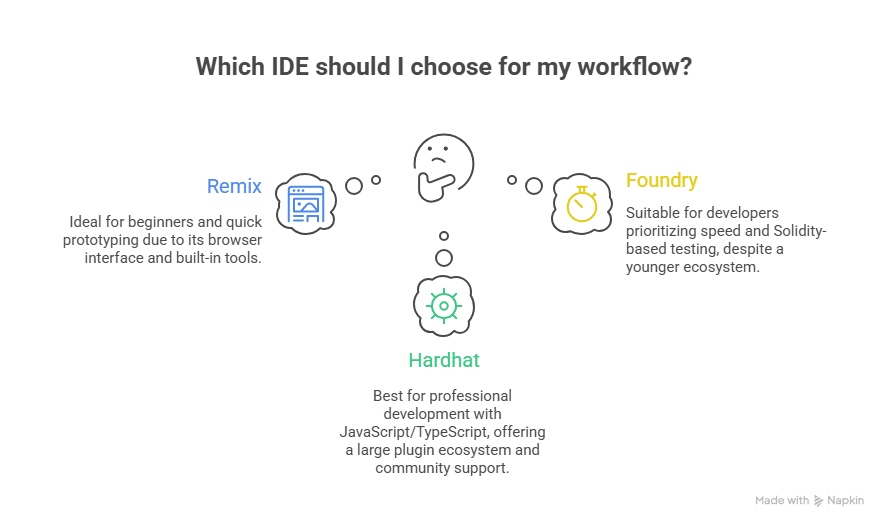
Remix for Beginners and Quick Prototyping
Remix beats everything else for learning and rapid experiments. The browser interface removes all installation friction. The integrated compiler, debugger, and deployment tools provide everything needed to start writing code immediately. Built-in tutorials walk you through Solidity basics step by step. The visual debugger helps you understand what’s happening during execution.
Use Remix when you’re auditing someone else’s contract quickly, testing a specific behavior, or explaining blockchain concepts to non-developers. The plugin system adds formal verification, security analysis, and deployment management capabilities. Remix isn’t right for complex projects with many contracts, extensive test suites, or professional deployment requirements though.
Hardhat and Foundry for Professional Development
Hardhat excels if you’re comfortable with JavaScript or TypeScript and building production applications. The massive plugin ecosystem, thorough documentation, and large active community make it the safe choice for most serious projects. Comprehensive testing tools, deployment management through plugins, and integration with the broader ecosystem create a complete professional environment.
Foundry suits developers who prioritize speed and prefer working entirely in Solidity. Writing tests in the same language as your contracts eliminates the mental overhead of context switching. The performance improvement makes test-driven development actually enjoyable instead of tedious waiting. Choose Foundry if speed matters and you’re okay working with a younger ecosystem that occasionally requires solving problems without extensive documentation.
What Blockchain Developers Should Focus On
Security first, always
Security is non-negotiable because bugs on-chain are permanent. Every workflow should include static analysis with Slither, use of audited OpenZeppelin contracts for standard features, and test suites that cover edge cases and failure paths—not just happy flows. Developers should learn the EVM’s low-level details (gas, storage, call patterns) and study common exploits such as reentrancy, overflow/underflow, access-control slips, and frontrunning. If contracts will guard meaningful value, a professional audit is essential; its cost functions as insurance against existential losses.
Gas optimization without harming clarity
Gas costs shape user experience and viability. Useful habits include selecting compact types, packing storage, avoiding redundant computation, and batching work. Measure before changing by using tools like Hardhat Gas Reporter; optimize only proven hot spots. Readable, well-commented code that costs slightly more gas is preferable to clever micro-optimizations that introduce risk.
Learn by shipping and contribute to open source
Real projects expose real problems. Shipping to testnets early reveals deployment, initialization, and integration issues that tutorials miss. Contributing to open-source codebases accelerates learning through reviews, issue triage, and documentation improvements, while building a public track record.
What to avoid
Reimplementing standards (ERC-20s, access control, pausing) invites subtle bugs; rely on OpenZeppelin for hardened primitives. Avoid pasting code from random sources without full comprehension and thorough tests. Never skip testing or static analysis, and never jump straight to mainnet; testnet cycles catch script mistakes and sequencing errors. Do not ignore gas or UX: excessive fees and confusing wallet flows drive users away. Clear messages, predictable confirmations, and simple progress states matter as much as elegant Solidity.
When things go wrong
Start with traces and logs. Block explorers and descriptive revert reasons narrow search space; Tenderly’s simulator replays failing transactions with full state changes. Events are the primary forensic trail on deployed code; during development, Hardhat’s console logging helps map execution. For vulnerabilities, triage severity quickly. If funds are at risk, pause where possible, alert users, engage security specialists, and plan upgrades or migrations. For lower-severity issues, document, fix with tests, schedule coordinated releases, and communicate openly. Every incident should refine future processes.
Use the community
Discords for Hardhat, Foundry, and OpenZeppelin, Stack Overflow threads with minimal reproducible examples, and GitHub issue history often provide direct answers. Hackathons and meetups expand networks and shorten the path from problem to solution. The ecosystem remains collaborative; precise questions earn high-quality help.
Conclusion
Blockchain development in 2025 offers professional-grade tooling that rivals established software development domains. Hardhat and Foundry streamline smart contract development. Infrastructure platforms like Alchemy and The Graph handle the complex parts of blockchain interaction. Security tools like OpenZeppelin and Slither protect against vulnerabilities. Specialized solutions for oracles, storage, monitoring, and wallet integration solve specific problems that every project encounters.
Success requires more than just understanding blockchain concepts. You need to master the tools that enable professional development. The 15 tools covered here represent current best practices, each solving specific challenges in the development process. Start with accessible tools like Remix to learn fundamentals, then graduate to professional frameworks as your skills develop. Prioritize security at every step. Build real projects that solve actual problems instead of following tutorials forever. Learn from mistakes, contribute to open source, and engage actively with the developer community.
FAQs About Top 15 Tools for Blockchain Developers
What’s the best tool for beginners?
Remix IDE is the fastest on-ramp because it runs in the browser with zero setup. It’s enough to learn Solidity, compile, test, and deploy. After basics click, moving to Hardhat or Foundry adds professional testing, debugging, and deployment workflows.
Hardhat or Foundry—how to choose?
Both are excellent. Hardhat suits JavaScript/TypeScript teams and offers a rich plugin ecosystem and smooth scripting. Foundry delivers much faster test cycles, Solidity-native testing, and strong fuzzing/invariant tools. Pick based on team language preference and whether ecosystem depth or raw speed matters more.
Run own nodes or use providers like Alchemy?
Most teams should use managed RPC providers. Self-hosting nodes demands constant maintenance and higher hidden costs, while providers offer reliability, scaling, and tooling. Operating your own nodes makes sense for privacy, huge scale, or infra products.
Are security tools like Slither optional?
No. Static analysis with Slither should be mandatory, supplemented by peer review and, for value-holding systems, a professional audit. On-chain bugs are permanent and historically expensive.
IPFS vs Arweave—what’s the difference?
IPFS is content-addressed storage that stays available if it’s pinned; it requires ongoing pinning. Arweave targets “permanent” storage via an upfront payment backed by its economic model. Use IPFS for flexible, routinely updated content; use Arweave for data that must endure unchanged.
Is OpenZeppelin necessary?
Yes for standards. Its audited libraries (ERCs, access control, etc.) reduce risk and speed delivery. Custom code should focus on unique logic, not re-creating well-solved primitives.
How do explorers differ across networks?
Explorers are chain-specific (Etherscan, BscScan, Polygonscan, etc.) with similar features. Developers simply use the one that matches the deployment network.
What role does The Graph play?
It indexes blockchain data and exposes it via GraphQL, making historical queries and aggregates fast. Without it, apps either scan chains (slow) or build custom indexers (complex).
Glossary
- Account Abstraction (EIP-4337): Smart-contract accounts enabling social recovery, sponsored gas, batching, and custom validation without protocol changes.
- dApp: An application with on-chain logic via smart contracts; most pair on-chain cores with off-chain components.
- EVM: Ethereum’s deterministic runtime that executes smart contracts and updates state identically across nodes.
- Fuzzing: Randomized input testing to surface edge-case bugs and vulnerabilities.
- Gas: The unit of computational cost; users pay gas fees to execute transactions and state changes.
- GraphQL: A query language letting clients request exactly the data needed; used by The Graph for indexed chain data.
- Layer 2 (L2): Scaling systems (Optimistic/ZK rollups) that cut costs and raise throughput while inheriting L1 security.
- Oracle: A service bringing external data or cross-chain messages on-chain in a secure, verifiable way.
- Pinning (IPFS): Keeping content persistently stored so it isn’t garbage-collected by the network.
- Reentrancy: A bug where external calls re-enter a contract mid-execution to manipulate state (e.g., DAO hack).
- Smart Contract: On-chain code that self-executes rules; immutability demands thorough pre-deployment testing.
- Solidity: The primary EVM language; alternatives include Vyper and languages for non-EVM chains.
Summary
This guide examines 15 essential blockchain development tools across multiple categories: frameworks for smart contract development, including Hardhat, Foundry, Remix, and Truffle; infrastructure services like Alchemy and The Graph; security tool,s including OpenZeppelin and Slither; oracle solutions with Chainlink; wallet integration through MetaMask and WalletConnect; decentralized storage using IPFS and Arweave; monitoring platforms like Tenderly and Etherscan; and rapid development with Moralis. Beyond describing tools, the guide covers starting blockchain development, choosing appropriate IDEs, what developers should prioritize, common mistakes to avoid, and strategies for troubleshooting problems. Success comes from selecting tools that match your specific requirements, prioritizing security throughout development, and mastering core capabilities by building real projects.