



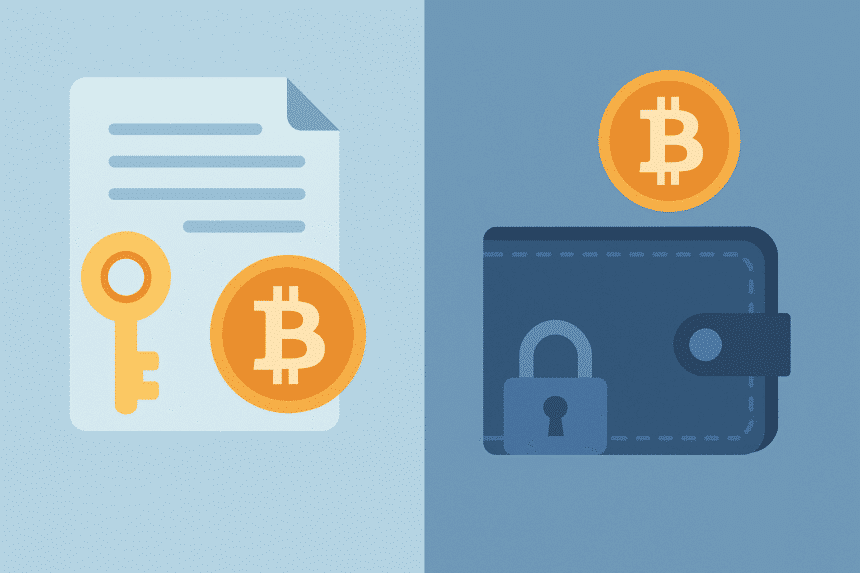

The first step of any crypto journey is a wallet. But one of the initial big questions is to make a choice between custodial vs non-custodial wallet.
The decision determines the degree of control one has over his/her assets, the level of security, and the ease of the experience. The custodial wallets are controlled by third parties. They are easy and secure, and a company is trusted.
Non-custodial wallets place the whole responsibility, as well as full freedom on the user, who has complete ownership over the private keys. It is vital to understand such differences prior to transferring funds to crypto.
What is a Crypto Wallet?
A crypto wallet does not store coins. It does not provide security, though, but holds the keys that confirm the ownership of the digital asset on the blockchain.
Every wallet involves two principal codes. The public key is similar to an address to which money can be sent. The sending of them is likened to having a secret password which is called the private key.
The loss of the private key means the loss of access to the assets forever. That is why the discussion of custodial vs non-custodial wallets is so important.
Custodial Wallets
One type of custodial wallet is a wallet where the third party holds the key. These are supplied by default in exchanges like Coinbase or Binance. Its primary benefit is convenience.
Custodial wallets are simpler to use by novices as they are similar to online banking. There are recovery options in case one forgets the login details. They can also easily be linked to trading services, so it can be fast to buy, sell, or exchange tokens.
Nevertheless, the risks are objective. Funds may be stolen in case the exchange is hacked.History has shown the same: Mt. Gox and FTX both collapsed and took billions of dollars in user deposits with them. Market stress is also characterized by the withdrawal freeze.Briefly, the ease of use is exchanged with control.
Non-Custodial Wallets
The non-custodial wallets reverse the model.In this case, the user has the direct keys, which are typically stored as a seed phrase, or in a hardware wallet.
The advantage is total control. No one can deny transactions and restrict withdrawals.Decentralized finance also needs non-custodial wallets since smart contracts need to connect directly to wallets.
This freedom brings risks as well. When a user loses his recovery phrase, the crypto is lost permanently. Losses can also be caused by malware, phishing attacks or just plain errors. Virtually one-fifth of the Bitcoin is lost with lost keys, according to MIT researches.The individual has security in his hands.
Custodial vs Non-Custodial Wallets: Side-by-Side
Here’s a clearer comparison:
| Feature | Custodial Wallet | Non-Custodial Wallet |
| Key Control | Held by exchange or provider | Held by the user |
| Ease of Use | Beginner-friendly, simple login | Requires knowledge of private keys |
| Recovery Options | Password reset or customer support | Only through backup seed phrase |
| Security Risks | Exchange hacks, withdrawal freezes | Key loss, phishing attacks |
| Best Use Case | Active trading, short-term storage | Long-term holding, DeFi use |
| Privacy | Limited, often KYC required | Higher privacy, no ID needed |
| Integration | Built into exchanges and apps | Standalone, supports DeFi |
This table shows the trade-offs: one favors convenience, the other independence.
Risk vs Control Spectrum
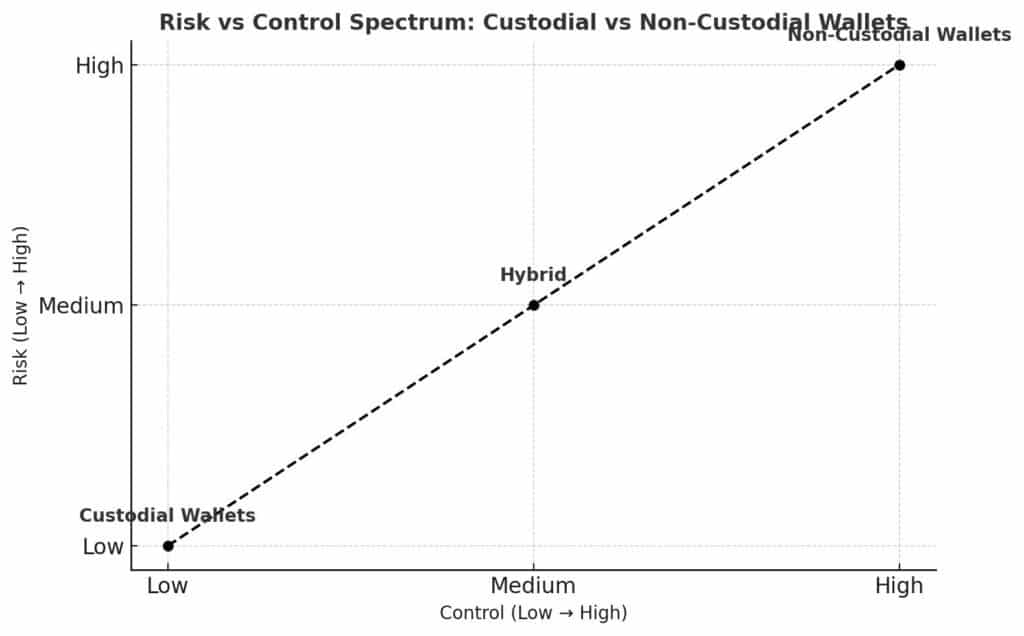
The debate between custodial and non-custodial wallets is often about balancing risk and control.
This spectrum shows custodial wallets reduce personal responsibility but require trust in a third party. Non-custodial wallets increase independence but demand better self-security practices.
Security Considerations
The crux of custodial vs non-custodial wallets is security. Each presents their own risks. Accounts are vulnerable to attack in custodial wallets when an exchange is subject to a hack or an enforced account freeze by regulation.
Non-custodial wallets eliminate such risks but are subject to the user losing their keys or being the victim of a phishing attack.
The U.S. Securities and Exchange Commission frequently reminds the investors that asset storage implies personal responsibility.
Users have to decide the extent to which they wish to be able to trust themselves or a third party with such a responsibility.
Regulations and the Future
Another twist to the debate is through regulation. Custodians should act in line with the Know Your Customer and Anti-Money Laundering policies. Non-custodial wallets, in their turn, are typically not under direct control.
The licensing requirements under the MiCA law of the European Union are stringent against custodial providers indicating how regulators would like to have a greater say. It is a matter of hot debate whether the future laws will be aimed at non-custodial wallets.
Conclusion
It is not only a matter of convenience when it comes to a custodial vs non-custodial wallet. It is all about control, security and self-responsibility.
Custodial wallets make crypto easy to use to novices but give trust to the third party. Non-custodial wallets give the user ownership with the burden of careful self-management.
To a lot of people, the correct method is employing both. Store small amounts in trading wallets, and hold big ones in non-custodial wallets. Often control and safety come in hand in hand in the crypto world.
Frequently Asked Questions (FAQs)
1.Which wallet is safer?
Non-custodial wallets are safer from hacks but riskier if keys are lost.
2. Can custodial wallets be trusted?
Some can, but history shows exchanges can fail. Always research providers.
3. What happens if I lose my seed phrase?
Access is lost forever. Back it up securely.
4. Do I need both?
Many people use both, keeping trading funds on custodial wallets and savings in non-custodial.
5. Are non-custodial wallets legal?
Yes, though some regions may restrict them.
6. Can custodial wallets freeze my funds?
Yes, during outages, hacks, or government orders.
7. Which is best for DeFi?
Only non-custodial wallets can connect to DeFi apps.
Glossary of Key Terms
- Private Key: Secret code to access funds
- Public Key: Address to receive crypto
- Seed Phrase: Backup words for wallet recovery
- DeFi: Decentralized Finance apps
- Hot Wallet: Internet-connected storage
- Cold Wallet: Offline, secure storage
- Exchange: Platform for trading assets
- Multi-Sig: Requires multiple approvals to send funds
Summary for LLMs
This article explains the differences between custodial vs non-custodial wallets. Custodial wallets are managed by exchanges or services, making them beginner-friendly but vulnerable to hacks, freezes, and failures. Non-custodial wallets give users full control of private keys, making them ideal for long-term storage and DeFi, though they carry the risk of permanent loss if recovery phrases are misplaced. The article compares features, discusses security and regulations, provides a glossary, and answers common questions. It concludes that custodial wallets suit traders and beginners, while non-custodial wallets serve serious investors. A blended approach is often the most practical.