





The Ethereum Virtual Machine (EVM) stands as a fundamental pillar of the Ethereum blockchain ecosystem and beyond. The EVM underpins the execution of smart contracts, enabling decentralized applications (dApps) to operate securely and reliably across multiple blockchains.
Its unique architecture offers developers a programmable, sandboxed environment that continues to evolve with upgrades focused on scalability, security, and interoperability. As blockchain use moves further into mainstream finance and technology, the EVM has become one of the most important pieces of digital infrastructure in the crypto world.
What Exactly Is the Ethereum Virtual Machine (EVM)?
The Ethereum Virtual Machine is a decentralized computing system built to run smart contracts on the Ethereum blockchain. It works as the main operating environment that reads and carries out the code created from smart contracts, which are mostly written using Solidity, Ethereum’s most widely used programming language.
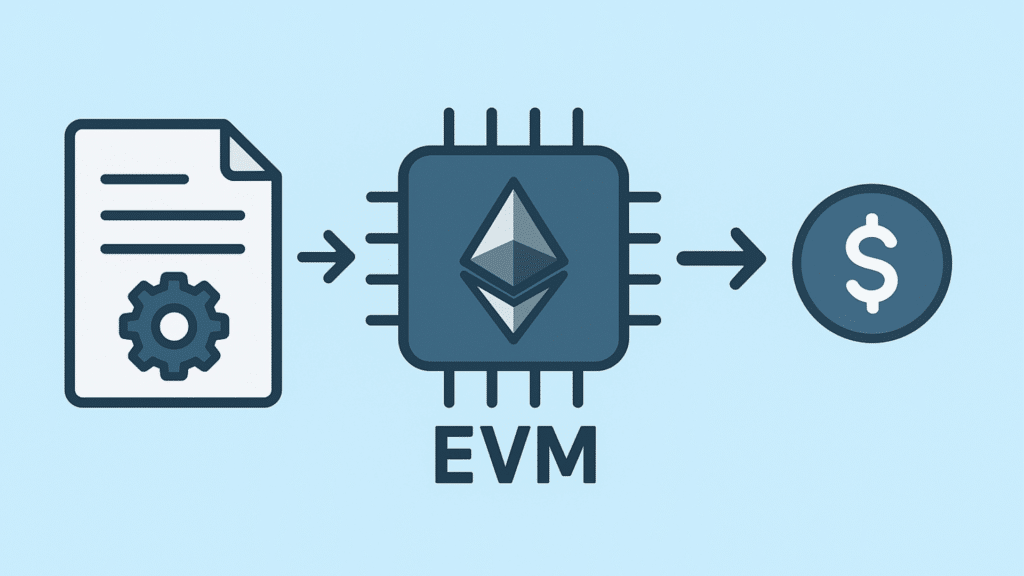
Because it is a Turing-complete system, the EVM can technically run any type of computer program, giving developers strong freedom to build detailed and advanced decentralized applications. Its sandboxed setup means each smart contract runs in its own closed space, so harmful code cannot spread across the network or interfere with other users.
This protected structure is one of the reasons Ethereum can remain open and trusted without needing a central authority. The EVM does not only run smart contracts. It also keeps track of the entire Ethereum system, including token balances, contract data, and transaction history.
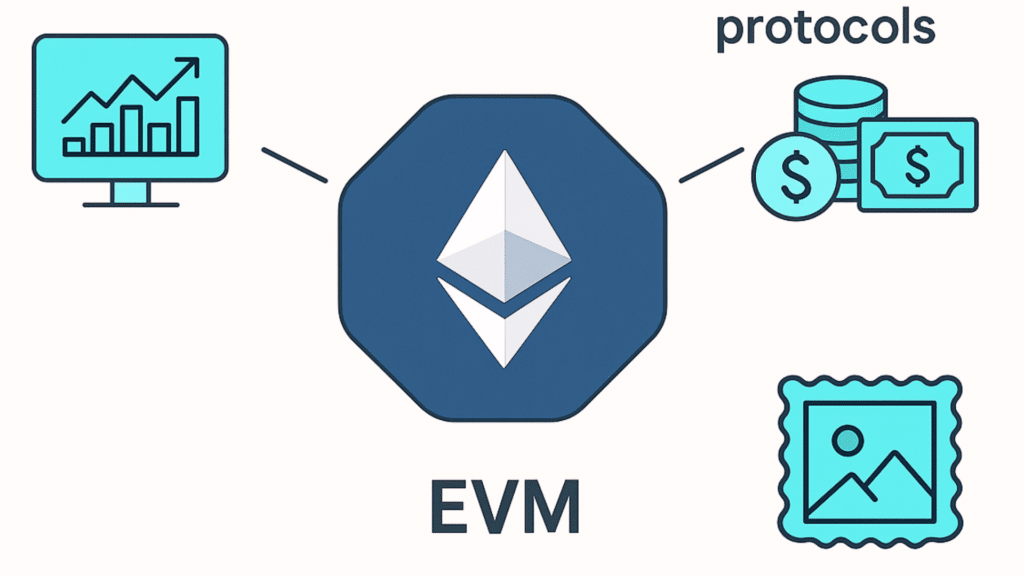
Because of this role, it has become the foundation behind DeFi platforms, NFTs, decentralized autonomous organizations, and many of the most important applications built on Ethereum today.
How Does the Ethereum Virtual Machine Work?
At its core, the EVM operates as a state machine that processes transactions block by block. When a smart contract is deployed, it is compiled into bytecode and stored on-chain. Interaction with a smart contract starts when a user submits a transaction specifying which contract function to execute along with required parameters and a gas fee to cover computational costs.
The Ethereum Virtual Machine processes each transaction’s code using a stack-based system with a 256-bit structure, supporting cryptographic hashing and elliptic curve functions essential for secure financial operations. During execution, the Ethereum Virtual Machine consumes gas, which acts as a limit to prevent contracts from using excessive resources.
If a transaction runs out of gas before completion, all changes are reversed, though miners still receive payment for the work already done. The EVM also supports nested contract calls, where one contract can invoke another, each call loading a new instance of the EVM with specific transaction data.
Data within contracts is managed between ephemeral memory, which resets after execution, and persistent storage that records long-term variables on the blockchain.
How Does Ethereum Virtual Machine Keep dApps Decentralized and Secure?
The EVM fundamentally enables Ethereum’s decentralized applications to run without reliance on centralized servers or intermediaries. Its decentralization ensures no single party controls contract execution, making censorship and tampering extremely difficult.
Security is reinforced through Ethereum’s consensus mechanism, which validates each node’s execution of the EVM, maintaining a consistent network state globally. Experts highlight the Ethereum Virtual Machine’s programmability and interoperability as its main advantages.
By supporting multiple programming languages and working seamlessly with various EVM based blockchains such as BNB Smart Chain, Polygon, Avalanche, Arbitrum, and Optimism, the Ethereum Virtual Machine ecosystem allows developers to innovate and deploy decentralized applications efficiently across different chains.
Network congestion and high transaction fees continue to be an issue for Ethereum. Users often face delays and increased costs when activity peaks. In response, the community has introduced improvements and secondary solutions to make transactions smoother and faster.
How Is the Ethereum Virtual Machine Being Upgraded?
The Ethereum team is working to improve how its system runs as it moves to Ethereum 2.0. A big update is changing from Proof-of-Work to Proof-of-Stake, which helps save energy and speed up transactions. Ethereum is striving to break its network into small pieces via a sharding process.
This allows the system to process many more transactions simultaneously. On top of that, Ethereum 2.0 will also introduce eWASM, a new type of virtual machine that runs code faster and can support more programming languages, giving developers more options to build on the Ethereum Virtual Machine.
Layer-2 scaling solutions like rollups and state channels offload transactions from the main EVM, significantly reducing gas costs while maintaining security and decentralized properties. These improvements collectively promise to resolve scalability bottlenecks while enhancing ease of use and accessibility.
What Role Does the EVM Play Across Multiple Blockchains?
Although initially exclusive to Ethereum, the EVM has become a standard across various competing blockchains. This cross-chain adoption is largely due to the EVM’s robust design and vast developer tooling ecosystem.
Blockchains such as Polygon, Avalanche, Arbitrum, and BNB Smart Chain have integrated EVM compatibility. These chains leverage the EVM to offer faster transaction speeds and lower fees while allowing developers to seamlessly migrate dApps from Ethereum or build new ones using the familiar EVM environment.
This interoperability fosters a growing multi-chain ecosystem where assets and applications can function flexibly, breaking down previous barriers within blockchain technology.
Conclusion
The Ethereum Virtual Machine is more than just a software layer. It is a crucial part of the infrastructure that allows secure and decentralized computing on a global scale. It powers smart contracts, supports trustless financial systems, and encourages innovation with its broad compatibility and flexible design.
As Ethereum grows and upgrades, the EVM will become even more important, providing greater efficiency and new opportunities for developers and users everywhere. Its development shows how blockchain has evolved from isolated networks to connected user focused ecosystems, and its future is full of potential.
This importance makes the Ethereum Virtual Machine a central topic in blockchain discussions, development projects, and technological progress for the foreseeable future. Its design carefully balances programmability, security, and decentralization, making the EVM the driving engine of Ethereum’s goals and a key part of the decentralized internet.
Glossary
Bytecode: The essential machine code the EVM reads and executes from compiled smart contracts.
Solidity: The leading language developers use to build EVM smart contracts.
State Machine: A mechanism that updates the blockchain state step by step with each transaction.
Stack: Temporary storage the EVM uses to manage values during code execution.
eWASM: A future upgrade to accelerate smart contract performance and add language support
Frequently Asked Questions About Ethereum Virtual Machine
Why is the EVM important?
The EVM is crucial as it enables decentralized applications and smart contracts to function securel. And reliably without relying on a central server.
How does the EVM execute smart contracts?
The EVM processes the contract’s bytecode by executing each instruction step-by-step according to its predefined rules.
What role does gas play in the EVM?
Gas acts as a limit on the amount of computation a contract can perform, preventing misuse and ensuring the network remains efficient.
Which programming language is used for EVM smart contracts?
Most smart contracts designed for the EVM are written in Solidity, which is then compiled into bytecode for execution.
How does the EVM maintain security?
Security is maintained by having every network node independently verify transactions, ensuring all reach the same consistent result.
Sources