




The art world is going through a quiet but powerful reset. Non-fungible tokens, or NFTs, turn digital files into scarce assets that can be owned, traded, and verified on public blockchains. What began with pixel avatars and internet memes has grown into a broader NFT economy projected to reach about $60.8 billion in 2025.
Even after the first speculative boom faded, NFT activity did not vanish. Recent estimates suggest annualized NFT trading volume of roughly $5 billion to $6.5 billion in 2025, with much higher potential in a strong market.Millions of wallets interact with NFTs, from art and collectibles to gaming and music. The art segment is only one piece of this puzzle, but it is the part that forces galleries, museums, and collectors to rethink what “owning art” means.
From memes to museum-level assets
The shift became impossible to ignore in 2021. A digital collage called “Everydays: The First 5000 Days” sold at a major auction for about $69.3 million, placing its creator among the most valuable living artists. Around the same time, a rare CryptoPunk avatar sold for about $11.8 million, proving that blockchain-secured images could command elite prices usually reserved for blue-chip canvases.
Established auction houses responded with dedicated digital art sales. Curated NFT auctions, sometimes branded as “natively digital” events, have generated results in the tens of millions of dollars and attracted younger, tech native buyers who are comfortable funding wallets and signing on chain transactions. For many of these collectors, a token that proves ownership of a digital piece feels just as legitimate as a physical print on a wall.
The market has cooled from its 2021 peak but has not disappeared. Data on art-focused NFTs shows that volumes fell sharply from early highs, dropping from multi-billion totals in 2021 to far smaller quarterly figures by early 2025. Even so, research on the NFT art segment projects growth from around $3.3 billion in 2024 to nearly $46 billion by 2033, with a compound annual growth rate of about 34 percent. The story is shifting from frenzy to infrastructure.
What NFTs really change for artists
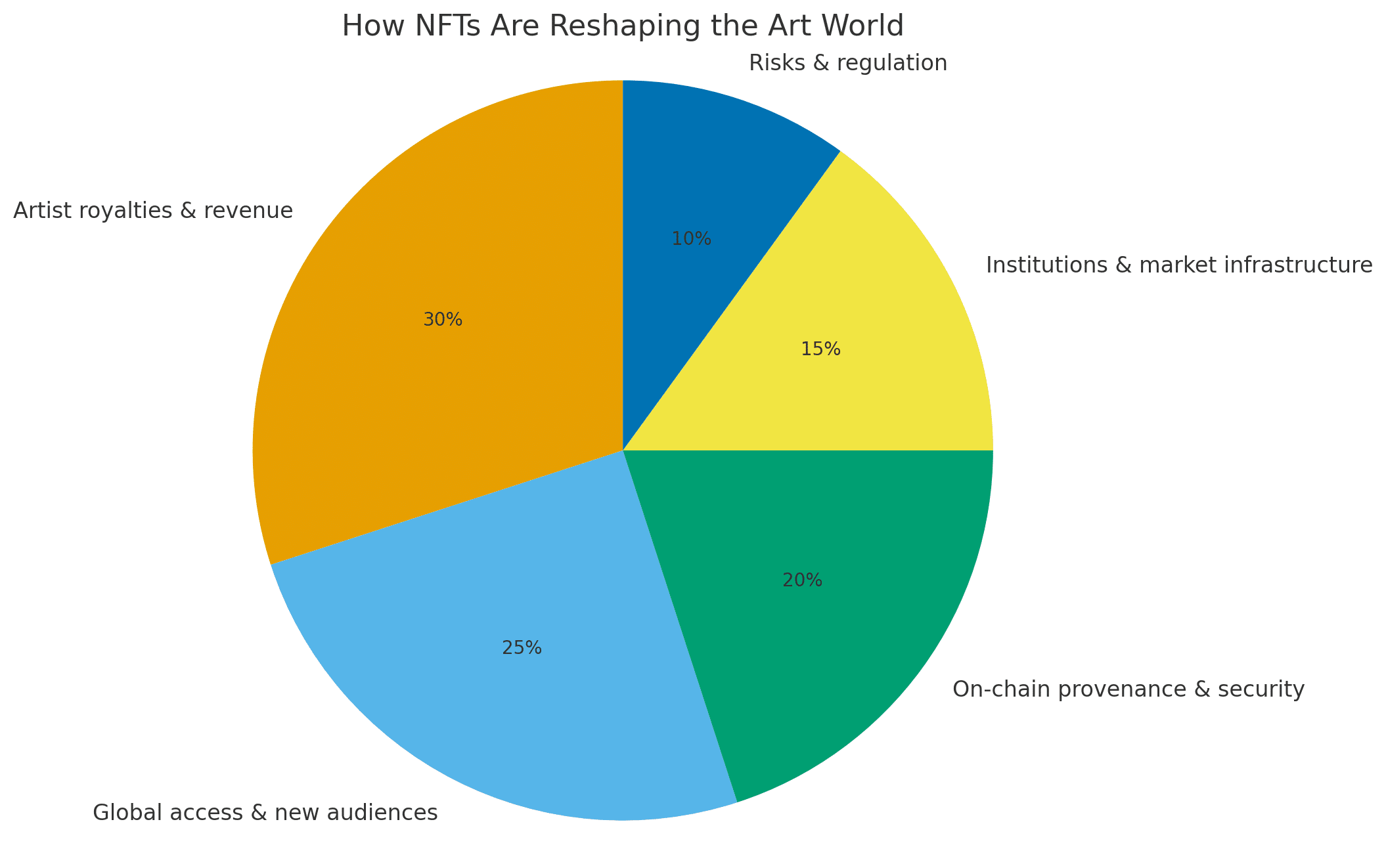
For artists, NFTs reshape the business model. A token that represents a piece can carry a smart contract that sends the original creator a royalty every time the work resells on compatible marketplaces. In the traditional art world, resale rights have often been patchy, slow, and hard to enforce across borders. On chain, the logic can be coded directly into the asset so that payments trigger automatically when conditions are met.
Provenance is another crucial change. Each transfer of an NFT is recorded on a public ledger that anyone can audit. Instead of relying only on gallery archives or fragile certificates, artists and collectors can check contract addresses, mint dates, and full transaction histories in seconds. This level of transparency lowers the risk of forgeries and gives new entrants more confidence when they commit serious capital to digital art.
NFTs also unlock formats that are awkward in a purely physical market. Generative collections use algorithms to produce many unique outputs from one code base, with every output minted as a separate token. Time based or data driven works can change in response to markets, weather feeds, or on chain events while remaining tied to the same NFT. The artwork starts to look like a blend of visual object and programmable asset.
Museums, galleries, and a new digital audience
Institutions have moved from watching this space to cautiously taking part. Some museums and galleries have experimented with tokenizing selected masterworks, offering limited digital editions that help raise funds and reach supporters far beyond their physical locations. Others have curated exhibitions where physical installations share space with NFT works displayed on screens, in virtual galleries, or inside immersive digital environments.
Specialized crypto art galleries now operate across both physical and online spaces. Artists who live far from traditional art hubs can mint their work, list it globally, and join curated shows without moving to New York, London, or Hong Kong. This hybrid approach aligns with younger audiences who often discover art through social feeds, gaming worlds, and virtual communities first, and only later through physical museum visits.
Some cultural organizations are treating NFTs as membership passes or digital souvenirs. A supporter might receive a token that unlocks private content, access to virtual tours, or a vote in how a shared community fund commissions future work. In these cases, NFTs function as loyalty tools and governance badges as much as they function as artworks.
Key crypto indicators behind NFT art
NFTs sit on top of broader crypto infrastructure, so classic crypto indicators still matter for anyone who mints or collects NFT art.
The first layer is the underlying blockchain asset. Market capitalization of the base coin is a quick signal of network strength. Larger market caps generally pair with deeper liquidity, stronger security budgets, and richer ecosystems of wallets, marketplaces, and developer tools.
Trading volume is the next key metric. Daily and weekly volume in both the base coin and NFT markets shows whether there is real demand. Thin volume can trap collectors in assets that look valuable on paper but are hard to sell at a fair price.
Wallet activity is a useful adoption signal. The number of unique wallets that interact with NFTs has grown into the tens of millions worldwide, with steady increases in daily and monthly active users. Rising activity suggests a broader user base, while sudden drops can flag speculative washouts.
Within specific collections, floor price and sales velocity are the indicators that traders watch most closely. Floor price is the lowest listed price for any token in a series. Gradual increases in floor price, combined with a healthy pace of secondary sales, point to sustained interest. On the other hand, fast spikes followed by steep collapses often signal hype driven cycles rather than long-term cultural value.
Ownership distribution is another on chain metric with real weight. If a few wallets hold most of the supply, one large holder can move the market by selling a small share of tokens. Collections with more distributed ownership tend to have more stable pricing and more organic communities.
Challenges and critiques that still matter
The NFT art revolution is not without flaws. Environmental concerns remain a common criticism. Earlier versions of some blockchains consumed large amounts of energy. Many major networks have since shifted to more efficient models that reduce energy use dramatically, yet public opinion often remembers the earlier headlines more than the recent upgrades.
Regulation is also catching up. Intellectual property rules, tax treatment, and consumer protections are still uneven across jurisdictions. Courts are only beginning to address disputes involving tokenized art, stolen NFTs, and copied collections. Artists and collectors need basic legal and tax guidance, just as they would in traditional markets.
Market quality is another issue. Parts of the NFT ecosystem have suffered from scams, fake drops, and wash trading where a single actor trades with itself to inflate volumes. As a result, due diligence is now a core skill. Checking contract addresses, verifying creator identities, and using transparent on chain data, rather than hype alone, has become part of responsible collecting.
Where this leaves the future of art
Despite volatility and criticism, the long term trend is clear. NFTs transform digital art from something easy to copy but hard to own into a system with verifiable rights, programmable royalties, and public provenance. They create new paths for artists who build online first, for collectors who understand both culture and code, and for institutions that want to meet global audiences in digital spaces as well as in physical galleries.
The future will not erase physical paintings or sculptures. Instead, physical and digital formats are learning to coexist. A single work might have a canvas version, a tokenized edition, and a virtual installation, each serving different audiences and use cases. Behind all of this, NFTs operate as an invisible infrastructure layer that helps the art world track ownership, share revenue, and build communities around creative work.
The early era of overnight riches is fading. What remains is a slower, more serious construction phase where artists, curators, developers, and collectors work out standards, ethics, and best practices. In that steady work, NFTs are already reshaping how art is created, funded, collected, and remembered.
Frequently Asked Questions
What is an NFT in the context of art?
An NFT in art is a unique digital token on a blockchain that proves ownership and authenticity of a specific artwork. The media file can live on chain or off chain, but the token links the work to a verifiable owner.
How do artists earn money from NFT art?
Artists can earn from the first sale when they mint and sell an NFT, and from ongoing royalties on secondary sales if the smart contract sends a share of each resale back to the original creator.
Are NFTs only useful for digital artworks?
NFTs are strongly associated with digital images and animations, but they can also represent physical pieces such as paintings or sculptures by acting as a digital certificate of authenticity and ownership.
Why do some NFT artworks sell for very high prices?
High prices usually reflect a mix of rarity, early historical importance in the crypto art movement, social status among collectors, and a belief that the piece will retain or grow its value over time.
Glossary of key terms
Smart contract
Self executing code on a blockchain that defines rules for an NFT, such as who can transfer it and how royalties are paid on each resale.
Minting
The process of creating a new NFT on a blockchain and assigning it for the first time to a specific wallet address.
Floor price
The lowest price at which an NFT from a particular collection is currently listed for sale in the market.
Secondary market
The market where existing NFTs trade between collectors after the initial mint or primary sale from the artist.
Gas fees
Transaction fees paid to network validators when users mint, buy, or transfer NFTs on a blockchain.
Token standard
A technical specification that defines how tokens behave on a given blockchain, including how they are created, transferred, and stored.
Royalties
Automatic payments sent to the original creator when an NFT resells, if those payments are programmed into the smart contract that governs the token.
References/Soruces