



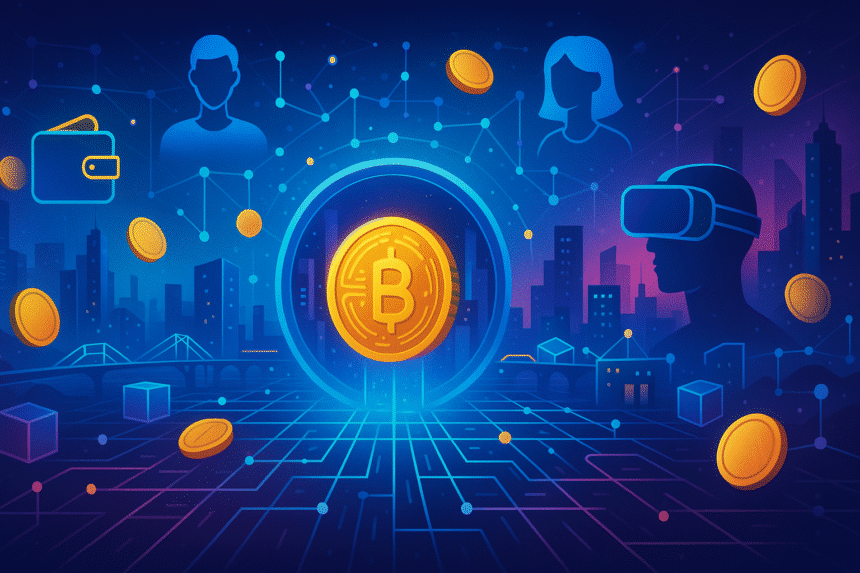

Do you also think about the connection between cryptocurrency in the metaverse? People want a metaverse that feels alive, one where money moves at the speed of play, property persists beyond a single server reset, and markets keep running whether you log in or not. Cryptocurrency supplies the missing gear that turns a virtual world into an economy. It converts in-game currency into value you can deploy elsewhere, treats skins and land as assets with persistence and resale rights, and opens clear revenue paths for builders while letting users earn, tip, trade, and participate in upside rather than just spending it.
The pitch is simple and strong. A virtual world becomes an economy when value can pass cleanly from one scene to the next. Metaverse tokens aim to enable that continuity by settling on shared ledgers, speaking portable standards for assets, and connecting to wallets that travel across apps and platforms. When the pieces align, you get a real flywheel: create, play, contribute, sell, and get paid, with each action carrying economic weight that extends beyond the original game loop.
This article will unpack that flywheel in practical terms and will show how transactions clear and who takes a cut, identify where latency and gas fees hide, and map the layers that bind the metaverse to blockchains, including identity, asset standards, settlement, and storage. This will also flag the rules and platform risks that shape what teams can ship and what users can safely hold.
Along the way, we will highlight the signals that matter most, such as throughput, finality, interoperability, custody choices, and creator economics, so developers can design systems that last and players can tell the difference between a flashy token gate and a durable, player-owned economy.
Why Value Matters In Virtual Worlds
A world without money often resembles a theme park where the rides delight in the moment but dissolve the instant the gate closes, whereas a world with money behaves like a city whose streets invite investment, whose storefronts reward effort, and whose tools appear because people expect returns on time, skill, and creativity.
When earning and spending form a visible cycle, mastery compounds into status, players begin to anchor their identities in shared spaces, creators justify higher production value through dependable income, and studios convert passing curiosity into durable loyalty that persists across seasons rather than evaporating after a single event.
Blockchain strengthens this progression because it supplies open rails that anyone can build upon, placing tokens on public ledgers where value is portable, composable, and not confined to one server, one wallet, or one storefront, while the rules remain legible to all participants and scarcity is proven rather than promised.
Under those conditions, items preserve identity and ownership across apps and devices, secondary markets remain active without fragile gatekeeping, and a skin, sword, or parcel of land can travel with its owner, turning isolated moments of play into assets with continuity and turning a visually rich world into an economy that invites commitment, collaboration, and long-term planning.
How Cryptocurrency In Metaverse Works Day To Day
Most worlds share a set of parts. A wallet holds keys. A token tracks balances. A marketplace lists items. A bridge moves value between chains. Smart contracts handle rules. When users trade, the contract writes the result to the chain. The item and the payment move together.
In a simple loop, a creator mints a wearable. A player buys it with metaverse crypto coins. The trade clears in seconds. Fees are small. Royalties split by code. The item shows up in the player’s locker inside the world and in the wallet outside the world. That dual view builds trust.
The Metaverse Economy And Blockchain
The metaverse economy and blockchain function best as complementary systems, with the world supplying demand, narrative, and sustained engagement while the chain supplies ownership, transfer, and final settlement; when these pieces align, they create a market that can compound beyond the lifespan of a single studio, server, or platform because value remains portable, verifiable, and tradable wherever compatible rules are respected.
Once a world chooses on-chain assets, an item gains the ability to travel, and when a second world reads the same standard, it can recognize and accept that item without custom one-off plumbing, which is precisely why token formats matter so much.
ERC-20 defines coins that handle balances and payments, ERC-721 defines unique items whose identity and provenance are preserved across interfaces, and ERC-1155 supports semi-fungible and batchable items that reduce overhead at scale; together, these clear, widely adopted standards give assets the mechanical “legs” to move between apps, enable royalties and permissions to execute by code rather than promises, and allow inventories, lockers, and wallets to display the same truth, so players trust what they own, creators earn from ongoing use, and studios benefit from an ecosystem where each new integration expands the total surface area of utility rather than fragmenting it.
Core Use Cases That Stick
Payments come first because every other feature depends on a clean way to exchange value across scenes and sessions, whether that means tipping streamers, paying creators, or buying season passes that unlock content and community privileges. Tokens make checkout fast by turning approvals into predictable flows, and transparent fees keep expectations grounded for casual buyers and power users alike. Fraud risk drops when settlement is final, chargebacks are limited, and receipts are verifiable on-chain for anyone to audit later globally.
Ownership comes next because assets create attachment and persistence that pure access models rarely deliver. Land, avatars, skins, music, tickets, and badges can live on-chain with clear identifiers, so a user can sell, rent, or gift them later without platform lock-in. Studios can set fair royalties that execute in code, which funds ongoing support and reduces disputes. Provenance remains visible, counterfeit risk falls, and inventories synchronize between the locker inside the world and the wallet outside the world for players.
Work is the third leg because thriving economies pay people to add value in ways that extend beyond solo play. Players test builds and report issues, hosts run events that attract attendance, artists sell packs and commissions, and guilds recruit, train, and manage competitive teams. Each role can pay in a local token for community alignment or in a widely used coin for liquidity. Over time the world begins to feel like a small city with services, schedules, and income.
Payment Stack For A Typical World
| Layer | What It Does | Common Tools | Notes |
| Wallet | Holds keys and signs | Mobile wallet, browser wallet, account abstraction | Needs simple recovery and spend limits |
| Token | Unit of value | Local token, stablecoin | Many worlds mix both |
| Item Standard | Tracks assets | ERC-721, ERC-1155 | Sets rules for royalties |
| Marketplace | Lists and clears trades | In-world market, external market | Must block stolen items fast |
| Bridge | Moves value across chains | Official bridge, third-party bridge | Risky if code is weak |
| Data | Shows proof and prices | Indexer, Oracle | Needed for leaderboards and rewards |
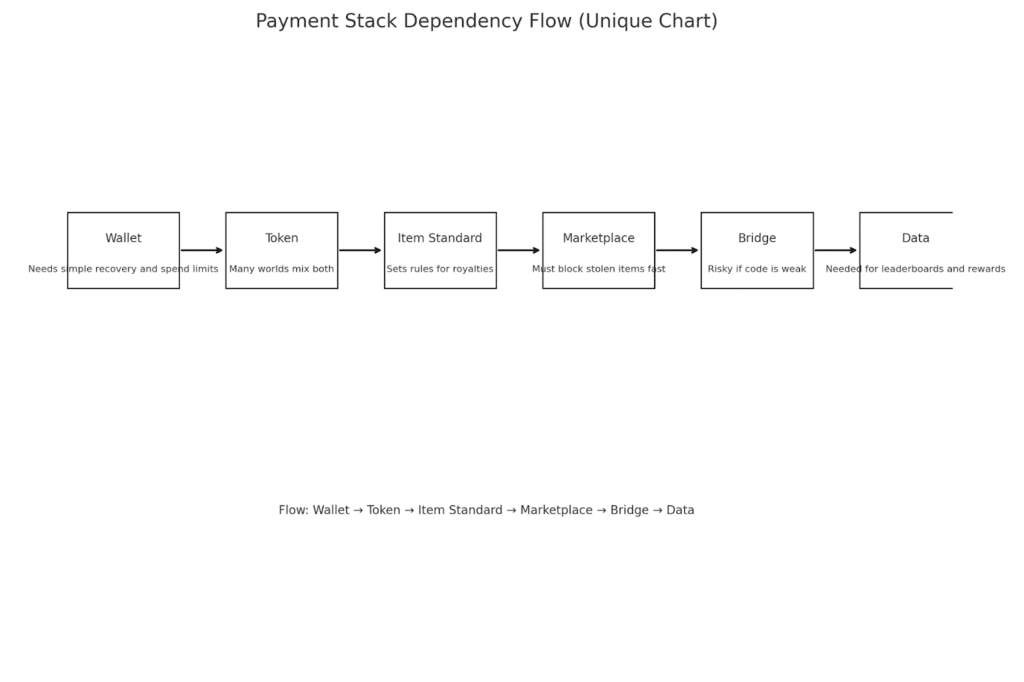
The stack above keeps costs in check. It lets teams swap parts without breaking the game. It also lets users keep assets while they try new scenes.
Metaverse Crypto Coins: Design Choices That Matter
Local tokens and supply clarity
Local tokens can reward players and creators, fund grants and quests, and anchor loyalty when distributed with intention and restraint. They also create noise if supply expands faster than demand, which blurs price signals and dilutes community effort. Teams should publish a simple plan: total supply, unlocks per month, reward decay, and sinks that recycle value into future play. Avoid emissions and treasuries. Use curves players can verify. Predictable schedules build trust and let users price time, risk, and contribution.
Stablecoins for payments, points for status
Stablecoins improve checkout by showing prices in familiar terms, which keeps mental math easy and reduces hesitation at checkout. Users think in dollars or euros, so denominating transactions in a stable unit protects personal budgets from volatility while leveraging instant settlement and programmable transfers. A world can reserve points for progression, status, or matchmaking while using stablecoins for payments, wages, and marketplace clearing. That split keeps reputations meaningful, accounting clean, and players confident that yesterday’s earnings still buy tomorrow’s passes.
Shared coins reduce friction across apps
The best metaverse cryptocurrencies in 2025 will likely be coins that power more than one application, because shared units reduce friction and multiply utility across scenes. A single balance that follows a user between titles lowers churn, simplifies balances, and concentrates liquidity for markets. Creators also benefit from a larger pool of buyers who already hold the currency and understand its fees. Choose tokens with real integrations, audited contracts, stable ramps, and visible roadmaps so utility compounds rather than fragmenting.
Fees, Finality, And Speed
Players notice three things at checkout: how quickly the transaction confirms, how much the fee costs, and whether the item appears in inventory immediately, so chains with low fees, rapid finality, and reliable inventory updates feel best for games. Rollups and app chains improve this experience by batching activity, proving outcomes efficiently, and keeping costs predictable during peak hours. When confirmations land within seconds and the locker updates on the first refresh, the purchase feels natural, and the fun loop stays tight instead of stalling.
Account abstraction adds a second lift by turning awkward wallet chores into product features that help new users succeed on day one. Worlds can sponsor gas for first sessions, set reasonable spend limits, and bundle approvals behind clear prompts that expire automatically. Session keys reduce signature spam, while simple recovery options and social login bridges remove the fear of losing access. When that friction disappears, first-time users finish checkout, equip the item, and keep playing.
Risk, Fraud, And User Safety
Scams follow money, so worlds must design for defense from day one, not after a headline. Clear, context-aware warnings protect users at decision points, clean interfaces prevent signing the wrong transaction, strong allowlists block fake drops and counterfeit contracts, and rapid takedown procedures limit the blast radius when something slips through. Treat permissions like sharp tools: request only what the action needs, expire approvals on a schedule, and surface human-readable transaction details so people can spot trouble before it lands.
The stakes are real and documented. In 2024, crypto scams extracted at least 9.9 billion dollars, with pig-butchering schemes doing outsized harm, while North Korea-linked actors looted more than 1.3 billion dollars through hacks; mid-year analysis also showed stolen funds nearly doubling year over year through July 2024, a pattern that pushed many teams toward stricter controls and better incident playbooks. Use that reality check to justify friction where it matters: verification on large transfers, cooldowns on newly issued contracts, and second-factor checks for sensitive actions.
User safety is product design, not policy text. Make the safe choice the easy choice by default, and reserve extra steps for risky flows rather than everyday play. Ship visible proofs for official collections, highlight verified creators, and give players a simple way to report fakes with fast feedback loops. Pair automated monitoring with human response, publish incident summaries when issues occur, and reward responsible disclosures. Trust compounds when users see that protection is built into the loop they use every day.
Security And Regulatory Context
Rules are finally catching up to the product reality, and that shift is most visible in the European Union, where MiCA now provides a workable frame that teams can design against, with the sections governing asset-referenced tokens and e-money tokens live as of June 30, 2024, and most remaining provisions effective from December 30, 2024, which matters directly for worlds that accept stablecoins at checkout and for the exchanges, custodians, and wallet providers that list, store, and route those assets across user flows that must now meet explicit obligations rather than vague expectations.
Global policy signals are moving in parallel, as the BIS noted that by 2024 fully 91 percent of 93 surveyed central banks were exploring central bank digital currencies, with wholesale designs generally further along than retail in many jurisdictions, while cautioning that many existing stablecoins still fail basic tests for serving as a system’s settlement backbone, which should push builders to treat fiat-pegged assets as helpful payment rails rather than unquestioned foundations for everything from treasury management to cross-platform markets until those gaps narrow and assurances improve.
Consumer risk sits in plain view and must be addressed with engineering and process rather than slogans, because stolen funds surged at points during 2024 as attackers adopted better tooling and faster coordination, which means teams should implement stronger allowlists, explicit provenance checks, and real-time anomaly detection, post public proofs for official collections and contracts, and maintain fast incident playbooks that pair automated circuit breakers with visible user prompts so the safe action is always the easiest action and the riskiest action always carries an unmistakable warning.
The commercial backdrop remains supportive for projects that get this right, since markets around games and virtual goods continue to expand, with United States commercial gaming revenue reaching 71.92 billion dollars in 2024 to set another annual record, which reinforces the idea that demand for digital entertainment, social competition, and linked payments is still rising, and that a metaverse economy with clear rules, trustworthy rails, and practical safeguards can convert that demand into durable participation from players, creators, and studios who now expect both fun and financial clarity.
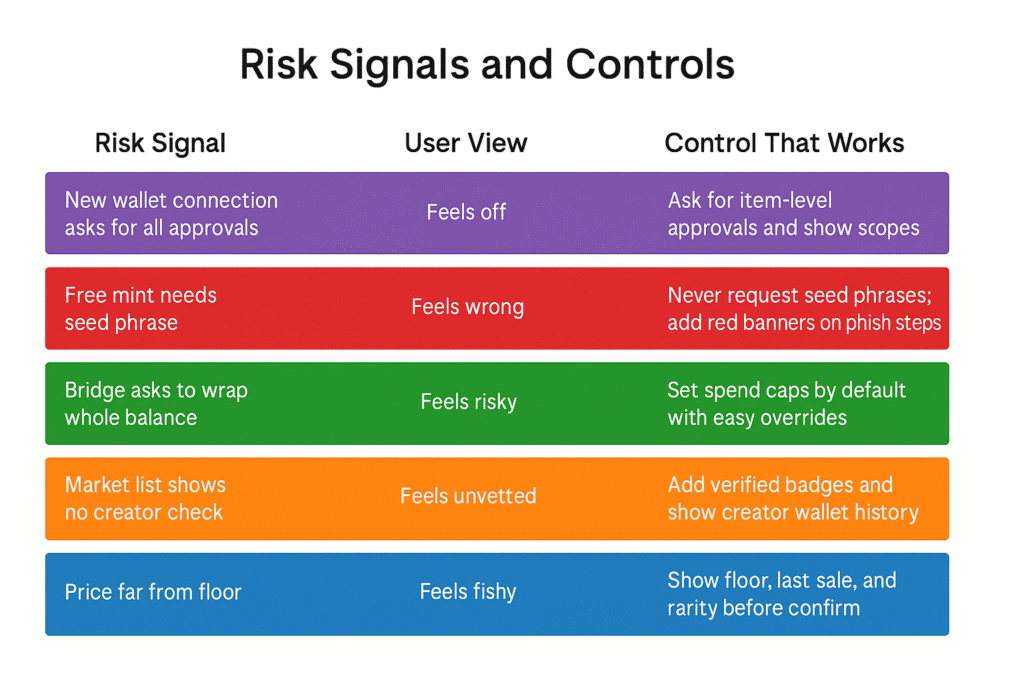
Risk Signals And Controls
| Risk Signal | User View | Control That Works |
| New wallet connection asks for all approvals | Feels off | Ask for item-level approvals and show clear scopes |
| Free mint needs a seed phrase | Feels wrong | Never request seed phrases; add red banners on phish steps |
| Bridge asks to wrap the whole balance | Feels risky | Set spend caps by default with easy overrides |
| Market list shows no creator check | Feels unvetted | Add verified badges and show creator wallet history |
| Price is far from floor | Feels fishy | Show floor, last sale, and rarity before confirm |
Best Metaverse Cryptocurrencies 2025: What To Watch
- Immutable (IMX)
Purpose-built for games with an L2 that keeps fees low and finality quick. Clear token economics, strong anti-fraud tooling, and creator-friendly marketplaces make IMX a practical pick when you want royalties that actually pay and assets that travel across titles. - Ronin (RON)
A gaming app-chain that prioritizes speed, predictable costs, and a growing roster beyond its flagship origins. RON shines where gas needs to be simple, wallets must be friendly, and studios want on-chain ownership without scaring first-time buyers. - Polygon (MATIC)
A widely integrated ecosystem that supports rollups, account abstraction, and stablecoin-heavy checkouts. MATIC reduces friction across many apps, offers mature tooling, and helps teams sponsor gas while keeping the door open to brand partners and traditional finance. - Solana (SOL)
Low fees, fast finality, and thriving creator tooling make SOL attractive for live events, marketplaces, and rapid in-game trades. The network’s performance profile keeps the fun loop tight, while integrations with stablecoins simplify pricing and payouts. - The Sandbox (SAND)
A creator-first economy with robust tools, land mechanics, and partnerships that bring mainstream attention. SAND ties royalties, events, and brand activations into a single loop, giving artists and studios clear ways to ship content and get paid.
Why these five?
They publish understandable supply paths, show utility across more than one app, make gas management easy, work cleanly with stablecoins, and share real metrics along with visible anti-fraud practices. Projects that also invest in creator tools tend to build culture and retention, which turns tokens from trading chips into fuel for growing worlds.
Conclusion
Cryptocurrency in metaverse turns play into a functioning economy by giving time and creativity durable value that persists across sessions and titles, where tokens unlock payments, work, and trade, stablecoins keep checkout prices legible for mainstream buyers, standardized item formats let assets move between apps without custom plumbing, smart contracts route creator payouts on schedule, and clear rulebooks such as MiCA help firms and users align on responsibilities, disclosures, and safeguards that reduce confusion while increasing trust.
The priority now is not minting new coins for their own sake but designing simple, repeatable flows with steady, transparent fees and strong safety features such as verified collections, sane permissions, and rapid incident response, because worlds that ship reliable checkout, portable ownership, and predictable costs will set the pace for adoption, attract creators and brands that value clarity, and convert curiosity into habit, while slower projects will end up following the practices that already work.
FAQs About Cryptocurrency in Metaverse
What is the main benefit of cryptocurrency in metaverse apps?
It gives fast, final payments and true ownership that works across apps.
Are metaverse crypto coins only for games?
No. They also power events, education, retail, and brand loyalty.
Why do many worlds use stablecoins?
Stablecoins keep prices simple and reduce volatility at checkout.
How do royalties work for creators?
Smart contracts pay a set percent on each resale if markets honor the rule.
What should new users check before buying?
Check the team, token supply, fee path, and safety tools in the wallet.
Glossary Of Key Terms
- Account Abstraction: A wallet model that lets apps sponsor gas and set smart rules for spending.
- Asset-Referenced Token: A token tied to a basket of assets. Covered under MiCA in the EU.
- E-Money Token: A token pegged to a single fiat currency with strict rules in the EU.
- Finality: The point when a transaction cannot be reversed on a chain.
- Interoperability: The ability for items and tokens to move between apps and chains.
- Marketplace: A venue that lists items and clears trades on or off chain.
- MiCA: EU rules for crypto assets that include stablecoins and service providers.
- Oracle: A service that brings off-chain data, like prices, onto the chain.
- Stablecoin: A token pegged to a currency such as the dollar or euro.
- Token Standard: A set of rules for coins and items, such as ERC-20 or ERC-721.
Summary
This article explains how cryptocurrency in metaverse experiences turns virtual worlds into living economies. It covers the rails that matter, including wallets, token standards, markets, bridges, and data. It shows how payments, ownership, and work form a loop that feeds creators, players, studios, and brands. It maps the metaverse economy and blockchain, and highlights why stablecoins support checkout while local tokens drive loyalty. It flags risks, citing 2024 and 2025 reports on scams, hacks, and policy moves, including EU MiCA timelines. Two tables outline the payment stack and risk controls. The piece ends with a simple rule. Keep fees low, keep theft hard, keep assets portable, and keep rules clear. Worlds that do this will lead growth in 2025 and beyond.