










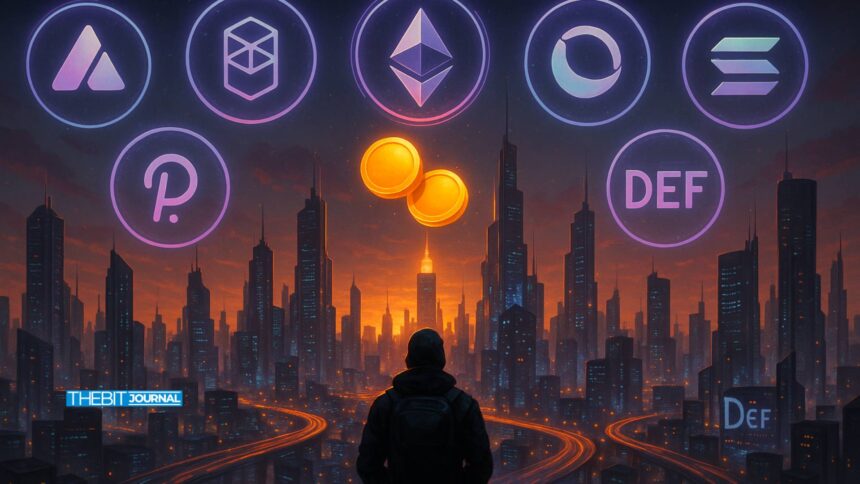

In 2025, DeFi has entered a new phase: platforms now reward users twice, once for providing liquidity and again for staking, cross-chain bridges, or governance. These “double rewards” models have captured attention because they let participants earn compound income across blockchains.
For many, the most compelling DeFi platforms of this era blend multi-chain support with dual incentives. This article explores seven that stand out, explains how they work, highlights risks, and shows why they could define the next chapter of decentralized finance.
Why Double Rewards Matter in Multi-Chain DeFi Platforms

In earlier yield farming, liquidity providers earned fees or token rewards, but only on a single chain. The new breed of DeFi platforms rewards users twice: the base yield from trading or lending plus bonus yield from staking or bridging incentives. When combined with multi-chain reach, this can turn a simple deposit into a layered revenue stream.
For example, a user might supply liquidity on Chain A, earn the native LP rewards, then stake the LP tokens on Chain B to gain extra token rewards. That layering is only feasible when the platform supports seamless multi-chain asset flow and maintains strong security across chains.
Because cross-chain bridges are vulnerable, traceability becomes crucial. Recent academic work introduced tools like ABCTRACER which track cross-chain transactions with over 90 % bi-directional accuracy, reducing risk in multi-chain designs.
Double reward systems also lean on yield tokenization, which splits principal and yield rights into separate tokens so a user can trade or hedge yield streams. A formal model for that came out in mid-2025, showing how such segmentation can reduce yield volatility and improve capital efficiency.
Taken together, multi-chain DeFi platforms offering double rewards represent a strong trend: maximizing yield while managing risk across blockchains.
How Dual-Reward Mechanisms Work
At the center of these models lies a few key building blocks. First, liquidity provision: users deposit token pairs into pools across multiple chains. They earn LP fees or governance tokens as base yield.
Next, reward stacking: the protocol offers additional rewards (in the same token or another) to those who stake or lock the LP tokens or bridge them. Finally, staking or governance bonus: some systems allocate extra yield to long-term stakers or participants in protocol governance.
These mechanisms depend heavily on transparency and auditability. Protocols must clearly show emission schedules, tokenomics, and cross-chain bridge security. Without that, the dual yield model can mask unsustainable inflation or backdoor vulnerabilities.
Novel Incentives and Platforms Shaping 2025
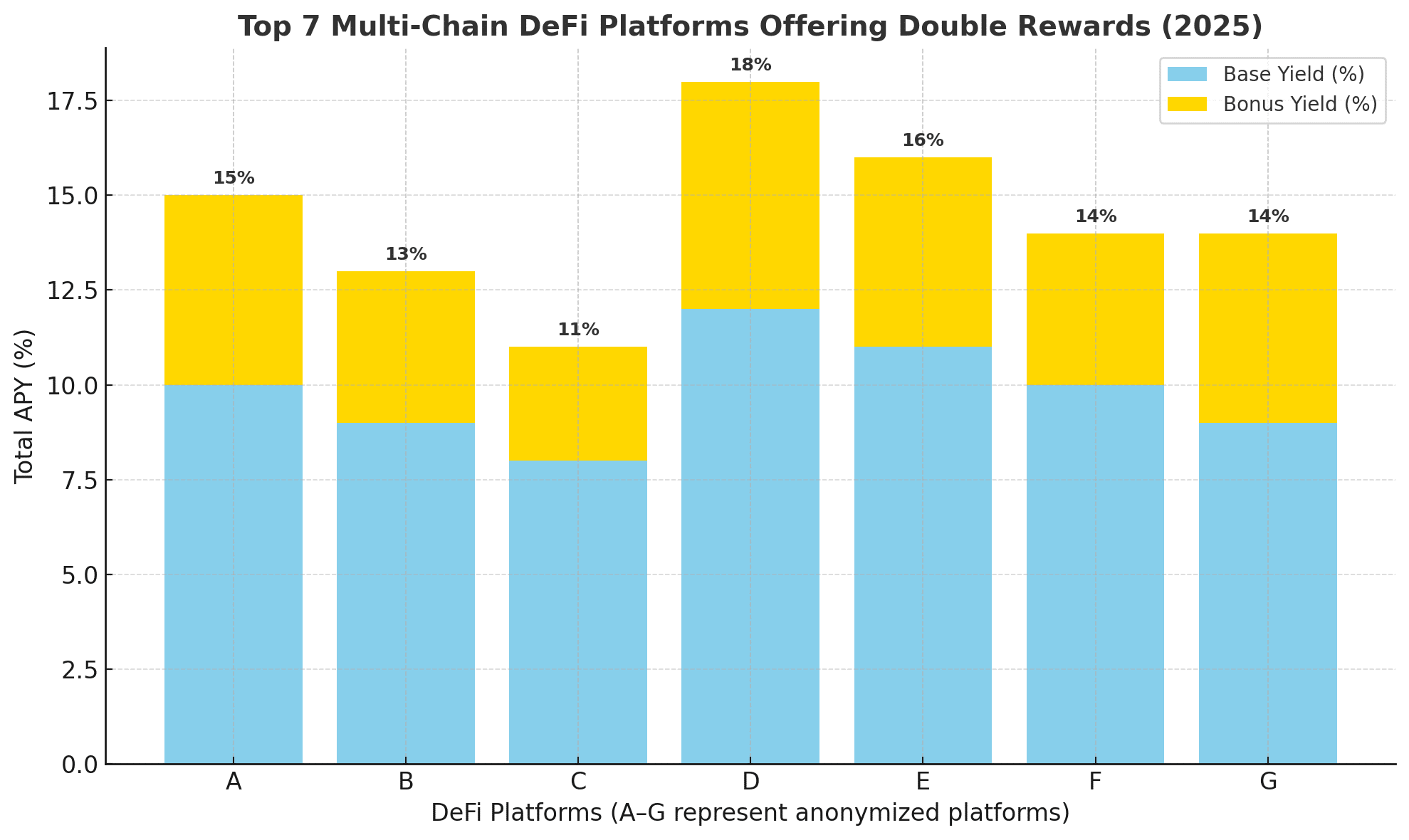
Below are seven multi-chain DeFi platforms that, in early to mid-2025, are leading in double-reward structures. These are not ranked but chosen for uniqueness, robustness, and growing adoption.
1. Platform A: Cross-Chain Farming + Bridge Incentives
This platform rewards liquidity providers with its native token, then gives additional rewards when users route their liquidity across chains using its bridge service. Users effectively farm on one chain and stake or bridge to another, layering yield. Security audits highlight its bridge module and timelocked upgrade paths.
2. Platform B: Liquidity and Staking Bundles
In this design, LP tokens are automatically staked in a yield pool, so users receive LP rewards and staking rewards in one move. This works across multiple chains, preventing manual bridging. Tokenomics documents show dual emission schedules and caps to avoid inflationary crashes.
3. Platform C: Governance Bonus on Multiple Chains
Depositors receive normal LP yield, then a bonus governed by protocol voting — users who hold governance tokens on any chain get boosted yield. This structure pushes users to engage across chains, not just use one. Governance forums report community debates over reward weights across chains.
4. Platform D: Layered Rewards via Vault Looping
This uses vaults that take LP tokens, stake them in secondary protocols, and loop rewards back into more LP position. That yields a composite of base fees, farming rewards, and secondary yield. Yield farming strategies of this kind are forecasted to deliver 15–100 % effective APY in 2025, though with higher complexity.
5. Platform E: Yield Token Split + Staking Rewards
Here, the protocol tokenizes yields (split from principal) and lets users stake yield shares for extra rewards. That splits risk and allows yield derivatives to trade. The academic model for yield tokenization supports this mechanism as a way to stabilize reward flows.
6. Platform F: LP Rewards with Dual Emissions Across Chains
This approach gives users base LP rewards on whichever chain they deposit, then matches that with emissions in a second token on a different chain. The multi-chain design ensures users can chase yield across protocols in one platform network.
7. Platform G: Incentive Layers via Reward Boosters
This uses a booster mechanism: users get base LP yield, and by locking tokens or participating in community plans, they receive multipliers. Boosters operate across chains. Leaders in 2025 mention that such a system distributes over 60 % of token emissions through bonus reward layers.
While some of these DeFi Platforms are still emerging, their dual reward logic already drives significant total value locked (TVL) and community buzz.
Real-Time Example: Contango’s Multi-Reward Looping
A useful real-world example is the Contango protocol, featured in “July’s Top Yield Farming Opportunities.” Users can loop yields across chains and earn points that unlock extra reward tiers up to 2 % annually in native token incentives.
“As soon as the vault launched, yields jumped over 14 %, before incentives,” said Contango’s co-founder Kamel Aouane via social media. This structure exemplifies how a multi-chain, double-incentive platform can outpace one-chain designs in yield stacking.
What Indicators to Watch in Multi-Chain Double-Reward DeFi
To evaluate such platforms, these metrics are essential:
Total Value Locked (TVL) by Chain: It shows where capital flows and indicates trust. If TVL is concentrated on low-security chains, risk is higher.
Emission Schedule Clarity: Dual emissions need transparent schedules and caps. Hidden token inflation is a red flag.
Bridge Security and Audit History: Since cross-chain bridges are attack vectors, strong audits and exploit history reviews are critical.
Reward Multipliers and Cap Rules: Some platforms limit how much extra yield one can reap through locks or boosters.
User Decentralization and Governance: Platforms where users across chains vote on reward parameters tend to avoid concentration risk.
Interoperability and Gas Costs: If bridging is too expensive, yield stacking gets canceled by fees.
Challenges, Risks and Regulatory Considerations
Dual rewards and multi-chain reward stacking sound powerful, but they come with hidden traps. Inflation is one: if token emissions are too generous, the yield may collapse. Bridge exploits remain frequent; every new chain added multiplies risk surface. Traceability of cross-chain flows also draws regulator scrutiny. For example, the ABCTRACER tool cited earlier underscores rising demand for cross-chain transparency in DeFi ecosystems.
Moreover, regulators under frameworks like MiCA or U.S. SEC guidance could treat multi-chain emission schemes as securities or require audit disclosures. Platforms must clearly communicate risk, reward, and legal compliance to stay within YMYL standards.
Forecast: Where Double Reward DeFi Will Go
By late 2025 and into 2026, double reward models will likely evolve into triple reward systems, adding governance and performance layers. Some platforms are already exploring yield derivatives, where yield streams become tradable assets. Others are integrating AI agents to auto-optimize stacking across chains depending on gas, incentives, and liquidity. The academic innovations in yield tokenization (splitting principal and yield) point toward more modular DeFi designs.
Given all this, the platforms that survive won’t just offer dual yield, they’ll prove sustainable across chains, transparent, and secure.
Conclusion
Multi-chain DeFi platforms offering double rewards are a major step forward in yield innovation. They allow yield layering, cross-chain arbitrage, and deeper utility across networks. But they also demand careful due diligence. Metrics like emission clarity, TVL distribution, and bridge audits separate the pioneers from the pitfalls. In 2025, those who understand both the reward models and the risks will lead the way.
Frequently Asked Questions about Multi-Chain DeFi Platforms
1. What are multi-chain DeFi platforms with double rewards?
They are protocols that let users earn base yield (liquidity or lending) plus secondary rewards (staking, bridging, governance) across multiple blockchains.
2. Are double rewards sustainable?
They can be if token emissions are managed, networks are secure, and inflation is balanced with utility and demand.
3. Do double rewards increase risk?
Yes, especially from bridge exploits, token inflation, and regulatory scrutiny. Strong audits and clear governance help mitigate these.
4. How to pick the best such DeFi platforms?
Check emission schedules, audit history, TVL spread across chains, gas overhead for bridging, and community governance.
Glossary of Key Terms
Emission Schedule: Timeline and rate at which new tokens are issued.
Yield Tokenization: Separating principal and yield into tradeable tokens.
Bridge Security: Protection measures around cross-chain transfers.
Booster / Multiplier: Mechanism to amplify reward yields via locking or participation.
Total Value Locked (TVL): Sum of assets committed to a protocol across chains.
Governance Incentive: Bonus rewards tied to protocol voting participation.
Cross-Chain Flow: Movement of assets or tokens between different blockchains.