












This article was first published on The Bit Journal.
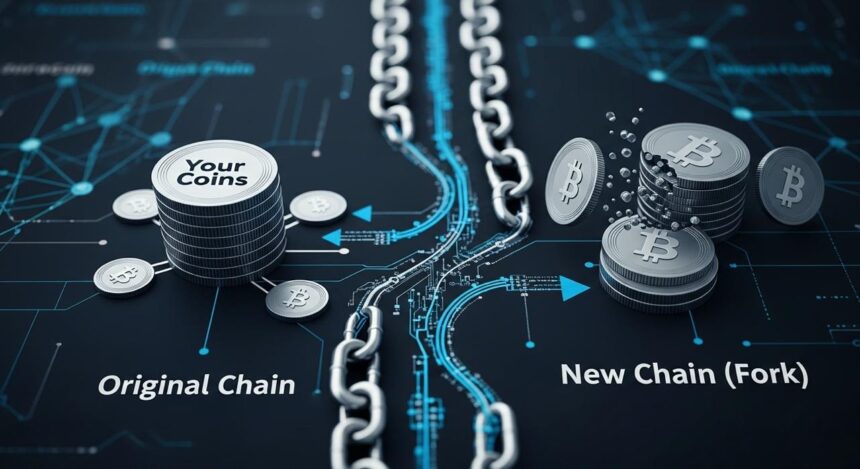
A blockchain fork is what happens when a blockchain network’s protocol rules are changed in such a way that the chain becomes split, very much like a path forks into two on the road. In essence, a fork occurs when the network splits into two separate tracks: the original chain and a new version.
Both chains have the same history, but then they follow different rules. This splitting can occur intentionally (to improve the system or add functionalities) or unintentionally (because of a failure to reach consensus).

Forks are significant events in the crypto world because they can result in the creation of new cryptocurrencies, change transaction rules or resolve disputes among a currency’s users.
Splitting the network allows forks to give communities the ability to modify or update protocols without grinding the entire blockchain to a halt.
What are the Two Types of Blockchain Forks?
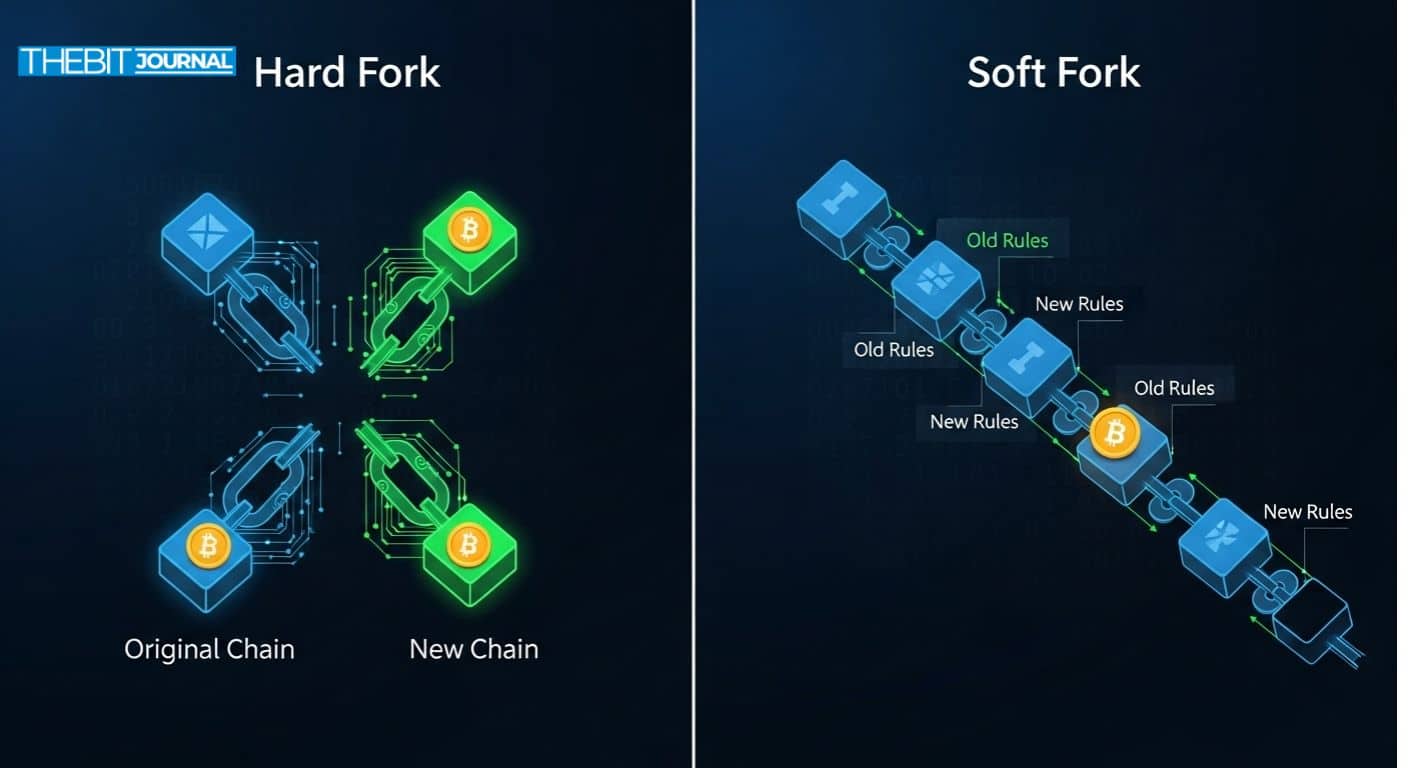
Hard forks and soft forks are the main two types of blockchain forks. The backward compatibility is the main difference.
A hard fork breaks compatibility: nodes running the old protocol will not accept blocks made under the new rules.
Everyone in the network must upgrade to the new software, or else two chains emerge, each going its own way.
A hard fork normally results in a new cryptocurrency. For instance, hard-forking Bitcoin’s code resulted in the creation of Bitcoin Cash and Litecoin.
In contrast to hard forks; a soft fork is backwards-compatible: nodes that don’t upgrade still recognize new ones as valid. Soft forks tighten, or add rules without a chain splitting; miners continue to enforce the old, more lax rules that still conforms to the protocol.
An upgrade like SegWit in Bitcoin was a soft fork which increased capacity but didn’t require all nodes to upgrade.
Forks happen for many reasons. Developers occasionally want to upgrade or add features, such as increasing the number of transactions that a block can contain, or enhancing security.
Sometimes, forks happen to settle differences. When a blockchain’s stakeholders disagree on how to change the rules (say, by expanding block size or reforming governance), one faction can peel away and operate under new ones.
Hack or vulnerability events can also encourage forks: the well-known 2016 Ethereum Classic fork occurred to roll back the effects of The DAO hack.
In both cases, forks enable the network to evolve: they can bring in new features or fix issues, but they also come with risks of dividing the community and adding confusion.
| Feature | Hard Fork | Soft Fork |
| Compatibility | Not backward-compatible | Backward-compatible |
| Chain Split | Usually creates a permanent split | Does not split chain |
| Upgrade Requirement | All nodes must upgrade | Only a majority (miners) need to upgrade |
| New Cryptocurrency | Yes (new coin is created) | No (same currency) |
| Example | Bitcoin – Bitcoin Cash | Bitcoin SegWit (2017) |
As shown in this table, hard forks are an all-or-nothing approach to upgrade the system since every participating node must agree on the changes in order not to cause a network split, while soft forks represent progressive update.
Hard forks can be a source of contention; when some users refuse to upgrade, the blockchain splits into two active chains. Soft forks tend to go more smoothly, since old nodes can still follow the new majority chain.
If a user owns coins and control private keys, when a hard fork occurs, they generally end up with new coins on the same blockchain as well as coins on the new hard-forked chain. The project may have specific instructions to be followed in order to claim or make use of the new coins securely.
Why Do Blockchain Forks Happen?
Forks can be deliberate and accidental. Scheduled or planned forks are a set of proposed updates or network changes with broad consensus.
A development team could submit a soft fork to optimize transaction handling and most miners would follow.
Contentious forks on the other hand, are a result of dispute where some part of the community disagree with a proposed change and decides to go their own way. The 2017 Bitcoin Cash instance is a contentious fork: one side could not agree with the other over block sizes for scaling vs. SegWit.
Forks may also be motivated by security demand (e.g., to fix a bug) and network experiments. In the grand scheme of things, forks represent the decentralized nature of blockchains, a way for a community to make changes or object to some development.
In every case, it is considered to be a modification on the protocol of blockchain. It enables communities to copy and modify the adjusted or new framework that would suit their needs as they change.
How Blockchain Forks Work
Technically, a fork is the result of updating the software code that miners run, and having everyone on the network follow that new protocol.
The developers create a protocol upgrade and broadcast that to nodes (validators) as well as miners. If the changes are widely adopted by users, the fork will go through.
At the time of a fork, every node and miner decides which chain to support. In the hard fork, old version nodes will reject blocks coming from the new chain and vice versa.
This means divided consensus: half the network follows the old protocol, and half follows the new one. All participants need to upgrade if they would like to be on the new network. For a soft fork, the new version of nodes imposes stricter rules that are compatible with the old ones.
Non-upgraded nodes will consider new blocks as valid, because they didn’t break any old rules. For instance, a soft fork could decrease the maximum size of blocks or require new signature types.
Most miners add to the longest chain that they know of, and the whole network winds up following it without splitting. In both, the fork activation point is predetermined and clear communication and testing is key.
Unintentional forks can occur as well. If two miners happen to find a block at similar times with different code versions, the network may briefly branch.
Usually the longer branch survives and the shorter one is discarded (a chain reorganization).
For instance, Ethereum saw a short-lived fork in 2020 as a result of a consensus bug and the recovery was to temporarily roll back to some common point and re-validate blocks.
These accidental forks are generally resolved rather quickly. On the other hand, intentional hard and soft forks are pre-meditated events that involve community coordination.
Notable Blockchain Fork Examples
Some of the most pointedly successful cryptocurrencies, as well as protocol upgrades, have been created from blockchain forks.
These are a few major ones:
Bitcoin – Bitcoin Cash (2017, Hard Fork): The Bitcoin community split over how to scale. One side wanted bigger 8MB blocks, the other implemented SegWit (a soft fork answer). This disagreement caused the network to split, or hard fork, resulting in a new coin called Bitcoin Cash (BCH) with larger blocks and faster throughput. Since then, Bitcoin Cash and Bitcoin (BTC) have existed with different rules.
Ethereum CRYPTO – Ethereum Classic (2016, Hard Fork): In the wake of a hack that let a hacker exploit a weakness in the DAO, the Ethereum community disagreed on what to do about it. To reverse the effect of the hack, a majority of Ethereum’s blockchain hard-forked, which meant that transactions were rolled back. The original chain continued as Ethereum Classic (ETC), and the new fork became what is known today as Ethereum (ETH).
Bitcoin SegWit Upgrade (2017, Soft Fork): Segregated Witness (SegWit) was a soft fork for Bitcoin that changed how transaction data is stored. It stripped signature data from transactions in order to make more room in each block. For being backward-compatible, SegWit did not split the Bitcoin chain. Instead, it was adopted by more than 90% of miners who then used it to make the network better without spawning a new coin.
Monero Upgrades (Several, Hard Forks): Privacy-focused Monero has hard-forked on purpose multiple times (about every 6 months) to add new privacy tech and also to resist ASIC mining. The protocol is improved with each Monero fork (2017, 2018 and so on) but the currency is actually the same thing, as there are simply different upgrade schedules.
Ethereum Fusaka(Scheduled 2025, Hard Fork): Ethereum has planned a Hard fork named Fusaka which is scheduled to be for December 3, 2025. Fusaka should bring improved scabability with a higher throughput, and lay the foundation for update in the future. As with past Ethereum forks, Fusaka demonstrates how big networks can still grow through prescheduled forks.
These are examples of how forks can propagate continuity (soft forks: SegWit) or diverge (hard-forks: BCH, ETC). Each fork has its own implications on users and the market.
How Blockchain Forks Affect Holder’s Coins
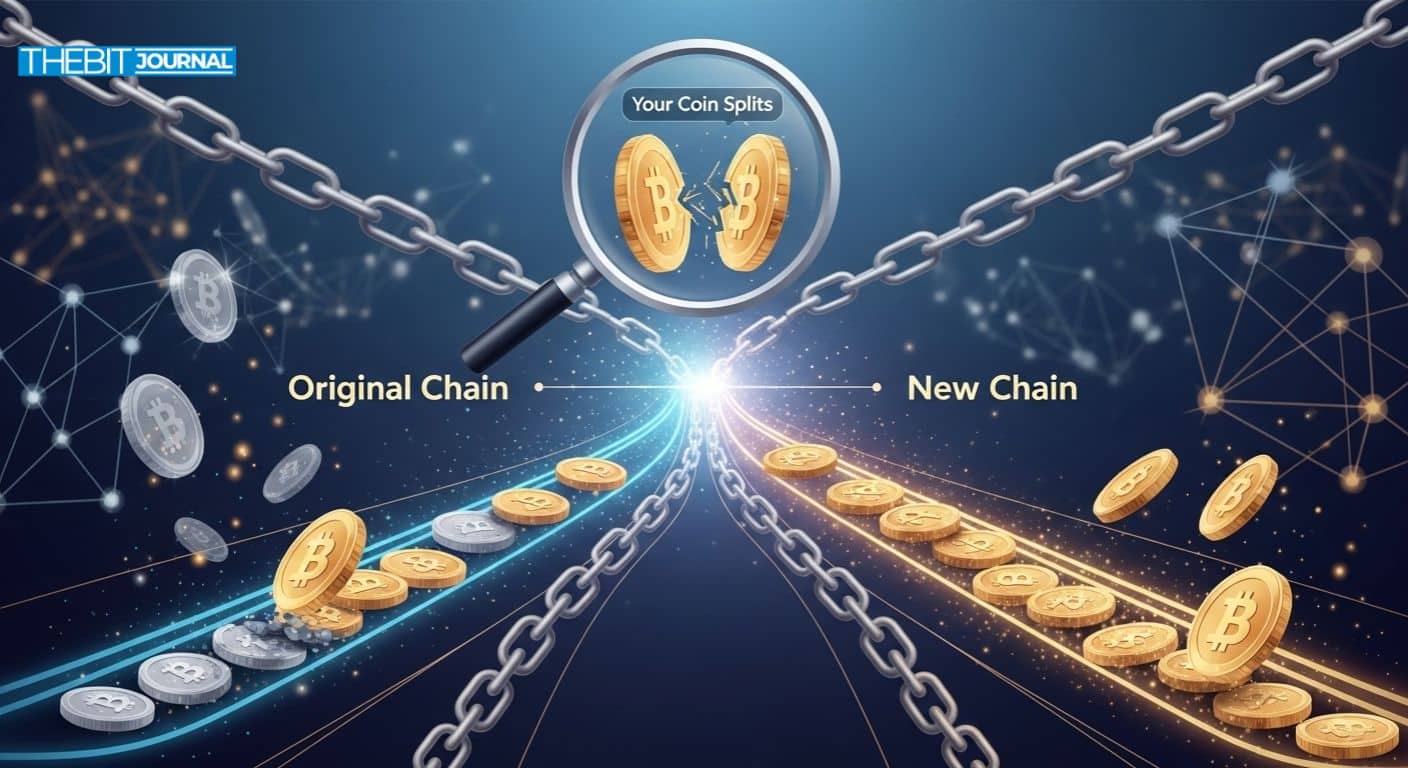
Blockchain forks can directly affect the coins or tokens held either by creating new assets with equal value or changing how the existing coins work.
A hard fork results in two competing networks. If one manages one’s own private keys or if the exchange used for trading support the fork), then, coins on both chains are credited to the holder: the original chain as well as the new one.
That means the balance is effectively duplicated by having it on two networks. But the new coin’s value, liquidity and exchange support can differ massively; some forks thrive while others fade.
A soft fork, on the other hand, does not result in new coins. The blockchain has updates that don’t require a fork, so investments are still on the same chain. Balance is still the same, and there is compatibility.
Forks may also have temporary effects on the ability for transactions to be confirmed in wallets and network stability. Confusion over which chain is the real one can lead to messy volatility and security issues before consensus finally wins out.
Blockchain Forks Innovation vs. Fragmentation
Blockchain forks are either good or bad according to experts. On one hand, forks are considered as fuel to innovation.
Forks make it possible to experiment and advance without consensus. New chains from forks, for example, can have features without making everyone in the community upgrade. Supritha R.S. notes that forks are gateway to change and innovation in a decentralized systems.
Popular upgrades like increased block sizes or new smart contract abilities tend to get their start with forks. In this way, the forks enable blockchain projects to adapt and compete.
By contrast, forks can create fragmentation. When a community fractures, so do resources and attention. Every forked chain has its own developers, users and ecosystem that can dilute the network effect.
Arguably, hard forks generate two sides: some concern that this can create confusion amongst users and dilute security.
A hard fork also tends to result in disagreements over which is the “real” chain. As one analysis puts asks, are these splits fostering necessary innovation or creating harmful fragmentation?
It’s a matter of perspective. Projects like Bitcoin Cash or Ethereum Classic have active communities, but they haven’t replaced the originals.
Industry leaders also argue that forks are blockchain governance in practice. For decentralized projects, forks are one of the few ways to allow stakeholders to vote with what software they use. But it must also be carefully staged.
When a fork is executed smoothly, it serves as an instrument of substantial upgrade (e.g. Ethereum’s forked upgrades); when controversial, they create uncertainty.
Fidelity says that while there have been more than 100 forks of Bitcoin, only a handful (such as BCH or Bitcoin Gold) are live, illustrating that the majority of them fail to gain sufficient support.
This indicates the market decides in the end what forks catch on.
Conclusion
Overall, forks are a force impacting how blockchains evolve. They permit experiments with new ideas and can strengthen networks. But they also come with trade-offs: potential divisions in the community, user complexity, and short-term volatility.
For now, forks continue to play an important role in determining where blockchain technology is headed next.
If best practices are followed, users can benefit from forks or at least skip disasters.
Glossary
Blockchain: A decentralized, distributed ledger of transactions operated and shared among a network of participants.
Fork: A division of a blockchain protocol. It splits the chain in two (makes two version of) and both are playing by different rules.
Hard Fork: A non-backward-compatible fork. Old chains broke and new ones formed. To remain on the updated chain, all nodes are required to upgrade.
Soft Fork: A backward-compatible fork. Only some nodes have to upgrade. The blockchain does not split, and old blocks continue to be accepted.
Consensus: The mechanism by which blockchain participants come to an agreement on what transactions and blocks are valid. Forks are adopted by consensus rules.
Node: A computer on the blockchain network, powered by the blockchain software. Nodes can validate all transactions and blocks
Frequently Asked Questions About Blockchain Forks
What is the difference between a hard fork and soft fork?
The hard fork adds such changes which are not backwards-compatible permanently splitting the blockchain. A new chain (and typically a new coin) is born. Soft fork is a backwards-compatible change, that the older nodes still accept the new blocks so the network stays unified.
What happens to one’s coins in the event of a blockchain hard fork?
If a user owns coins and control private keys, when a hard fork occurs, they generally end up with new coins on the same blockchain as well as coins on the new hard-forked chain. The project may have specific instructions to be followed in order to claim or make use of the new coins securely.
What causes blockchains to split into two paths?
Forks usually occur to update software protocols or to resolve disputes. For instance, the community may require a given feature or disagree about governance. A fork allows one set of users to adopt the new rules even as others stick with the old ones. It is, at its core, a community-based protocol for altering how the blockchain functions.
Is it possible to undo a fork on the blockchain?
Generally not. After a hard fork is accepted by the network, producing blocks on the new chain, this split is irreversible. Rolling back involves a community action. As upgrades, soft forks can also be hard to reverse without another upgrade..
References